 Blogcritics The critical lens on today's culture & entertainment
Haydn, Haydn and more Haydn! Sounds a little monotonous or pedestrian in 2024, does it not? But whether with one composer or many, one time period or several, the Chamber Music Society of Lincoln Center (CMS) generally comes through with a varied and rewarding program. The leadoff concert of its 2024–25 season, billed as “Haydn’s Surprise,” was no exception. We heard chamber Haydn and symphonic Haydn; Baroque-origin Haydn and mature Classical Haydn; joyful, aggressive, and smart-aleck Haydn.
We also got several generations of artists. The young Viano Quartet are members of CMS’s Bowers Program for early-career chamber musicians. Keyboardist-composer Michael Stephen Brown, also a Bowers alumnus, has received an Emerging Artist Award from Lincoln Center and an Avery Fisher Career Grant. (We recently reviewed a Mozart concert featuring Brown and fellow pianist Adam Golka.) CMS Co-Artistic Director David Finckel is a familiar presence behind the cello. And what needs to be said about legendary violinist, violist and conductor Pinchas Zukerman?
Sunrise, Sunset
The Viano Quartet endowed the sublime opening movement of Haydn’s Quartet in B-flat major (“Sunrise”) with lyrical energy and melodic richness. The sixteenth-note passages sparkled. The Adagio had a cloudlike, almost gossamer air that elevated the richness of the chorale harmonies. Agile first violinist Hao Zhou played sweetly and expressively leading an overall impressively focused and assured ensemble performance.
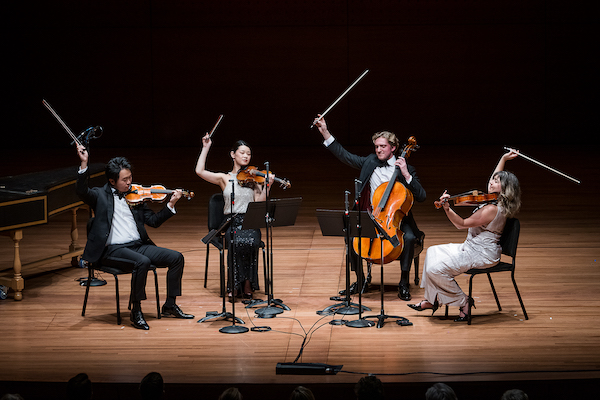
After a springy Menuetto the musicians attacked the finale with perhaps a touch of over-enthusiasm, or maybe it was the acoustics that made the tutti passages sound a wee bit harsh. But the movement ended with a satisfying flourish and the musicians walked off to amply deserved applause.
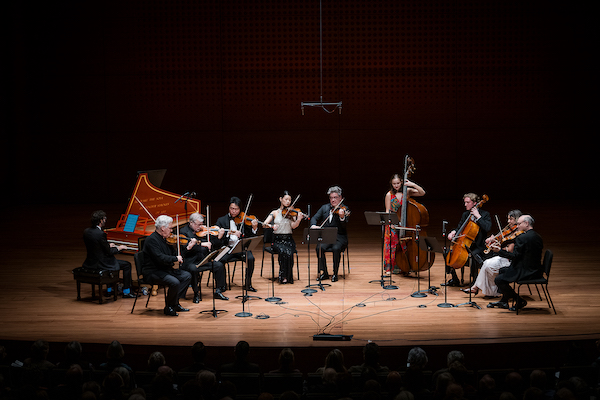
Pinchas Zukerman then joined an ensemble that included the Viano musicians and Brown, as well as violinists Daniel Phillips and Aaron Boyd, CMS mainstay violist Paul Neubauer, and double bassist Nina Bernat, in the Concerto in C major for Violin, Strings, and Harpsichord. In this more youthful work one can hear Haydn transitioning from Baroque techniques toward what would become the mature Classical style.
Mr. Zukerman’s vigorous fluidity made the intricate solo part, even those multi-octave arpeggios, look easy. Between solo sections he played the first violin part along with the ensemble; no egotism for this legend! He also made sure we knew his muscular cadenza was by Marc Neikrug.
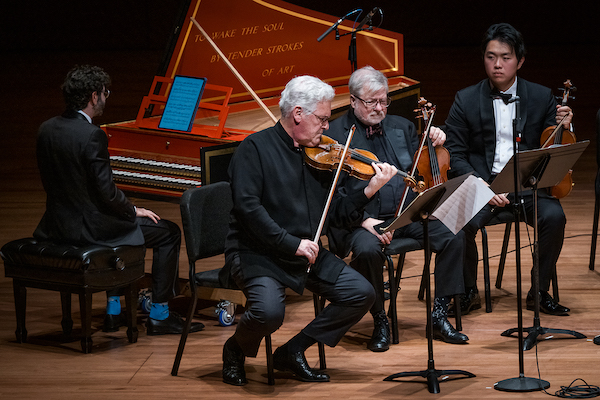
Plucked strings and Brown’s deft harpsichord fingering supported Zukerman in a sweet and homey Adagio that boasted wonderful balance and lightness. The finale sounded strong, celebratory, with superb dynamics. No harshness here.
Haydn and the Chamber Music Society: Bridging the Eras
During intermission the harpsichord was wheeled offstage and replaced with a grand piano. Haydn’s Piano Trio in C major is mostly a piano feature. Brown uncovered a reverberant, chocolatey tone in the quiet sections. He then brought boisterous energy, supported by Boyd and Finckel, to the nearly perpertual-motion triplet passages of the wearing first movement.
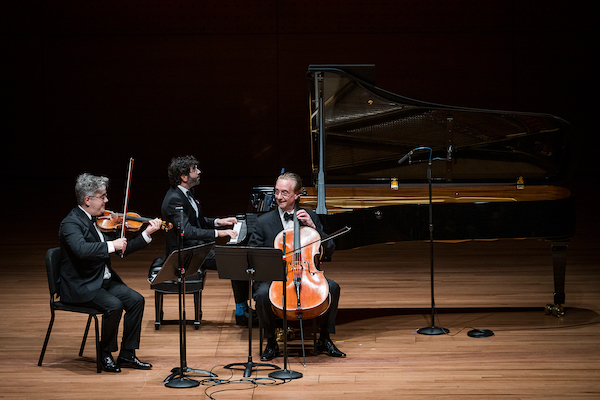
The pianist’s elegant touch elevated the second movement, and his bravura keyboard work made the Presto finale, a real piano showcase, a sheer delight.
See our interview with pianist Michael Stephen Brown
From Sunrise to Surprise
A chamber arrangement of Papa Haydn’s “Surprise” Symphony in G major, arranged for flute, strings, and piano, capped the evening. In the first movement the ensemble produced a full, chunky sound that preserved a sense of the original orchestration, with percussive rhythm from the piano, swirling wafts from the first violin, and airy high end from flautist Tara Helen O’Connor.
The famous surprise in the second movement still gets a bit of a laugh, even in a thinned-out arrangement, though otherwise at times the music felt a bit clunky; I don’t think this particular movement works as well in the small format as it does with a symphony orchestra. The finale, though, featured a raft of playfully virtuosic ensemble playing that did have the feeling of a large group.
Even when they stick to familiar music by canonical composers, CMS’s concerts provide variety, both in the music and in the artists who play it. This one boded very well for the Chamber Music Society’s 2024–25 season.