 Blogcritics The critical lens on today's culture & entertainment
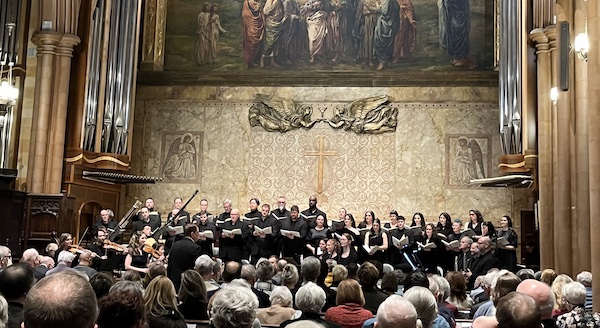
The Vespers of 1610 (or Vespro della Beata Vergine) by Claudio Monteverdi opens with titanic D major chords from the choir. These sturdy harmonies pulsed through the lofty Church of the Ascension through the voices of Voices of Ascension, the Greenwich Village church’s namesake choir. But voices of Ascension is no ordinary church choir. And the Vespers of 1610 is no ordinary musical suite.
A Summation Supreme
Magnificent in scope, ambition, and innovation, the 13 movements take on and advance the musical forms of the late Renaissance. They comprise, as artistic director and conductor Dennis Keene pithily writes in the program notes, “a supreme summation of the musical creation of the time.”
We don’t know for what occasion Monteverdi composed this great opus, but this Vespers gives the impression of straying from the strictly liturgical. It encapsulates elements of hymns, secular dances, and archaic and then-current forms, including opera, a form Monteverdi was pioneering.
Accompanied by a full array of instrumentalists – strings (early and modern), trombones and cornettos, keyboards, and not one but two theorbos – the Voices choir and soloists were thoroughly up to the task.
That opening “Deus in Adjutorium” in D major is followed by the first of five psalm settings. The performance of the “Dixit Dominus” reveled in wonderful solo voices, fine contrapuntal passages, and majestic tuttis. Monteverdi then turns and sets lyrics from the Song of Solomon for a tenor soloist accompanied by the theorbos. Scott Mello, substituting on late notice for tenor Thomas Cooley, carried it off with confident expressively.
The evening was packed with fine solo voices. A lilting soprano duet in the “Pulchra es” sinks from the angelic into contrasting minor chords all the more powerful for their rarity and unexpectedness. Chloe Holgate and Liz Lang sang it sweetly and skillfully. Other solo vocalists shone in various combinations in the “Laudate Pueri” and “Lætatus Sum” psalm settings. The former included a superbly executed vocalise-like “Amen”; the second featured rich performances from the bass-baritone soloists.
Voices of Ascension
The full choir filled the large church with waves of glorious sound, especially in the psalm settings with their complex choral writing and in the finale, a massive “Magnificat.” At full strength their sound tended to dwarf that of the instrumentalists, but the church’s good acoustics allowed us to hear the Dark Horse Consort pretty well at most times, even in the rear pews.
Those musicians themselves had plenty of moments to express their virtuosity, as in the instrumental “verses” of “Ave Maris Stella” and the mostly instrumental sonata “Sancta Maria, ora pro nobis.”
Throughout, the assembled company showcased Monteverdi’s endless creativity. We experienced the echo technique, where one tenor sings a verse and a second, positioned at a far corner of the church with his own attendant theorbist, echoes the final phrase or syllables. Well realized were the cascading harmonies of the triple choir in the “Lauda Jerusalem Dominum”; the tenors again, as seraphim in a movement I imagined the songwriters of the great doo-wop hits studying in the 1950s; the strings and brass chasing each other up and down scales in the Sonata; a bass-baritone soloist doubling the ground bass (or did I image that?) in “Lætatus Sum”; the several vocal duets in the “Magnificat”; the surprise entrance of the choir near the end of the liturgy-like “Audi Cælum” with its echoing tenors.
For years and years I’ve been all over New York City each week attending concerts and shows. Somehow I had never before heard Voices of Ascension or been inside their magnificent church. I could hardly have imagined a better way to finally get acquainted. Visit the website for information about their upcoming concerts.