Blogcritics The critical lens on today's culture & entertainment
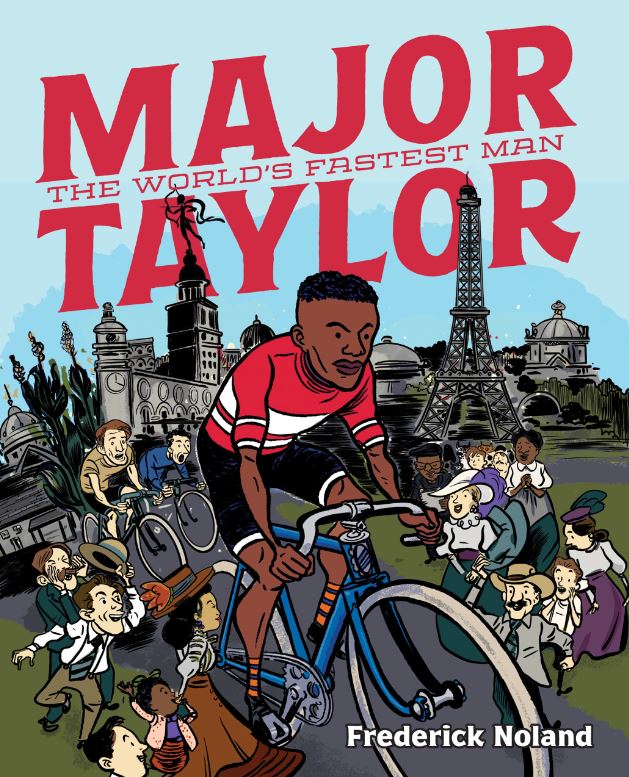
Major Taylor
Major Taylor by Frederick Noland, published by Drawn and Quarterly, tells not only the far too-seldom-shared story of one of the greatest early cyclists but also the story of the beginnings of bicycle racing. Taylor’s incredible life makes for an impressive biography, but centering it on the culture of cycling shows how universal the themes of struggle and achievement in the face of prejudice are.
Major Taylor begins with a grayscale prologue about bicycles, a product of the 19th century. Industrialization made a machine that could rival horses for personal transport. The revolution spurred many new social realities, such as longer commutes for employment and women wearing trousers, but the most exciting and violent of all was bicycle racing.
With the background set, Noland presents young Marshall Taylor in the 1880s, cycling alongside his friend, Dan.
The two boys, one Black and one white, one rich and one poor, racing side-by-side show that on the wheels, the only things to truly separate them are talent, daring, and hard work. Marshall leans into every opportunity he has, using his talents to secure a position as a bicycle promoter doing tricks in the street to encourage people to buy from the local store. As part of the promotion, he gained his nickname “Major.”
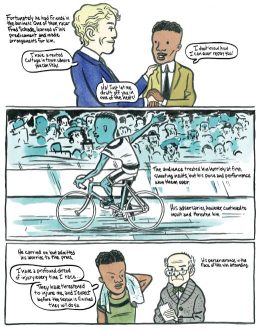
The story continues with Marshall’s first race in 1892. Even he is surprised he is allowed to race alongside whites, but the shop owner demands it, and so Major vows to do his best among the racist jeering. Major wins readily and proves he went all out by fainting once he gets past the finish line. Short of his 15th birthday, Major begins setting track records even as he is banned from tracks because of the color of his skin. This is the beginning of years of competition. He meets his heroes only seen before on cyclist trading cards, and comes under the wing of Birdie Munger, a retiring champ who sees the greatness Major has inside him.
Through rigorous training and advice from other cyclists like Arthur Zimmerman, who won races back when they were novelties and prizes ranged from livestock to silverware, Major spends his late teens becoming a champion. He faces an uphill battle both on and off the track against racism, with racing leagues banning non-white cyclists and competitors purposely crashing into him. Despite the discrimination, Major keeps his nerve and remains polite toward those who attempt to demean him.
Time and again, Major must move to new circuits, out of the Midwest to the Northeast, then to Europe and Australia, where later rules changes force him out. Noland quotes Taylor’s letters and interviews, summed into a discussion with a journalist asking what his secret is to being such a successful racer when few other Black riders are. Taylor says, “I train, and I sleep, and I eat properly…I’ve met my betters on the track. And I’ve been the better of many. Negro. White. I measure no difference.”
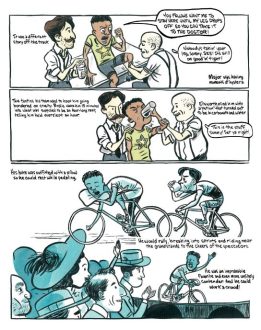
Noland’s art in Major Taylor presents the story with smooth flows. Some pages are packed with ziplines and sweeping background showing the speed of the races. Others are very personal, with close-ups of Major and others as they talk and clap one another on the shoulder. One of the most gripping scenes comes from the six-day race, a challenge where riders sought to complete as many laps around a track as possible in 144 hours. Starved and sleep-deprived, Major becomes hysterical that his leg will fall off and hallucinates a knife-wielding man chasing him. After all the brutality of riding 1,700 miles, he earned $125.
And after some rest, he was back to training, with dedication that would follow him all his life.