 Blogcritics The critical lens on today's culture & entertainment
Haute couture is big business in San Francisco, the City by the Bay, a hip and with-it kind of place. Lots of money, lots of well-paid high-tech drones working for start-ups. Still, since haute couture’s business model revolves around super-expensive exclusivity that then trickles down to the masses by way of knock-offs and prêt-à-porter lines, even well-paid techies can’t afford the good stuff. The reigning business model either cuts them out of the running or relegates them to looking just like everyone else. Bummer!
Branding is essential to haute couture’s business model. The more exclusive the brand the more the lumpenproletariat lust for it. Everyone wants to feel special and be perceived as one of the elite. The appeal is emotional, which, as most marketing experts are quick to point out, is why people buy things. It’s what keeps businesses in business. Luxury car makers operate on the same principle – BMW, Mercedes, Lexus, Infiniti, Ferrari, Tesla, ad nauseam. People want what they can’t afford or can’t have. It’s human nature.
This means most people are doomed to unrequited lust. Unless they marry well or happened to invest in Google when it was less than $100 a share, it’s not happening. They should just resign themselves to shopping at Walmart, Target or Forever 21.
Maybe not.
Enter the mistress of mechanical advantage, whose name is Trudy Hodges. Ms. Hodges in not only a sorceress with needle and thread, she also has a happy knack for business. She created a unique business model for her own line of clothing, one that maintains exclusivity but doesn’t require customers to hock their first-born child or make a deal with the Devil or sell their body parts on eBay.
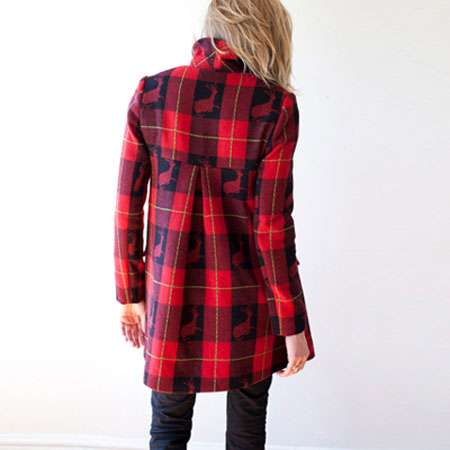
The company is called Poppy von Frohlich. And even though the name sounds like a cross between Pippy Longstocking and the Austrian army, the designs are anything but Teutonic. PvF’s clothing spans the spectrum from avant-garde to retro, including Italian wool coats with cotton flannel or thick satin linings and cotton crochet dresses. But no matter what, it’s just about fashion, always. And it’s green: no muss, no fuss, no waste; it isn’t a line in which half the garments are destined for the dump.
Von Frohlich’s distinctive business model is based on limited exclusivity. Every six weeks Ms. Hodges allows her Muse to envelop her. She designs her offerings and sews samples of them. The designs are posted on her website. One or two orders for each size – from 0 to 12 – are taken. The orders are taken to a local factory, where they are produced. That particular pattern is then retired, never to be produced again. Since each garment is one of, at most, 24 similar items, customers are guaranteed limited exclusivity. And they’re made in the good old U.S.A., in U.S. factories using homegrown labor. No outsourcing of jobs by Poppy von Frohlich.
As Ms. Hodges said, “I specialize in limited edition and quick turn-around times, so this format could only be accomplished by using domestic manufacturing. I enjoy the factories I work with and like to shake the hands of the people making Poppy von Frohlich. Working with factories nearby also makes it possible for me to run my business from home while being a full-time mom.”
The cost of Poppy von Frohlich’s limited editions runs from $90 to $500, with wool coats from $400 to $700. Techies can afford that. Plus, they get to support a local Mom & Pop outfit that invented a successful business model, thumbing its nose at the monoliths of haute couture.