Blogcritics The critical lens on today's culture & entertainment
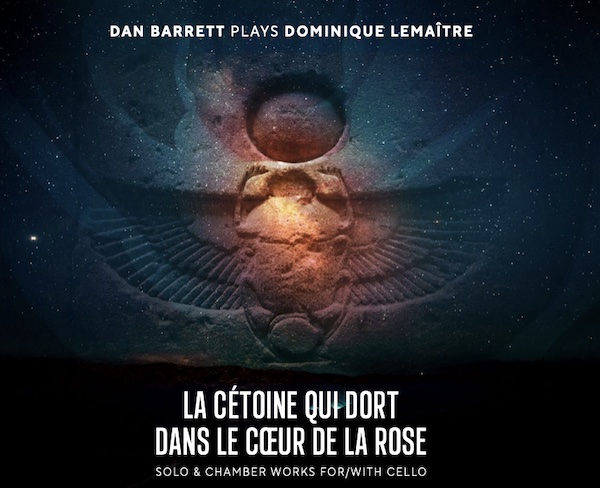
On his new album La cétoine qui dort dans le cœur de la rose cellist Dan Barrett and collaborators present the music of French composer Dominique Lemaître, most of it very recent.
We are told that the first piece, Instants d’espace for solo cello, is all about time – even the title indicates this. In five brief movements the piece wanders through lilting modalities. Fluid passages alternate with ruminative held tones and staccato extrapolations. Time passes, for sure – about 10 minutes in total – but if this is indeed, in the composer’s words, a “deep meditation on our perception of time,” then so is most music, whether rhythmic (time neatly divided) or open-ended (time stretched and dilated). Aside from sound installations, music by definition engages with the passage of time. This piece stands on its own without the need for any specific meaning.
The cello is beautifully played and the recording expertly produced (by Brian Keane). The instrument sounds very present without any sense of artificial enhancement. This excellence continues throughout the album.
Fully Formed
In Imago, Barrett is joined by clarinetist Michiyo Suzuki and pianist Taka Kigawa. The title refers to the adult form of the scarab beetle that gives its name to the album. The cétoine, or flower chafer, can be found nestled inside a rose. Naming this piece after the imago, or adult form, suggests something completed, fully formed.
Strictly speaking, we have to take a composer’s word that a piece is truly “finished.” For the listener, completion is an abstract concept in music. But it’s an effective image when positioned after a piece for solo cello. For here, three voices join in temporal (time again!) and conceptual as well as literal harmony. Fanciful, sometimes intertwined arpeggios rise, or rise and fall, amid sustained washes of sound. Reinforced by a recurring flatted fifth, a contemplative feeling persists, even as the ear is continually engaged by fresh figural and dynamic gestures.
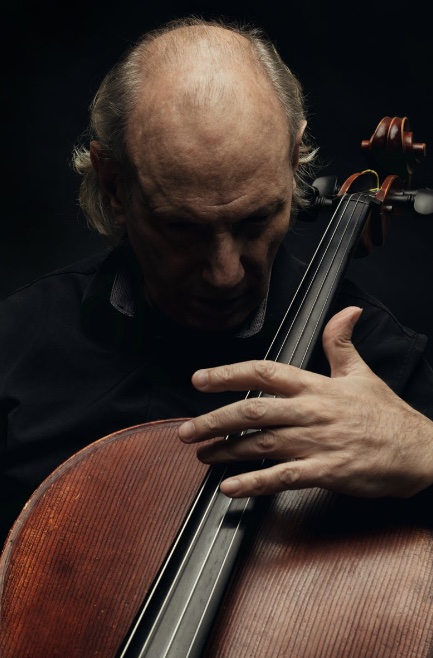
Those winding arpeggios continue to echo in Helix for cello and viola. In this more active piece, Nikita Yermak joins Barrett in trading spiraling scales and reclining into plaintive harmonies that sometimes climb into the stratosphere of harmonics.
Et le soleil comme désir for violin, cello and piano is an earlier work in which Lemaître fixated on two pitches just a half-step apart. The flowing composition builds clouds of anxiety out of this inherently tense interval. (Movie and TV scores build suspense this way all the time. It may be worth noting here that you can hear Barrett’s cello in several Ric Burns documentaries.)
The dynamics ebb and flow, with scales that start with a half-step, adding to an air of mystery. The fusion of the instruments into a single unit is as complete here as in, say, a Piano Trio of Schubert. Lemaître has an almost uncanny skill in this regard, evidenced throughout the album.
A Blue State
In Presque bleu, the composer calls upon the idea of synesthesia, taking inspiration from, well, the color blue. This is the kind of conceit which the listener – even the rare listener who actually has synesthesia – has to understand as a touchstone rather than something perceptible. This soft, easeful music is what “blue” meant to one composer at one point in his life.

For me, the soulful harmonic movement and gauzy atmospherics in the first part of the piece evoke something inchoate, perhaps a spiritual realm. A more active central section has the strings uttering pointed, descending phrases and fusing in intertwined scales. The latter is characteristic of the composer’s work over the decades. Here, though, the rising figures seem to vanish into the ether – the great “bleu” yonder? – at least until the closing minutes, when much-slowed-down versions set a baseline for a panorama of downward ducks and swoops. The piece ends with a lonesome high keen that leaves us wondering what’s next.
La cétoine qui dort dans le cœur de la rose, with music by Dominique Lemaître performed by cellist Dan Barrett and others, captivates from beginning to end. It’s out now on New Focus Recordings and available at Bandcamp.