 Blogcritics The critical lens on today's culture & entertainment
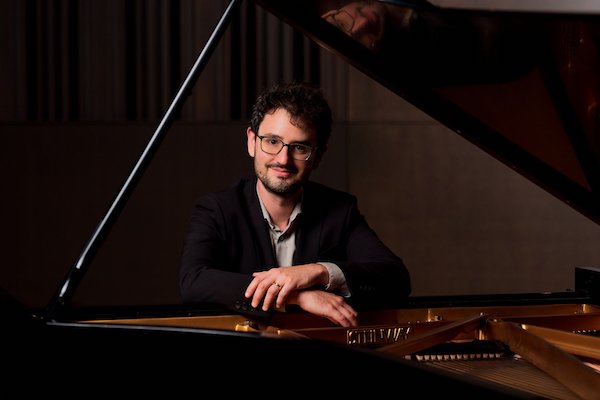
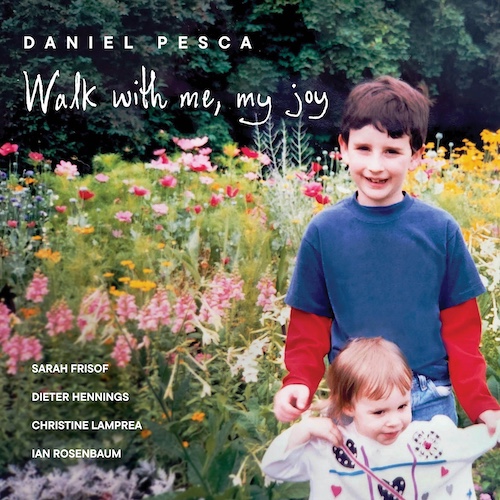
There’s something about the sound of a flute that makes people smile. So I’m guessing it wasn’t an arbitrary decision to begin Walk with Me, My Joy, the new album of recent works by composer Daniel Pesca, with Gestures of Grace, a piece in five short movements for flute and piano.
The work features flautist Sarah Frisof with the composer on piano, and it’s both charming and intriguing. Like the other music on the album generally, Gestures of Grace deals in modal consistency and abstract but easily digestible narrative design. Pesca conceived the work as suggestive of a ballet. In the first two short movements he keeps unexpected changes in dynamics and mood to a minimum. The quirky “Twirling” and the spectral, more harmonically challenging “Flowing” then flow into “Hinting,” where a velvety tone from the flute contrasts with pointed piano strikes.
Having accustomed the listener to an accessible vocabulary, the piece goes on to take the partnership between flute and piano deeper in two longer movements. The flute dominates “Glinting” with flowing melodies, while in a six-minute sum-up called simply “Dancing” the instruments trade staccato gestures, alternately anxious and forceful. A ruminative middle segment with an angelic flute cadenza develops into a busy closing statement with the two instruments playing tag and racing to a coruscating finish.
A Cello Alone
“In Solitude,” a short work for solo cello, arose from the pandemic lockdowns in 2020. Interestingly, though, Christine Lamprea’s rich and woody tone is recorded with enough echo to hint at an invisible accompaniment. Despite the loneliness embodied in the setting, there’s a tense, exploratory energy to the music. After the journey takes us into the cello’s extreme low range, a coda reaches hesitatingly for the heights. It’s a full-throated, yearning piece of work.
Don’t expect a nod to Brahms in Pesca’s three Intermezzos for guitar. The first was written a few years ago for guitarist Deiter Hennings as a literal “intermezzo” between other programmed works. It betrays that origin with a languid pace that makes it feel structureless. A mix of unexpected and traditional harmonies and an open rhythm lend it a pleasant vagueness. Pesca added the other two Intermezzi recently. The first offers contrast, with pointillistic gestures and snapping of strings. On a second and third listen to these three pieces, I came to appreciate their open-faced expressivity.
Variations on Variations
Still, as relatively minor works they feel a little disappointing after what came before, and don’t grip like the selections that feature the composer’s own pianistic inspiration. The tumultuous and hypnotic “Chaconne” for solo piano breaks the mold of the chaconne form. This sequence of short, modal, virtuosic variations on a chord progression doesn’t hold to any steady rhythm. Its contours become clearer with repeated listens, but its overall effect over its 10 minutes is engagingly abstract.
The title piece is a theme and variations, plus a Prelude and an Epilogue, for piano, flute, cello, and percussion. Frisof and Lamprea return to join the composer in the studio, along with Ian Rosenbaum of Sandbox Percussion.
The theme is the Irish folk song “Shule Agra” (“Walk with Me”). The Prelude accustoms us to the configuration, with melodic and atmospheric contributions from all four instruments. Then, after the flute states the theme simply, 10 variations unfold. Harmonic explorations begin in the first of these. Marimba leads the second, piano the contemplative third. The fourth plays out as a piano-flute duet, while the fifth sees the cello sailing in long tones over a moving progression of unresolved chord changes.
The theme is easier to pick out in some variations than in others. The effect is of a journey through many landscapes. A plaintive wandering with a dissolute cello melody, a quick caper, a mechanistic clockwork attack, and an underwater swim lead up to a final romp with all four musicians joyfully hammering away, the cello restating the theme during a brief interlude.
The theme returns in mournful form in an Epilogue, leaving us to wonder if the “Walk” might not lead to ultimate happiness. The lyrics to a common version of “Shule Agra” known in English as “Johnny Has Gone for a Solider” are hopeful but uncertain. But that doesn’t take away from this colorful album’s predominantly upbeat feel. Sarah Frisof may be the flute player, but on Walk with Me, My Joy, Daniel Pesca, composer and pianist, is the pied piper of joy.
Walk with Me, My Joy is out now on New Focus Recordings and available at Bandcamp.