 Blogcritics The critical lens on today's culture & entertainment
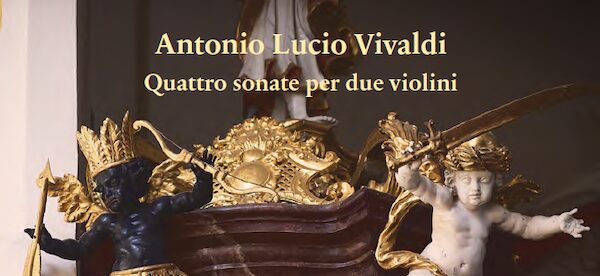
What accounts for the persistent popularity of Vivaldi’s music after all these centuries? Cecilia and Martin Gelland, together known as Duo Gelland, capture one important reason on their new recording of four of the composer’s sonatas for two violins. Vivaldi, a master violinist himself, infused his compositions for the instrument with the expressiveness of the human voice. In the hands of fine interpreters like the Gellands, works like these sonatas ring with an authenticity almost biological.
Not About the Bass
The effect may be most pronounced in Vivaldi’s music for two unaccompanied violins. These sonatas contain reworked material from his previous compositions (as was often done at the time, cf. J.S. Bach) such as concertos for two violins and even arias from his operas. But without orchestral accompaniment, or even the need for a continuo to provide the roots of the harmonics (the sonatas are marked “da suonarsi anche senza il basso” – “can also be played without a bass”), the music has a pure, conversational quality. It’s a naked kind of communication, you could say, between two individuals – and between musicians and listeners.
The Gellands recorded these sessions in a church in Sweden, and the results resound with the reverberations of open space. I have mixed feelings about this kind of recorded sound.
On the one hand it suggests you’re hearing the music in a live, “real” space as opposed to via closed-circuit capture in a recording studio. Motivic gestures in the tragic slow movement of RV 77, for example, drift and fade in a very natural-sounding way.
On the other hand, it can also smack of “effects,” probably because we’re so used to artificial reverb in popular music.
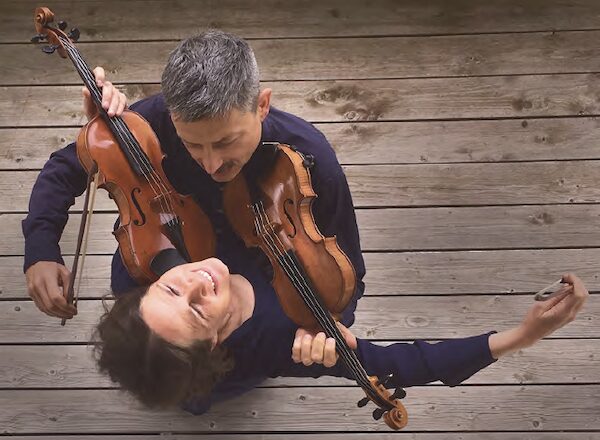
My preference in this case is to listen through good (and relatively large) speakers, where the effect of the reverb is somewhat dampened or assimilated by your own real space, rather than through earbuds, which create a closed, dissociated world for the ears. But your mileage may vary. It’s a rewarding and inspiring listen either way.
Vivaldi, per Duo Gelland
The opening Allegro of RV 71 launches the album joyfully with a scatter of playfulness and virtuosity. Throughout, the Gellands’ performances of these scores produce marvelous and manifold effects. Striking, for example, are the four-part harmonies achieved through combined double stops in the beautiful slow movement of RV 70, where gentle flutterings contrast with the rich chords. The boisterous dance of the same sonata’s “Allegro molto” finale hits home too. (These sonatas have but three movements each.)
Vivaldi’s clever insertion of individual “bass” notes, as in, for example, the Larghetto of RV 71, makes harmonic movement clear, giving the two voices the freedom to imitate each others’ melodies and motifs, trade licks, harmonize, argue and agree.
Swirling uplift transforms into minor-chord angst in the first movement of RV 77. Echo smooths the scurrying, near-panicky phrasemaking of RV 68’s opening movement, to eerie effect. But the delicacy of the playing ensures an intoxicating clarity. RV 68’s tiny Andante is composed of simple scales and motives and lacy arpeggios – ur-Vivaldi? – while the third movement has ethereal passages where ornamentation seems to have slipped loose of its bounds to melody. These clouds of sound encapsulate the almost-mystical togetherness that the Gellands achieve on this bold and fragrant album.
Did Vivaldi play or hear this music the way it sounds here? It would be fascinating to know what he would have thought of these interpretations. Would he appreciate the breathy eddies that the Gellands spin from the rave-up at the end of the third movement of RV 71? How did he and his contemporaries think about and account for echo and reverb when they composed music they knew would be performed in a high-ceilinged church?
When I hear chamber music in a church, it takes just a few minutes for my brain to adapt and assimilate the echo so that I can enjoy the music as much as I would in an acoustically designed concert hall. I find something similar happens with a recording. And I do feel like I’m in the room with Duo Gelland when I listen to their renditions, at once spacious and intense, of this wonderful music.
Antonio Lucio Vivaldi: Quattro sonate per due violini is out now and available at Bandcamp.