 Blogcritics The critical lens on today's culture & entertainment
What is a canon? In music, the idea is simple: counterpoint is produced by the statement of a melody followed by imitations of that melody by a different instrument or voice after some number of beats or measures have passed. The imitations can differ from the original in a variety of ways. But there’s a basic melody at the root.
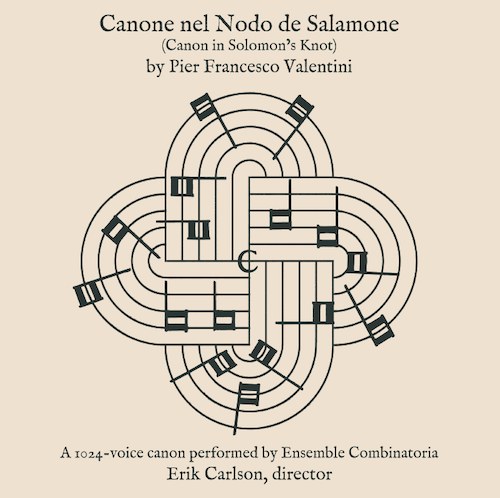
Pier Francesco Valentini’s 1631 “Canone nel Nodo de Salamone” (“Canon in Solomon’s Knot”) is an outlier. As Erik Carlson explains in the liner notes to his new realization, the original canon is a four-voice chorale notated graphically on a drawing. “Every note is part of a G-major chord, which gets repeated over time in exact imitation by a series of quartets.”
In this case, there’s no theoretical limit to the number of voices that could be part of a performance. Valentini wrote that it was “for 512 voices, and also for infinite voices.” More parts, more duration. Carlson and a large number of collaborators (who are named but without instruments specified) have created and recorded a version for 1,024 parts (256 repetitions of the chorale). At 51 minutes it fits comfortably on one old-fashioned CD.
With so many parts, the individual lines blend into what we hear as one prolonged chord. Listening to it out of context you’d likely think it was a piece of avant-garde conceptual art. You might picture multiple tracks of an organ or synthesizer all playing a steady G major chord, without letup and without melody, for nearly an hour. So it’s important to know the context.
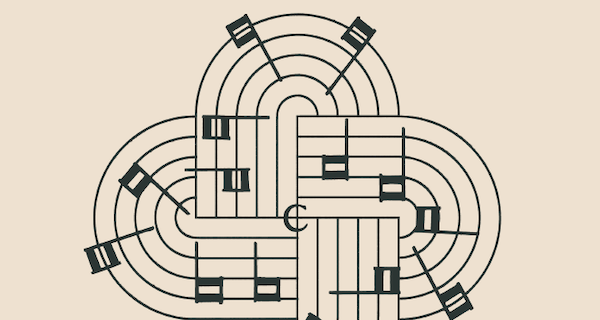
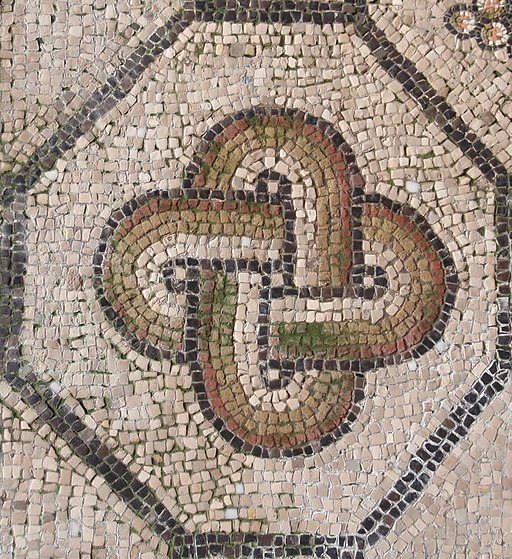
The score itself is an example of eye-music (Augenmusik), where meaning resides in graphic elements. Here the composer has taken normal musical staves with normal notes and bent them into a Solomon’s knot, an ancient decorative motif of two closed, interlaced loops (see above).
Carlson’s realization is akin to 20th-century Minimalism in that we hear gradual shifts over time. But it’s dynamics and timbre that evolve, not harmony or rhythm. Xenakis comes to mind more than Glass. And then you recall that the piece is by a contemporary of Monteverdi! Applying Valentini’s “infinite voices” could result in a rendition that goes on for thousands of years, or indefinitely.
Is John Cage’s ORGAN2/ASLSP (As Slow as Possible) a modern analogue? Not really; Cage’s effort represents an extreme duration, but multiple parts don’t figure. Other modern outliers might come to mind as well. But again: 1631.
Indeed, as composer John Dante Prevadini cogently writes in Classical Music Daily, “I see no evidence that Valentini was working with any compositional tools beyond the standard practices of counterpoint, imitative forms and music notation familiar to his own time and place.” And yet here we have something that sounds alien to our experience of 17th-century music, “even if the limitations of our own pedagogical and musicological tools render [such a piece] analytically problematic after the fact.”
Carlson’s realization might beg for analysis. But what about the listening experience? At low volume, the music can be meditative. Louder, and you can more easily detect the subtle changes: timbral elements increasing or decreasing in prominence, individual expressions of particular notes ringing out, then subsiding. The dimensionality becomes noticeable in a new way during the fadeout, where parts are stripped away.
As Minimalism once did, what Erik Carlson has created provokes in me fundamental questions about what music really is and why we respond to it as we do. These are questions not only for theorists and academics, but for us listeners too. It benefits us to think about them. Music taps our emotions first, our intellects second. The more we understand both, the wiser we become. Temet nosce: Know thyself.
Canone nel Nodo de Salamone is out now and available at Bandcamp.