 Blogcritics The critical lens on today's culture & entertainment
We’re accustomed to music tuned in equal temperament, the system, used in both classical and popular Western music for the past 270 or so years. In equal temperament the ratio of the frequencies of any adjacent pair of notes (the half-steps in the standard 12-tone scale) is the same.
In just intonation, by contrast, the intervals between the frequencies of adjacent notes are whole numbers (e.g. 3:2 for a perfect fifth). While this might sound like it would result in harmonious sounds, just-intonation music sounds ferociously out of tune to Western-trained ears.
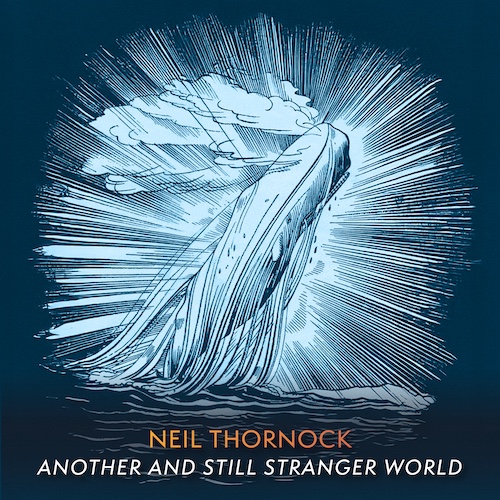
That’s what composer Neil Thornock demonstrates on Another and Still Stranger World, his album of short pieces played on a piano tuned to extended just intonation. “Extended” means with additional prime numbers used in determining the intervals. It opens the music to further experimentation and effects.
Extended Just Intonation
There’s a temptation when presenting unfamiliar tunings to create music that sounds like lessons for the ear. On a piano, that might mean repeated figures with slowly introduced variations, à la Philip Glass, or repeated chords that hammer home how different the harmonics are from what you’re used to.
There’s some of that here, as in the first of the three Études that begin the album. The designation “Étude” was originally devised for pieces intended to help students master technical challenges rather than necessarily please listeners. Here, we the listeners are the students.
The rhythmic first and third Études borrow from Minimalism, plying numerous iterations of each chunk of Thornock’s piano’s strange-sounding harmonic language. In “Étude 2” a triplet accompaniment to solemn simple melodies also help accustom us to the alien-sounding tuning, but again without exciting much musical sympathy.
The music gets more absorbing as the album progresses. The trickling downward figures of the lyrical “Cascade” explore much of the piano’s wide range. A few pieces seem designed to demonstrate specific effects. “Verset 2” shows the unexpected progression of just-intonation scales. “Verset 7” shows off the metallic timbre that the tuning can encourage. The theatrical “Lithic Bell” suggests the grand reverberations of the carillon – another of the composer’s specialties – as well as the tolling of church bells. Bells also come to mind in “Microwaltz” and especially in the gripping “Bellody.”
Merging Worlds
Pieces with elements of traditional forms are among the most effective: a jazz-standard flavor in “Verset 5,” chorale-like moving harmonies in “Poem 4,” insistent rhythm and tinkling melody in “Microwaltz.” Pastoral melodies and sensitive rubatos elevate the Schubertian “Rain.” The latter, anent its title, in its impassioned central section also nods to Chopin’s “Raindrop” Prelude.
There is also thoughtful melodicism (“Poem 2,” “Diptych 1”) and even interesting spatial effects, as in “Poem 4” and “Bellody,” where high notes seem to come from a different direction as those in the midrange. “Poem 4,” like “Verset 7,” also includes chorale-like passages that illustrate the strange harmonic possibilities of the tuning.

The longest piece, “Fantazia 1,” offers a smorgasbord of just-intonation delicacies as it grafts Minimalism onto a Romantic moodiness, all with an improvisatory feel. The shortest are the Versets, nine playful little sketches in a variety of styles. “Verset 7″‘s close harmonies go the furthest to impress on the brain the distinct weirdness of the tuning.
If alternate tuning systems are new to you, this album can be an introduction that’s more musical than pedagogic, and quite revealing. If not, it will be easy to admire Thornock’s ingenuity and talent. Once you’re used to the intervals, some of the pieces might put you vaguely in mind of Bartók’s short piano pieces, or Satie’s, with excursions into the jazzy and Romantic.
Either way, if you come to it with an open mind you may find Thornock’s just-intonation piano music a useful spur to thinking about how music operates on our brains and specifically our emotions.
Another and Still Stranger World from Neil Thornock is out now on New Focus Recordings and available at Bandcamp.