Blogcritics The critical lens on today's culture & entertainment
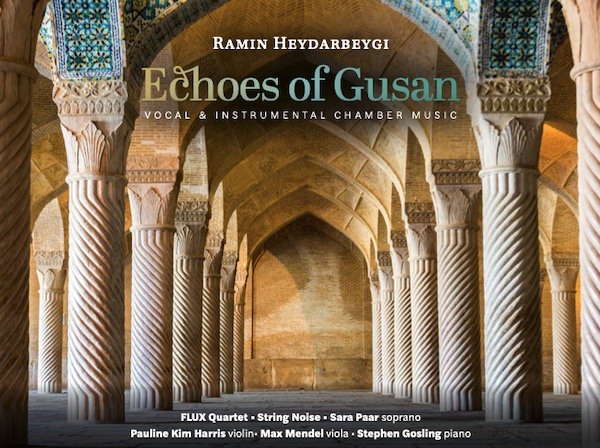
A gusan (or gōsān) was a minstrel, or poet-musician, of Persia during late antiquity. More than 30 years ago Ramin Heydarbeygi set short poems by Rudaki, a 9th-century blind harpist and poet in that tradition, to music in a song cycle he titled Gusan. You’ll find it at the end of Echoes of Gusan, a collection of Heydarbeygi’s vocal and instrumental music, where it’s the oldest work. And I could tell, even though I was unfamiliar with the composer’s music, that it’s from an earlier era of his sensibility.
But it comes last on the album. First up is an instrumental work, Rok-ku no Haiku, a suite of six very short movements for violin and piano that serves as a pretty good introduction to Heydarbeygi’s method of constructing larger statements from miniature elements. Unlike his vocal and choral works, these pieces reflect abstract emotions, depicted straightforwardly through a hybrid language of modernity and, in the fourth movement (“Adagio e con devozione”), echoes of the Romantic tradition.
Dissonant clusters and wide leaps launch the suite in the “Poco adagio.” The “Allegro ritmico” does a lighter-hearted dance with the same vocabulary, while the “Calmo” relies on partial-vibrato double stops to create a softened mood. Pianist Stephen Gosling plucks his strings in the exquisitely spare and touching 36-second “Sostenuto.” Violinist Kim Harris expresses high spirits through a variety of techniques in the dark and jokey “Allegro giocoso.”
Poetry and Music
Soprano Sara Paar joins the FLUX Quartet in Negah, a suite of six settings of poems by Persian/Iranian women. One of the authors is a contemporary poet; the others are from a thousand years ago and more. All but the last are on themes of love and eroticism, but the music varies to reflect the lyrics. Enlivened by Paar’s joyfully evocative vocals and the energetic accompaniment from the string quartet – who double on harmonicas – these songs show a deeply expressive side of the composer. Heydarbeygi has drawn for decades on Persian/Iranian poetry for his vocal and choral work, and both he and Paar display a uniquely warm affinity for these poets and the language.
First, lush and flowing but unsettled harmonies and constrained vocals illuminate the despair of an insecure lover: “Now I’ll pour my heart into your hands / So you will not call me drunk / like you did last night…” (All lyrics quoted in this review are translations from the liner notes of lines sung in the original language.) Next, pizzicato runs and plaintive harmonica chords evoke a woman “drunk with love,” ending with strange chords and a sigh.
Probing low tones from the cello introduce a deep and soulful song of intimacy and exposure: “How I adore your penetrating gaze / which sees me in all my nakedness / From beyond all masks / And discovers me as an earthen pot.” The melody shifts from wide intervals to cloudy half-tones accompanied by microtonal string lines.
The half-spoken lyrics and explosive ending are explicitly erotic in “Eshghbazi / Making Love.” Strikes on a hand drum then set off the “Largo” movement, the brief, slow sigh of a sex worker with no autonomy. Finally, in “Arezu / My Wish,” an aging woman looks back – and askance – at love in a mini-epic of despair. “Who am I but a mad woman who finds solace in death…I am like a wilting blossom, my petals plucked / before I knew the joy that life could bring.” Heydarbeygi’s skill at packing complex emotions and thoughts into compact pieces is at its height in this movement – longer, at four and a half minutes, than almost anything else on the album.
Miniatures
With Setayesh as Anahid for string trio, we are back to extremely short statements – the opening “Presto” clocks in at just 21 seconds. Here the composer honors Nahid (Anāhīd), an Iranian mother-goddess with hegemony over water and knowledge. As in Rok-ku no Haiku, he concentrates a variety of feelings into miniatures.
Humming vibratos suggest hovering insects in the “Lento.” The “Largo e delicato” crams what could be a whole night of vaguely disturbing dreams into just over a minute. The fourth movement scurries like a muscle spasm and the fifth has the three musicians sawing with all their might through ever-moving, never-settling harmonies. No. VI, “Alla persiano,” is notable for its non-Western-standard intonation. The suite ends distantly with an exquisite “Adagio e lontano” of wandering melodies and a quiet fade.
Muye baraye Farzin consists of “six expressions of lament” for solo viola, performed with impressive virtuosity by Max Mandel. Here Heydarbeygi exercises his skill at delineating different facets of what is essentially one emotion. Mandel creates such a full world of sound and feeling that this solo piece doesn’t give the impression of a significant departure from the trio music that precedes it on the album. The third movement is the most energetic “Elegy” I can recall; the fourth could be a mournful folk dance. The pathos is palpable in the final, keening “Lento doloroso.”
Bach and the Gusan
Heydarbeygi holds to his formula – in his words, “a series of small gestures that compositely form a larger gesture” – even with a form as traditional as the string quartet. His impactful String Quartet No. 2, performed again by the FLUX Quartet, is in seven movements totaling only about 10 minutes.
It’s followed by the three-part Gefangene, Musik hörend (after Käthe Kollwitz) for two violins. The work incorporates at the start a quotation from Bach’s Violin Sonata No. 3 in C Major, BWV 1005, then riffs inventively on Bach with variations and explorations over two substantial, though still short, movements. Parts of the last movement sound like more than two violins. The piece concludes in a passage of ethereal “whistling.”
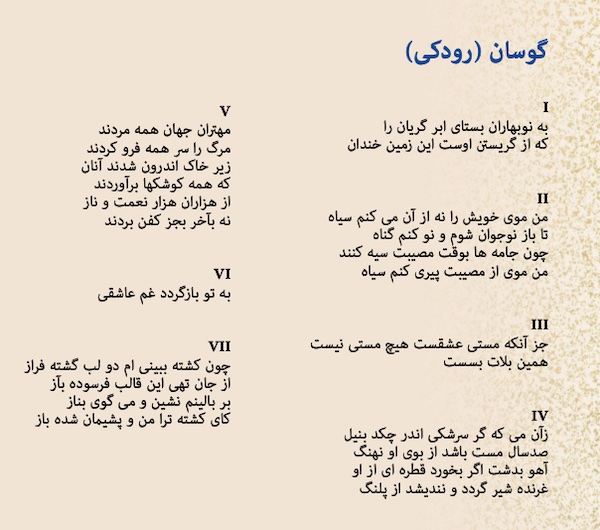
Sara Paar returns to sing Gusan, accompanied by violin and cello. Again we have a tour through the emotions. The Rudaki verses and fragments are on topics like aging and renewal, death and desire, but the music makes the suite seem like a continuing saga. Paar’s wonderful singing (and other vocalizing) breathes vibrant life into it, with instrumental musicianship to match, as throughout the album.
The energy never flags even as the poet bemoans her old age (“I dye my hair black…since black is the color of mourning”) and the “calamity” of love. In “Death of the Nobles,” the poet marks with words, and the composer with sorrowful sighs from the strings, how the mighty have fallen. Paar sings the lower notes as from a grave, the higher passages as if beaming them from the skies like a comet, lonely in near-empty space. The suite ends with “Regret.” The poet is dead, “destroyed by desire for you,” finally silenced in favor of a triumphantly dissonant half-tone dyad.
Gusan‘s seven movements slide smoothly one into the next. What this earlier song cycle lacks is the strain of lightness that rounds out Heydarbeygi’s later musical-poetical portraits. That doesn’t necessarily make this a lesser work, although in a way it may be. It does give a sense that the composer has evolved over the years to perhaps take himself, as an artist, a little less seriously, with increasingly appealing results.
All of this music touches the mind and the heart in complex and achingly familiar ways. This superb album is going on my permanent (digital) shelf. Echoes of Gusan from composer Ramin Heydarbeygi is out now on New Focus Recordings and available at Bandcamp.