 Blogcritics The critical lens on today's culture & entertainment
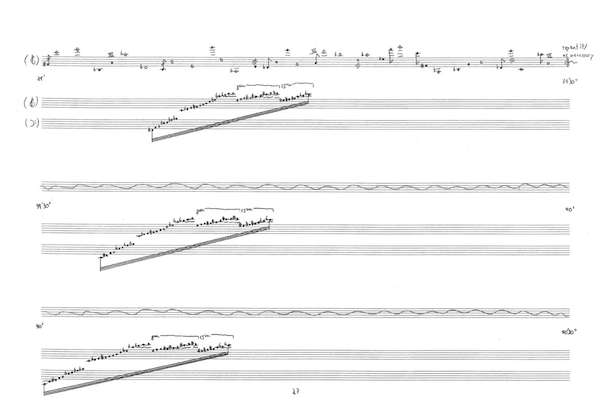
Two meditative, thought-provoking works for violin and piano comprise Vigil Vol. 1 from composer Ryan Vigil.
In “untitled work for violin and piano” (2009) the meaning of simple contrasts is magnified. What does it mean when some sequences consist of two chords and others of three? What about the differing tempos of the phrases? Does a particular long-held note crescendo or decrescendo (or both)? and does empty space follow it, or another note? Where during the chord sequence does the violin enter, and does the violin note “belong” to one particular chord sequence or span two? Even if their meaning remains obscure and open to interpretation, events and contrasts feel significant. As time progresses we find ourselves becoming alert to and even anxious for these variations, as they carry most if not all of the meaning.
Variations Not on a Theme
As pure abstractions these changes or evolutions in the music remind us that we don’t need concrete imagery to find meaning – whatever that may be. As Vigil writes, “I do not wish to entertain or educate with my music – although, if there is entertainment or education, or other things, I don’t object to this. I only seek to give place to the sounds that come to me in the clearest and most accurate way possible.”
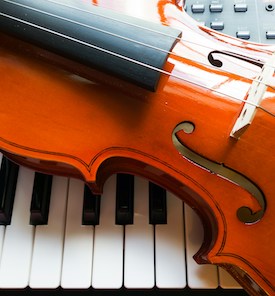
Halfway through the 50-minute piece a big change occurs. A sustained single low piano chord decisively ends the first section, whereupon a fluttery whistling sound from the violin introduces a new sequence where the two musicians use new techniques to create very different kinds of sounds. The character of the music alters dramatically; while remaining slow and contemplative, it introduces elements of 12-tone melody in the violin, with the piano interjecting stutters, fragments of scales, and percussive strikes. The overall effect is mysterious and moody. We may ask ourselves again: What does this tell us?
Does Ryan Vigil Care If You Listen?
Music, like other forms of stimuli, doesn’t have to be aimed at our pleasure centers. It can address our thinking centers instead (or also). And whether it’s contemporary experimental music or death metal, it doesn’t have to be for everyone. In his famous 1958 essay “Who Cares If You Listen?” Milton Babbitt analogized “serious” or “advanced” contemporary music to a field like theoretical physics, something we don’t expect a layman (or in the case of music, the everyday listener) to understand or even try to.
Vigil’s music here isn’t rooted in a complex theory, though. It merely reflects the composer’s musical “vision” spread relaxedly – but not lazily – over a long period. And “long” is relative; these pieces, 50 and 20 minutes in length, have nothing on the ongoing, centuries-long performance of John Cage’s “Organ2/ASLSP”. In any case, this music does resonate as something meant to be heard. The transitions between sections, marked by closures and introductions, would seem to indicate as much. So do the suggestions of melody and mode, the hints at 12-tone music, the careful interplay between the instruments.

A second transition takes place 42 minutes in. The jittery hums that opened the second section return, but now continue, alternating with individual plucked notes and piano chords like those of the first half. This development makes the third section in one sense a hybrid of the first two, while also giving it the piece’s only truly regular sequence: jittery hum, plucked note, pair of chords, the same three elements again and again.
Still No Titles
The second work, a mere pipsqueak at 20 minutes, bears the same (non)-title, though it dates from 10 years later. Again we hear piano chords and long-held single notes on the violin, but this time the entrances are synchronized. However, while the violin holds its note for the full length of each time segment, many of the piano chords cut off after only a second or so.
This may suggest something about the nature of melody and accompaniment. A sequence of chords played alongside single notes suggest an accompaniment and a melody, but the normal expectation would be for the chord to sustain, not abruptly cut off as the “melodic” note continues.
And again, new elements and techniques are suddenly introduced – an individual note, a wavering wail plus a piano octave, and a double-stopped chord, in that order, numerous times. A second transition has the violin whistling harmonics over soft, plaintive piano chords. Here the instruments are in different, clashing modes or scales, creating a drawn-out tension that concludes the piece, and the album, with a sense of non-resolution. And what does that mean? Does it mean anything?
And does the composer care what we think?
Vigil Vol. 1 features violinist Lilit Hartunian and pianist John McDonald. It’s out now on New Focus Recordings and available at Bandcamp.