 Blogcritics The critical lens on today's culture & entertainment
Oh, Canada! and Hard Truths
In the 2024 New York Film Festival’s Main Slate section, we see protagonists in pain. Characters portrayed by actors with fine careers require investments in emotional nuance. In Paul Schrader’s ‘Oh Canada!,’ Richard Gere stars as a renowned documentarian, dying of cancer. In Hard Truths by Mike Leigh, Marianne Jean-Baptiste portrays a character who spews anger with raw grist. Gere and Jean-Baptiste create uncompromising characters battling different forms of pain. Whether it’s physical pain as Gere documents, or emotional misery as Jean-Baptiste conveys, the viewer experiences the character’s pain almost viscerally.
Oh, Canada!
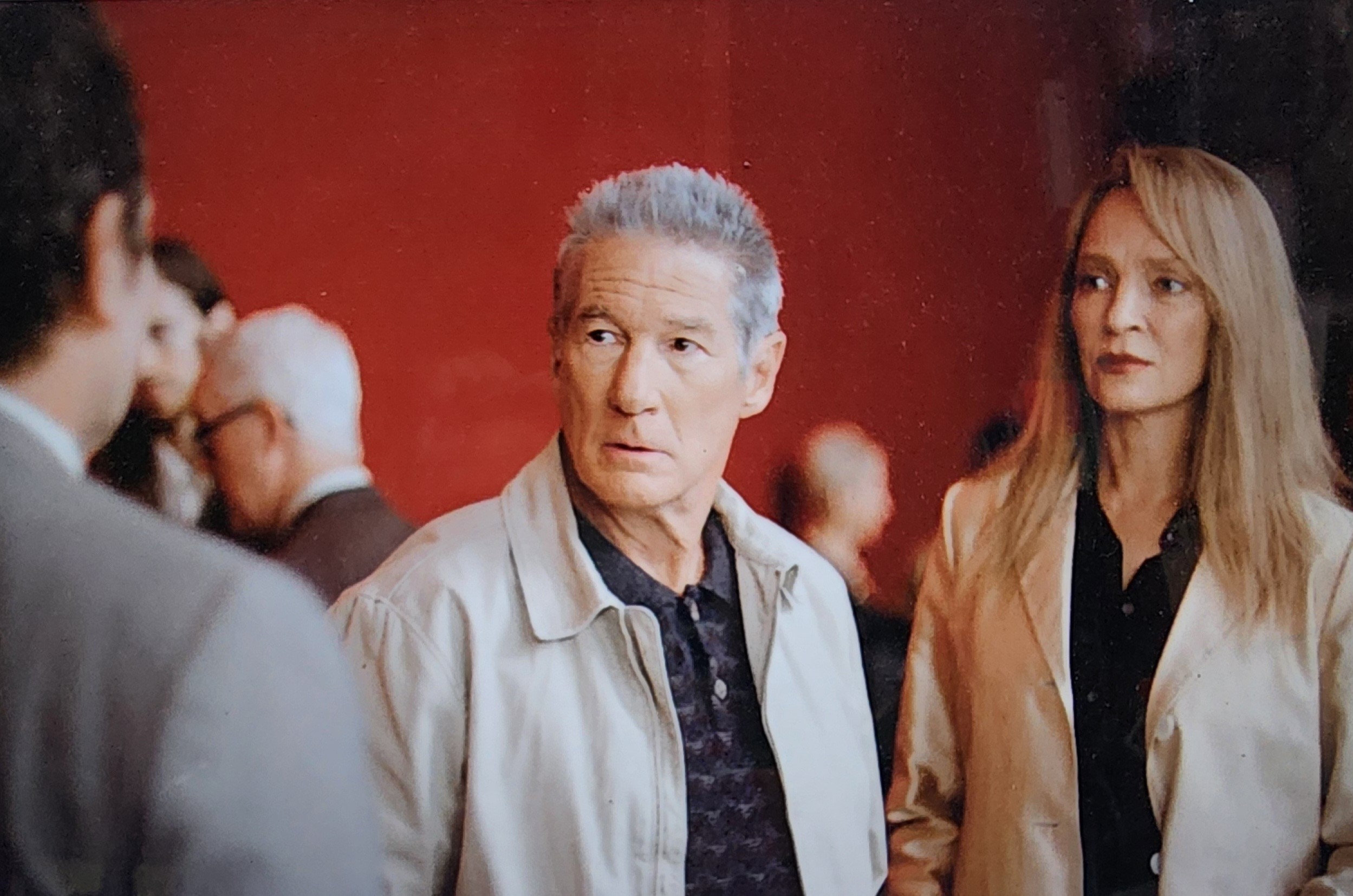
Oh, Canada! is Schrader’s adaptation of Russell Banks’ novel, Foregone. It involves a final confessional interview of a celebrated documentarian. Leonard Fife, on drugs and with steely determination, confesses his secret past to the public ad to his wife Emma (Uma Thurman) as she sits by his side. Throughout, the camera focuses on Gere’s commanding performance as Fife. Considering that the gorgeous Gere of Schrader’s American Gigolo has here disappeared into an old, dying man, Gere shocks us with his authenticity.
During the interview, Schrader cuts into flashbacks of the young Fife (Jacob Elordi). As the dying man reminisces, he visualizes his haphazardly unfolding actions. Interestingly, the flashbacks pass in and out of different time periods in the 1960s. Then, we see the young Fife with his first wife, baby, and in-laws. Later, he visits a friend and meets Emma, his friend’s wife. To reveal how pain is key to Fife’s memories, Schrader’s flashbacks unravel without linearity. At times Emma counsels that they take a break and stop filming. She realizes his pain causes his mind to wander and she questions why he continues. Throughout, we realize that Fife’s unreliable narrative may be truthful, but may still not reveal everything.
In Oh, Canada, Schrader Compels Us to Make Sense of Fife’s Confession
The film forces us to make sense of Fife’s confession and life. As we try to understand what he feels shamed him, we struggle with his opaqueness. In Fife’s storytelling, some incidents strike more clearly than others. However, key events reveal how Fife dodges the draft and avoids the Viet Nam War. By making his way to Canada and leaving his young son, Fife dodges his responsibility to himself, his family, the country.
Fife has agreed to be filmed by his former former protégé (Michael Imperioli). As he confronts his sterling public image, intentionally tarnishing it with revelations of cowardice and weakness, he seeks his own redemption. Thus, the private becomes public. The personal becomes a universal statement about living with lies and the need to confess before we die. Though Schrader’s adaptation doesn’t indicate it, we also question to what extent did the lies fester in Fife and make him sick?
The cinematography expresses clear contrast between the highly personal visuals focused on Gere and the flashbacks with the youthful Eliordi. Finally, Schrader’s emotionally naked drama numbs us by making us realize our own mortality, regrets and need for redemption.
The film screens at the 2024 New York Film Festival and receives a Kino Lorber release in December 2024.
Hard Truths
In director Mike Leigh’s family drama, Marianne Jean-Baptiste gives a hair-raising, unforgettable performance that drains the viewer. With flat cinematography, grit and power, the fine British filmmaker questions the pursuit of happiness in everyday reality. Additionally, he focuses on the limits of empathy and connection when a family member spews rage, complaint, and fear 24/7.
In a performance for the ages, Marianne-Baptiste (an Oscar nominee for Leigh’s Secrets & Lies) conveys Pansy’s hell. On the surface, the middle-aged, working-class woman’s lovely, well-kept home belies any problems or issues. However, the moment Pansy interacts with her son Moses (Tuwaine Barrett) and husband Curtley (David Webber), reality coalesces around her inner state. Nothing they do pleases her. Their presence gives her occasion for harangue, complaint, and fury. Increasingly, we note her inner misery and turmoil as Moses and Curtley say nothing in response. We empathize with them because Pansy needs help but won’t self-evaluate. Like a rabid, caged animal she strikes out and refuses to be comforted.
Pansy’s Interior Psyche Creates Toxicity for Others in Hard Truths
Pansy’s interior struggles, physical problems and fear create a horrific, toxic environment for everyone near her. Pansy doesn’t smile or give a kind word to anyone. Doctors, even strangers on the street, must receive her hateful spewing. Infuriated by her domestic life, son and husband, Pansy can’t kill herself to end her misery. Like Hamlet, she fears the afterlife. She wakes up with sweats after nightmares. Indeed, fear and rage become embodied in her. Thus, she can’t even find a way out through hobbies or entertainments to numb herself from the emotional pain and terror. Apparently, these have no boundaries. Nor do we see their causes, which might suggest avenues of relief.
The only hope and solace for Pansy lies in the unwavering love of her sister, Chantelle (the wonderful, light-filled Michele Austin). When they visit their mother’s grave, Pansy spits out how their mother abused her. Chantelle comforts her and they go to Chantelle’s place for a celebration. But Pansy’s sickness at heart creates discomfort with her nieces, and with Moses and Curtley. Furthermore, Pansy can’t eat or drink. The happy Mother’s Day celebration turns to dust without the promised relief of an intervention for Pansy. In this steady state, Pansy finds no way out.
With his eye for the details of extraordinarily complex human behavior delivered by a superb cast, Leigh reveals Pansy’s descent into the abyss. He offers no clear reasons for it or solutions. The viewer watches in horror and experiences Pansy’s emotional state, relieved when the film ends.
Hard Truths opens at Film at Lincoln Center on December 6 for an exclusive one-week run, then returns January 10. For tickets visit the website.