 Blogcritics The critical lens on today's culture & entertainment
When Congress finally passed a continuing resolution on November 12, 2025, ending the longest government shutdown in American history, the press coverage focused on furloughed workers returning to their desks and SNAP benefits flowing again. What didn’t make the headlines was the constitutional crisis that had quietly unfolded inside federal courthouses across the country—one that exposed fundamental cracks in how we fund the right to counsel.
The shutdown lasted 43 days. However, the damage to the federal criminal justice system began months earlier, and it won’t be rectified by a stopgap spending bill.
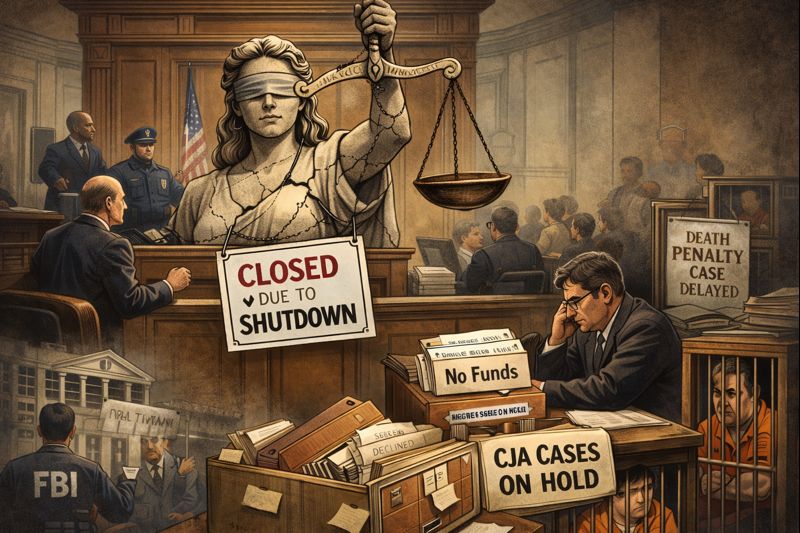
Criminal Prosecutions Kept Running; Defense Teams Did Not
On paper, the system worked exactly as designed. Under the Department of Justice’s FY 2026 contingency plan, criminal prosecutions are classified as “excepted” activities that continue during funding lapses. Assistant U.S. Attorneys kept showing up. Grand juries kept meeting. The FBI kept investigating.
What the contingency plan doesn’t address—what no contingency plan addresses—is who pays the other side.
The Criminal Justice Act (CJA) program, which compensates private attorneys appointed to represent the roughly 40% of federal defendants who can’t afford counsel and aren’t assigned to federal defender offices, ran out of money on July 3, 2025. That was three months before the shutdown even started.
The culprit was the continuing resolution Congress passed in March, which froze judiciary funding at FY 2024 levels. The freeze hit Defender Services especially hard. By midsummer, thousands of panel attorneys, investigators, paralegals, and interpreters were working without any guarantee of payment.
They kept working anyway, most of them, on the assumption that Congress would sort things out when the new fiscal year started on October 1.
Then the government shut down.
‘The System’s About to Break’
Michael Chernis has been a CJA panel attorney in Southern California for years. By October, he’d stopped taking new cases entirely.
“The system’s about to break,” Chernis told reporters during the shutdown. He’d taken out a personal loan to make payroll at his law firm. One of his clients lived in Sacramento, but neither Chernis nor his court-appointed investigator could cover the cost of travel to meet with him. The expert witness they needed for trial refused to work without payment.
In the Central District of California—the largest and most complex federal trial court in the country—roughly 80 of the district’s 100 CJA panel attorneys stopped accepting new appointments. In New Mexico, more than 50 panel lawyers made the same decision.
David Kaloynides, another Los Angeles panel attorney, couldn’t even communicate with some of his clients during the shutdown. They spoke only Spanish, and the interpreters weren’t being paid either. His caseload backed up to the point where he was scheduling trials for 2027.
“We don’t do this appointed work because of the money,” Kaloynides said. “We do it because we’re dedicated. But we also can’t do it for free.”
A Death Penalty Case Hits the Wall
The constitutional stakes came into sharpest focus in New Mexico, where the Trump administration had announced plans to seek the death penalty against Labar Tsethlikai, a 52-year-old man from Zuni Pueblo charged in a series of kidnappings involving sexual abuse and two deaths.
Capital cases are different from ordinary prosecutions. They require exhaustive mitigation investigations, including social histories, mental health evaluations, and expert consultations, which can take years and cost hundreds of thousands of dollars. The defense team working on Tsethlikai’s case had continued their work after the July funding cutoff, trusting that payment would come when the new fiscal year began.
When the shutdown hit instead, the case ground to a halt.
On October 18, U.S. District Court Judge David Herrera Urias granted an emergency stay of proceedings. His order didn’t mince words:
“The right to a defense is one of the bedrock principles of this country, and the shutdown has unquestionably impeded Defendant’s right to counsel in this case.”
According to the court’s findings, one member of the defense team had been forced to dip into retirement savings to cover basic living expenses. A defense expert who’d intended to work on the case told counsel they couldn’t do anything until the budget crisis ended.
Federal prosecutors opposed the stay, arguing that it was a tactic to delay justice. But Judge Urias wasn’t persuaded. The defense, he wrote, “cannot be expected to represent Mr. Tsethlikai without compensation and without the ability to conduct a thorough investigation or consult with adequately funded and necessary experts.”
Of the 23 federal death penalty cases authorized by Attorney General Pam Bondi, Tsethlikai’s was the only one halted because of the shutdown. It won’t be the last case where a judge ties funding failures to Sixth Amendment violations.
The Courts Tried to Stay Open. It Wasn’t Enough.
The Administrative Office of the U.S. Courts announced on October 17 that the judiciary had exhausted its reserve funds. From that point forward, federal courts would operate in “limited” mode—judges would keep working, but staff could only perform activities permitted under the Antideficiency Act. Criminal proceedings continued. Civil dockets got pushed aside.
Individual courts handled the crunch differently. The D.C. Circuit kept a full schedule. Rhode Island, Connecticut, and Alaska dropped to four-day workweeks. Law clerks worked without pay. Probation officers worked without pay. The electronic filing system remained online, but the personnel processing the filings weren’t receiving paychecks.
The situation wasn’t unprecedented—courts survived the 35-day shutdown in 2018-2019 by juggling fee balances and delaying expenses. However, that shutdown ended before the courts had to make truly difficult choices. This one didn’t.
Inside Federal Prisons: A Perfect Storm
The Federal Bureau of Prisons (BOP) was already reeling before the shutdown started.
Chronic understaffing had left facilities across the country operating below safe levels for years. At the federal prison in Edgefield, South Carolina, nearly 30 officer positions sat vacant out of a roster of 120. Teachers, nurses, and electricians were being pulled off their regular duties to staff housing units.
Then, on September 25—less than a week before the shutdown—BOP Director William Marshall terminated the agency’s collective bargaining agreement with the union representing more than 30,000 employees. The timing couldn’t have been worse.
When appropriations lapsed, corrections officers became “excepted” employees—required to show up and work, but with no guarantee of when they’d see a paycheck. Support staff, including the teachers and medical personnel already stretched thin by augmentation duties, faced the same choice.
“It’s a perfect storm,” Brandy Moore White, president of the Council of Prison Locals, told reporters.
The ripple effects reached inmates directly. Family visits were canceled at some facilities. Transfers slowed or stopped entirely. Paperwork for compassionate release requests—the very process that the First Step Act was supposed to streamline—piled up without anyone to process it.
Congresswoman Summer Lee, ranking member of the House Subcommittee on Federal Law Enforcement, demanded a briefing from BOP leadership, citing concerns about prolonged lockdowns, interrupted medical and mental health services, and staff reassignments that put everyone at risk.
The Bureau declined to comment, citing the shutdown.
The Speedy-Trial Problem Nobody’s Talking About
Federal criminal defendants have a statutory right to be tried within 70 days of indictment under the Speedy Trial Act. The clock can be paused for various reasons—pending motions, competency evaluations, and “ends of justice” continuances—but the delays must be justified on the record.
During the COVID-19 pandemic, courts routinely excluded pandemic-related delays under the ends-of-justice provision. Every federal court that addressed the issue held that courthouse closures and jury unavailability qualified as excludable time.
Shutdown delays present a different question. When the government itself creates the conditions that make timely prosecution impossible—failing to fund the courts, failing to pay defense counsel, furloughing the staff who keep the system running—can it then claim those delays don’t count?
The Tsethlikai stay suggests that at least one judge sees a constitutional problem. Criminal defense attorneys in districts across the country now have documented evidence—written court orders, contemporaneous news coverage, official judiciary statements—that the shutdown directly impaired their clients’ right to counsel.
That record matters. The next time a prosecutor asks a court to exclude shutdown-related delays as a routine matter, the defense will have something to point to.
What Comes Next
The continuing resolution that ended the latest shutdown funds the government through January 30, 2026. It doesn’t fix the underlying problem.
According to Judge Robert Conrad, Director of the Administrative Office of the U.S. Courts, the pending FY 2026 spending bill remains $196 million short of what Defender Services requires. If Congress doesn’t close that gap, the CJA program will likely run out of money again—possibly as soon as June.
Panel attorneys have started receiving back payments. The U.S. Courts website says vouchers are being processed in batches of 4,000 per day, oldest first, with complete clearance expected within two weeks of the November 13 reopening.
But the backlog of cases won’t clear that quickly. Attorneys who stopped taking appointments in July and August aren’t rushing to restart. Clients who waited months for their lawyers to be paid—or to even communicate with them—remain in limbo.
Judge Amy St. Eve, chair of the Judicial Conference’s Budget Committee, warned Congress in July that the right to effective counsel was “at risk” because of the funding freeze. She wasn’t being dramatic. The system held together through the shutdown, barely, because thousands of people continued to do their jobs without pay.
That’s not a plan. That’s luck.