 Blogcritics The critical lens on today's culture & entertainment
Eureka Day
Eureka Day, an ultra-progressive elementary school in Berkley that uplifts humanity, decency, and inclusion, takes its name from a word that means discovery. The school’s title references mathematician/physicist Archimedes’ cries of joy after he discovered the principle of water displacement and cried, “Eureka.”
With the confidence that discovery will guide their journey, at the beginning of each year the Eureka Day’s board of directors meets to set and review policy and congratulate themselves on their high-minded ideals. However, the 2018-2019 school year brings a terrifying discovery that creates havoc and spins the parents and school community into a frenzy. Manhattan Theatre Club’s rollicking Eureka Day, a riotous comedy with profound twists, unpacks its chaotic dynamic at the Samuel J. Friedman Theatre through February 2.
Eureka Day is timely
Directed by Anna D. Shapiro, Jonathan Spector’s timely play ignites with surprises that the playwright first presents quietly. Then Spector humorously detonates his setups. In fact, the play develops as a series of committee meetings that grow increasingly hot-wired. Because the executive committee represents parents who support social justice, they encourage overarching decisions by consensus. Some solutions don’t resolve easily through agreement. This is especially so when divergent views lead to disparate solutions that defy consensus, like views about vaccines.
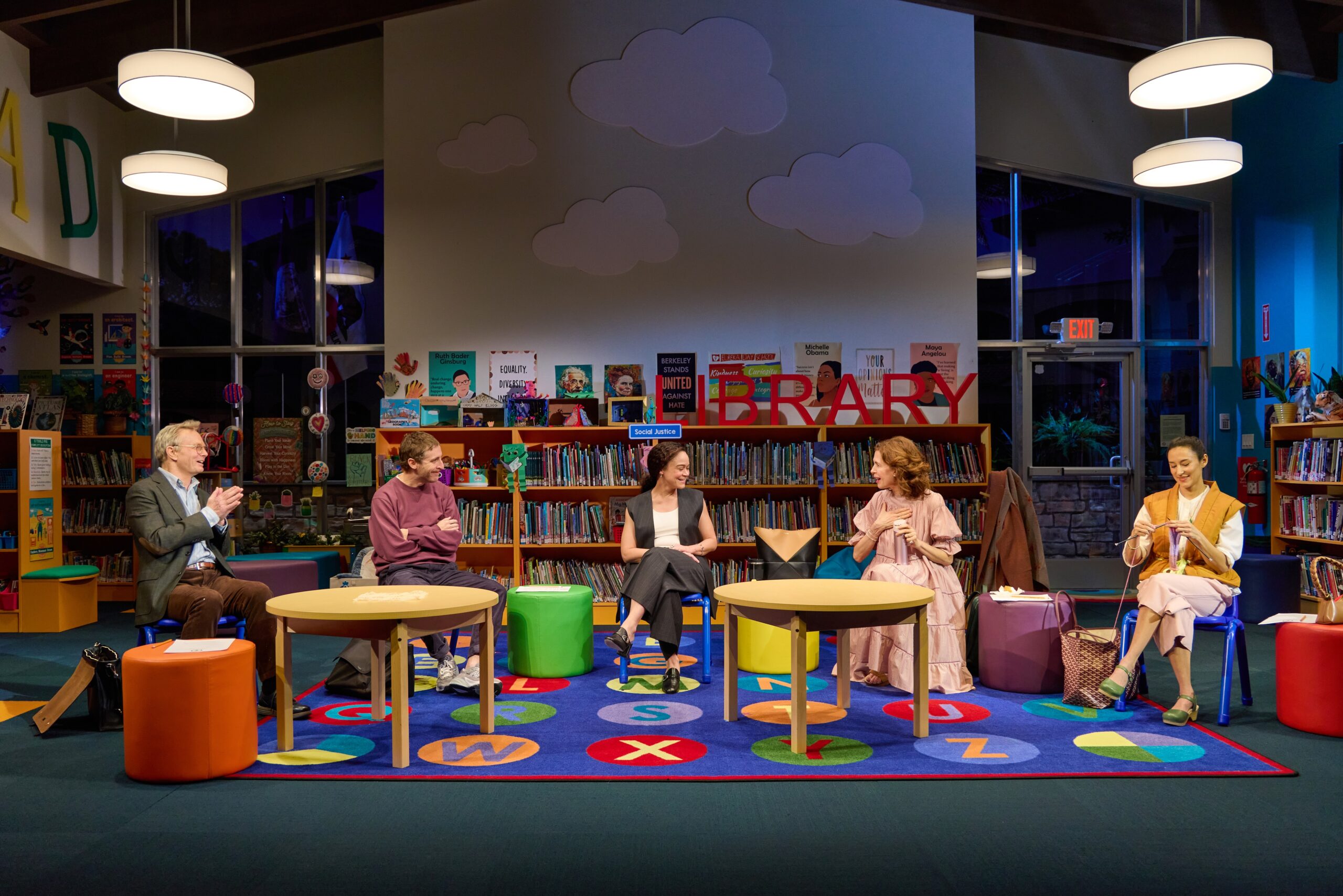
The action is set in designer Todd Rosenthal’s colorful children’s-library set, where posters scream with progressive activism. One states,”Your opinion matters.” Another poster proclaims, “Equality, diversity, inclusion.” Another poster decries hate. Shapiro’s creative vision for her design team enhances Spector’s main themes. The committee, confronting a mumps outbreak, learns tough lessons bumping up against its own superficial and oftentimes mistaken assumptions and philosophies. Powerful voices give way to more powerful ones. Making decisions by committee rarely works fairly, unless viewpoints are similar. At Eureka Day, the committee discovers that parents’ perspectives about vaccination protocols are incredibly diverse.
Principal Don has good intentions
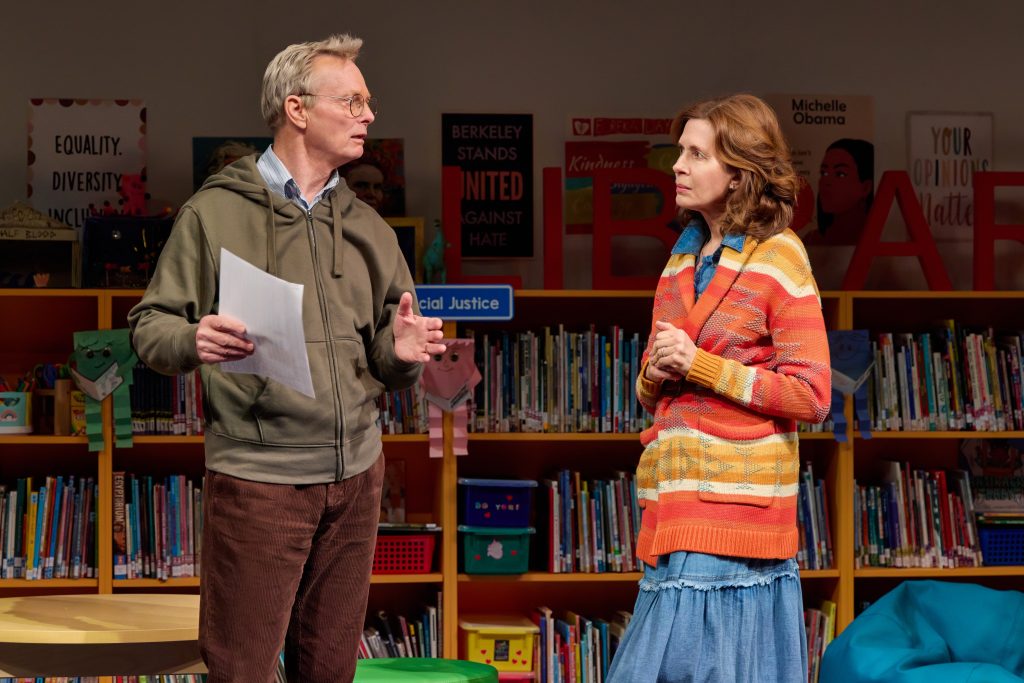
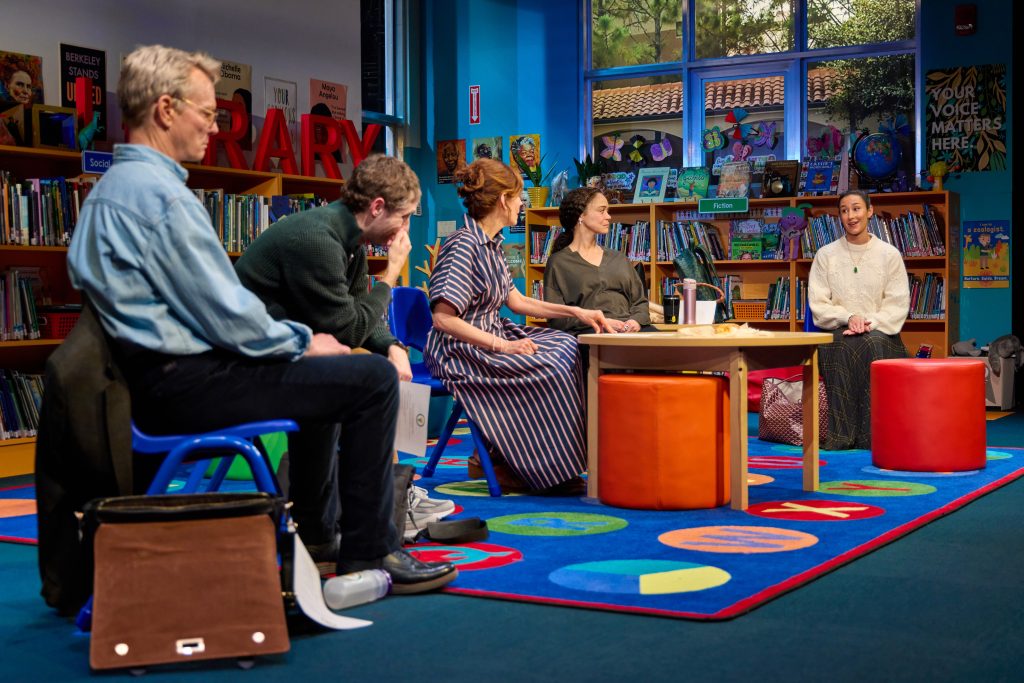
With all good intentions, hapless principal Don (the always wonderful Bill Irwin) and supportive long-time committee member, hippie-elite Suzanne (Jessica Hecht), try to confront the mumps outbreak in an open meeting. With other board members Carina (Amber Gray) and Eli (Thomas Middleditch), they prepare to decide the best ways to deal with the outbreak, which has closed the school down. The health department stipulated that children should get the MMR vaccine before they return. The sick children under quarantine can return when they are well because they have immunity.
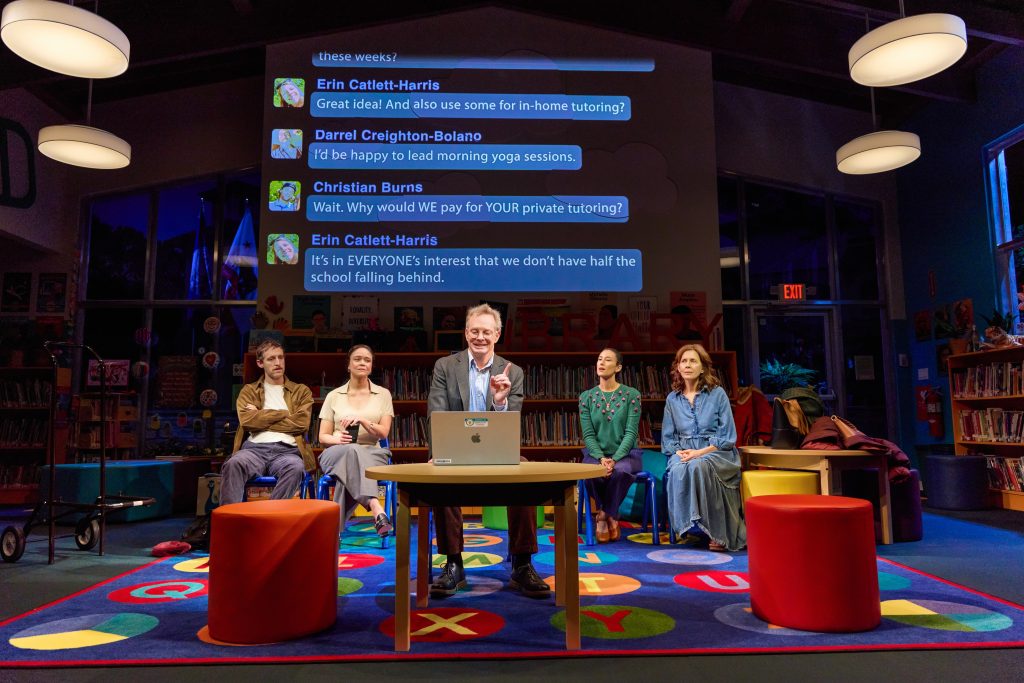
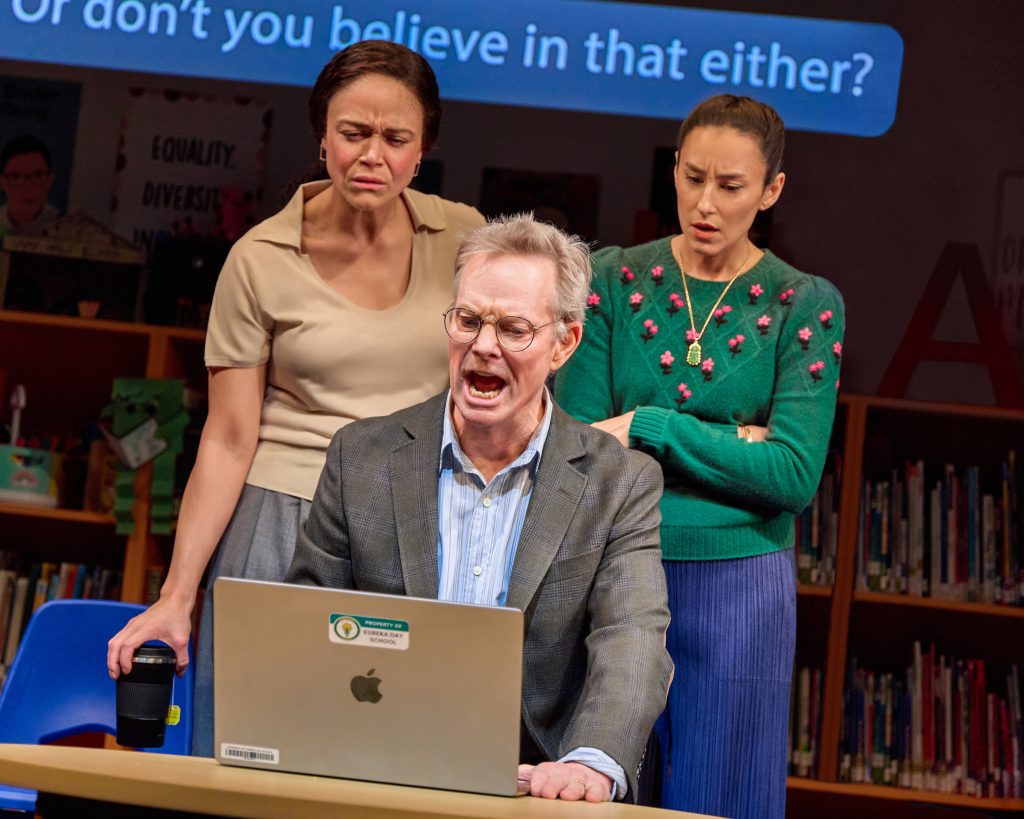
As the board members meet in the library, other parents meet online in a livestream with Don, who hosts both groups simultaneously. This first-time experience for him seems facile enough. However, surprise upon surprise happens as volcanic difficulties emerge to thwart any potential communal solution. With this otherwise liberal and inclusive community, all bets are off when it comes to the MMR vaccine and vaccines in general. In fact a kind of civil war erupts.
A ‘town hall’ meeting reaching no consensus
As parents in the library and online listen and type their opinions, the online conversations veer off topic humorously. Both groups never stay on the same subject long enough to know what other individuals think. Though Don tries to keep the focus on arriving at a workable plan, the wayward parents elude his control.
Catching up to the written comments too late to respond, he achieves the opposite of agreement. The conversations spiral into divisiveness, and online parents turn into undisciplined, tormenting, obnoxious children. The audience, in the catbird seat, gets to read the online conversations projected on a screen and see Don’s scrambled attempts to rein in the wild discussions live and online. Bill Irwin masterfully deteriorates Don into his own meltdown, shocked at the hateful rhetoric and high-pitched arguments.
Insults fly in the livestream
As the conversation morphs, everything Eureka Day stands for is forgotten and trashed. Insults fly. Personal attacks fomented by the intimate/removed yet public medium of the virtual kind blow up treacherously. Passions flare, and thoughtless, vengeful, ego-driven comments take the day.
In one mild example, a parent asks horrified, “Half the school is anti-vaxxers?” Another responds, “Anti-vaxxer is not really a term I’m uncomfortable with. It’s actually something said out of ignorance.” Because Don can’t follow all the comments and corral the committee members in the library at the same time, decency evaporates into lowdown hellishness. Meanwhile, the audience rolls in the aisles with laughter. Afraid the guns will come out, Don shuts the wildness down, slapping his laptop to close it.
Spector’s incredible, edgily written script engineered and paced by Shapiro and the cast brilliantly elucidates the profound themes. The problems raised have no easy answers. In the discussions online and later in the play, parents bring up the supposed correlation of autism with the MMR vaccine, believed by swaths of the nation to be true even though proven false. Spector magnifies the real-time debate about the MMR, big pharma and the push toward homeopathic remedies.
The question of social responsibility
The issue of social responsibility arises. If a parent chooses not to have his child vaccinated and causes injury to others, his accountability looms large. In a secondary plot, board members Meika (Chelsea Yakura-Kurtz), and Eli (Thomas Middleditch), who have an illicit affair, use their children’s playdates to get together. At a playdate, Meika’s unvaccinated Olivia gives Eli’s vaccinated Tobias mumps. Contrary to wisdom and science and with unanswered questions, Tobias ends up in the hospital with a severe case that nearly kills him.
With this example and others, the board members understand that the vaccine debacle needs resolution so the school can reopen. How should they do this when every parent has his or her own agenda that differs and each view must be respected? On top of these problems, parents circulate a petition demanding the vaccination policy be changed, which impacts funding if families pull their kids out of Eureka Day. Carina and Suzanne go head to head, creating ill will which, too, must be overcome.
How Spector resolves these issues delights and also instructs.
Eureka Day’s cast is uniformly excellent, and Shapiro primes them for maximum hilarity. Spector creates a searing and sardonic expose of well-meaning individuals who cut deeper than they appear on closer inspection. In a key point he makes, no one philosophy “works,” if only a few benefit from it, relying on science and medicine carries its own issues, and sometimes science fails us, especially if the profit motive trumps a patient’s well-being.
Eureka Day runs one hour 40 minutes at the Samuel J. Friedman Theatre on 47th Street between Broadway and 8th Avenues until February 02, 2025. You cannot afford to miss this relevant, provocative and thought-provoking comedy.