 Blogcritics The critical lens on today's culture & entertainment

Left on Tenth
How many of us get second chances in life and don’t realize it? And what if you do realize it and don’t appreciate it because you don’t believe in miraculous synchronicity? In her bestselling memoir Left on Tenth: A Second Chance at Life, Delia Ephron memorialized the second chances she receives in love and life. Ephron dramatized the memoir in a beautifully heartfelt play. Acutely directed by Susan Stroman in its Broadway premiere, Left on Tenth resonates with the symbolism of second chances. The engaging hybrid, romantic comedy stars Julianna Margulies and runs at Broadway’s James Earl Jones Theatre until February 2.
With precision, nuanced light-heartedness and profound threads of wisdom, interspersed within cleverly crafted romance, Ephron introduces Delia (herself), played by the classic, terrific Margulies, having lost her husband of three decades. She has requested Verizon to close down her husband’s landline phone and mistakenly, the company cancels her internet. As fallout from her grief, she goes to war with Verizon. Indeed, how can a bestselling author, sister of the renowned Nora Ephron (who died of cancer a few years prior), survive without the internet?
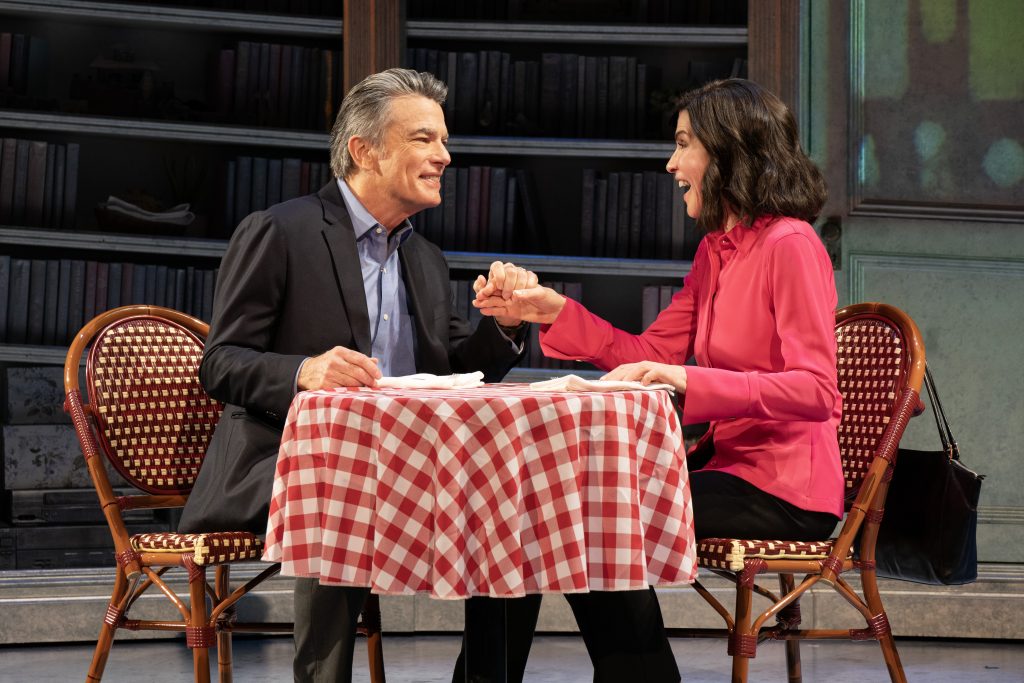
Trying to get a live person on the line to correct the situation becomes Verizon hell. Stroman paces this confusion and frustration riotously. Yes, we’ve all been put on hold, then disconnected by a company allegedly the most expert at handling communication. But perhaps only a writer can fully express the burning anxiety and catastrophic impact of this on one’s nervous system.
Turning the Corner on Her Former Life
Feeling compelled to disgorge her frustration, Delia writes a humorous piece and sends it off to the papers. On publication in The New York Times, the article brings empathetic feedback from other customers – and an immediate response from Verizon. Ephron makes the most of this with irony and humor.
As she deals with “Verizon hell,” Margulies’ Delia, through direct address, catches the audience up on her life as a writer with husband Jerry Kass, a screenwriter and playwright. Through interactions with her neighbors, friends, and doctors (Peter Francis James, Kate MacCluggage), we understand what she lost with his death. Ingeniously, James and MacCluggage portray various characters with the help of Michael Buonincontro’s wigs and Jeff Mahshie’s costumes. During these brief vignettes we understand that Delia’s shutting the landline signified acceptance of Jerry’s passing. Still, the grieving process sometimes goes on for years, unless something or someone intervenes.

We empathize with Delia’s feelings of loneliness and “the invisible widow syndrome.” The character endears us and draws us into her world. Stroman smartly operationalizes the couple’s happiness with a dance, projecting a shadow figure of Jerry dancing on the gorgeous back wall of books in their Greenwich Village apartment. We recognize the joy. The image and emotion works thanks to Beowulf Boritt’s versatile set design and Jeanette Oi-Suk Yew’s projection design. The projections include the surrounding buildings in the Village, helping to convey the divine picture of their lives together on “Tenth (Avenue).”
Verizon Hell Becomes a Blessing
Verizon’s mistake leads to a miraculous series of events. As one line closes and Jerry fades into the background, another communication line opens after Verizon restores the internet connection. Reading Delia’s humorous piece, Peter (the glorious, gorgeous, spot-on Peter Gallagher), an old friend Nora had set her up with in college, emails her. He’s a Jungian psychiatrist who sees synchronicity in events and believes in bashert (fate). In the email he says the same happened with Verizon when his wife died and he closed down her account.

Before Peter’s email, Delia had been asked to speak at a conference of Jungians which perplexes her, as she knows little about Carl Jung and Jungians. When she shares this with Peter, he tells her that as a Jungian, he “believes that the unconscious can be a source of joy and creativity.” He also “believes in confluence or, as we call it, ‘synchronicity’ – in the mysteries of life joining and flowing together as rivers do.” After a steady stream of emails back and forth, bashert takes over and with each exciting and lovely turning point, they finally meet, become intimate and take the next step.
Humorously referencing You’ve Got Mail and other screenplays Delia wrote with Nora, she claims that she feels like she’s in her own “rom-com.” Nevertheless, hovering over the whirlwind romance which Nora precipitated long ago, a grey cloud forms that relates to Nora. Though Peter knows about it, Delia fears for him. At first all is well and they are dancing with joy. Then, what Delia fears comes upon her. Perhaps that’s fated, too.
Left on Tenth: Guiding Us into Delia’s Life for a Reason
Without being weighted down with exposition, Ephron’s play engages with its theatricality. Stroman’s stylization, using minimal props to suggest the doctor’s office, a restaurant, the park, a hotel, etc., allows Delia to relate her story purposefully. Consequently, we trust her as a reliable narrator.
However, we don’t initially get the deeper themes in the extended flashback. That construction, gradually laid brick by brick to its solid completion, presents a story for the ages.
Margulies’ Delia and Gallagher’s Peter stir a flood of emotions. Theirs becomes a roller coaster adventure of joy, love, happiness, fear, great sex, more happiness, and then, terror. Through it we follow with a white-knuckled grip on the railing of their lives together. We watch their series of firsts – phone conversation, dinner date, intimacy, proposal, marriage. Then, they disappear into the darkness.
In vignettes, turning points that help us understand a “totality of being,” Delia achieves a new lease on life. How new? Indeed, this new life strikes at her very marrow, the lifeblood of existence. And by the conclusion, we understand her profound wisdom about salient themes of life, death, fate, love, and synchronicity. Metaphorically, she receives a second chance of creation. This could only happen with Peter. He is her co-equal and half of their whole in a totality that began in Verizon hell.

Magically Dramatizing Fate
This subtly symbolic production slyly nudges your psyche and emotions. Ephron proves her writing merit in this balanced, metaphoric play about important verities, spun like gold by Stroman’s direction. Gallagher and Margulies are sensational together, what would be a beautiful pairing for an Ephron film. But there is nothing like live theater with actors and a receptive audience present. When Delia’s dogs come on stage, the unmistakable “awwww” from the audience integrates perfectly. It’s a typical “Ephron moment” every time they appear in character sitting, trotting off, ignoring those folks out there “in the dark.”
Likewise, kudos to Margulies staying in sync to accommodate with aplomb the fourth wall’s rupturing. When a reference to one of Delia’s friends, a Dodgers fan, received boos, Margulies broadly smiled empathetically, and waited. This lasted about one minute until the audience’s Yankee fans had enough of themselves. And this was before the Yankees lost the World Series. The challenges to actors in live theater thrill audiences with one-of-a-kind vital experiences. You don’t get that at home, popcorn in hand, watching a film on Netflix.
Praise goes to all on the creative team who masterfully conveyed Stroman’s vision for this truly marvelous must-see production. The cast and direction are brilliant.
Left on Tenth speeds by at 100 minutes with no intermission at the James Earl Jones Theatre, 138 West 48th St. Seeing Left on Tenth is bashert in Peter’s additional definition: “Instant Recognition, of a Special Fit or Match, or COMFORT, that one has been awaiting for a long time…”