 Blogcritics The critical lens on today's culture & entertainment
Here There Are Blueberries
The many-layered, fine production of Here There Are Blueberries, first presented at New York Theatre Workshop, landed on Broadway in early November. The acting and direction are terrific. It runs at the Barrymore Theater until January 20, 2027.
Stylized as a quasi-documentary that travels back and forth in time, the play investigates the mysteries centered around an album of 116 photographs taken at Auschwitz death camp. A retired U.S. Lieutenant Colonel, who found and kept the album, contacts the U.S. Holocaust Memorial Museum to see if it can contribute to their research. The album has no pictures of the victims to be memorialized. However, after a tense build-up to a crucial meeting, museum director Sara Bloomfield (Montego Glover) determines archivists can work on the album.
Following archivists on their research journey
Based on interviews, extensive research, and photographs from another perspective, the play follows archivists on their journey of discovery. Written by Moisés Kaufman and Amanda Gronich, and directed by Moisés Kaufman, Here There Are Blueberries resonates deeply. In fact, the play reaffirms Hannah Arendt’s explanation for those who allow bad things to happen as, “the banality of evil.”
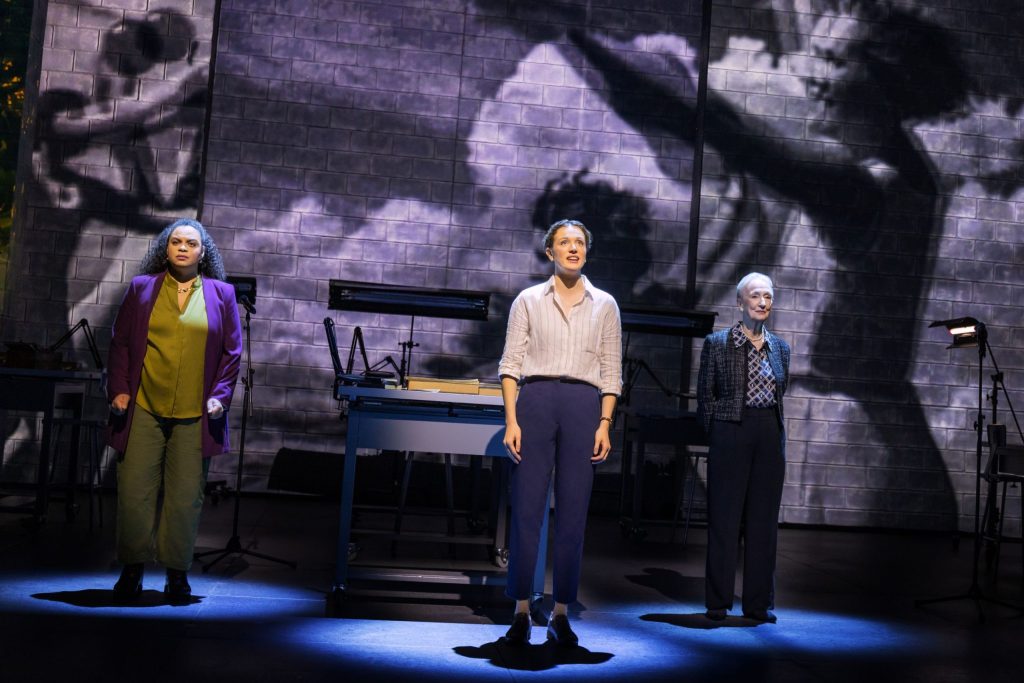
The playwrights introduce us to the archivists in the second scene. It is then Rebecca Erbelding (Delia Cunningham in an emotionally invested portrayal), reads the letter from the Lieutenant Colonel notifying the museum about the album. From that juncture on, we become engrossed. The researchers close the monumental gaps in information about the album’s purpose and provenance.
The production’s Broadway transfer
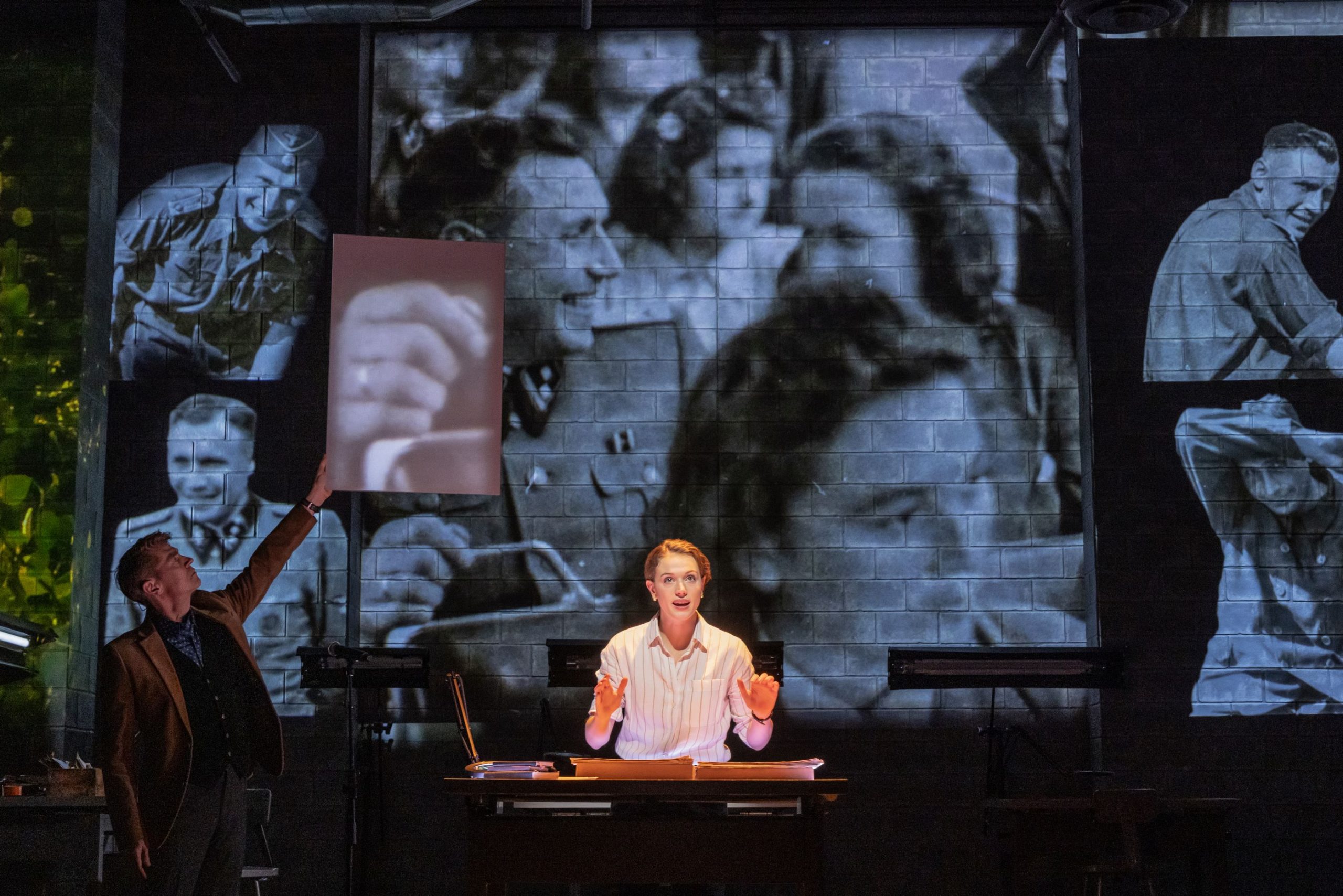
In the production’s transfer to the Barrymore, scenic designer Derek McLane makes use of the expanded space to meticulously define the large room where archivists pour over photographs. As a result of David Bengali’s expert projection design of the black and white photographs displayed at the back of the stage, the audience engages with lead archivist Rebecca Erbelding’s questions. One strange photograph concerns a Nazi officer laughing as he enjoys blueberries with various secretaries (Helferinnen, who had jobs at the camp).
Kaufman’s staging moves forward the search for the purpose and ownership of the album. Using Erbelding’s queries, he creates suspense because the archivists become detectives. Personifying the various characters/historical individuals, fine actors like Kathleen Chalfant, Michael Cerveris, and Brandon Flynn take on a variety of roles.
As they step forward from their research tables, like a Greek chorus, they bear powerful witness and speak from the ethereal realms of history. All of the creatives-Dede Ayite (costume design), David Lander (lighting design), Bobby McElver (sound design)-further the play’s themes. For example, how do nondescript bureaucrats of civil society become instrumental accomplices of an efficient, mass murdering operation?
The owner of the album
After pinpointing the owner of the album as Karl Höcker (Scott Barrow), who moved his way up to become the administrative assistant to the head of Auschwitz, the archivists explore the lifestyle of the staff of Auschwitz in the photographs. The SS guards, top brass, doctors, and secretaries have prosaic meals, relax at a nearby resort, participate in athletics, and carry on with wholesome activities. Meanwhile, monumental horrors happen nearby on the death camp’s grounds. The disconnect staggers the audience.
The global attention the album receives, creates new interest. When individuals from around the world contact the museum, they bring information. Some revelations are from grandchildren of the SS, like Tilman Taube (Conrad Ricamora). Of course, seeing hidden aspects of their relatives shocks them.
The photographs show a happy social network
None of the photos show the functions of Auschwitz, the prisoners, victims, or crematoria. All is pleasant and reflective of the wonderful world that Hitler spoke about bringing to humanity, after the “vermin” were removed. That the Helferinnen were photographed, surprised a number of researchers who wondered if the young women knew about the gas chambers. How could these young women be aware of the exterminations and stay?
After denials, one of the secretaries who worked at Auschwitz discusses this. Charlotte Schunzel (Michelle Beck) states that she and the other women recorded how many victims were sent to hard labor and how many were sent to “SB.” The initials stood for “special treatment,” a euphemism for the gas chambers. In other words, the smiling secretaries enjoying blueberries with Karl Höcker in the titular photograph, knew they participated in a genocide.
The “chorus of criminals”
The archivists pin down the identity of the SS officers and high command in the photographs. One is the notorious “Angel of Death,” Dr. Menegele. Another is the commandant who set up Auschwitz-Birkenau, Rudolph Höss. They realize he returned to oversee the extermination of Jewish Hungarians.
The researchers determine that the vanity photos reveal the pleasant Auschwitz camp life of Karl Höcker (Scott Barrow). Pictured in a large group photograph are Höss, Menegele, Tilman Taube’s grandfather, and others. Ironically, archivists describe them as a “chorus of criminals.” However, researchers don’t understand the date or significance of the photo.
An enlightening revelation
The most enlightening revelation comes from Holocaust survivor Lili Jacobs, who contacts the archivists. She possesses an album she uncannily found of 193 photographs of Hungarians standing in groups waiting. After she donates her album, the researchers solve the dates of the mystery of both albums. They figure out the purpose of the photo which shows the SS, high command, and workers relaxing at Solahütte, a resort on the camp grounds. At this resort Karl Höcker occasionally rewarded the staff when they did something special.
With the evidence of the two albums together, archivists complete the full story of murderers and victims. The victims in Jacobs’ album were those who arrived in train transports from Hungary. The album included photographs of Lili, her family, and her rabbi, right before they were separated into the lines for labor camp and gas chambers which the secretaries recorded.
Explaining the albums
Höcker assembled and photographed what archivists called the “Chorus of Criminals'” photograph for a vital reason. At Solahütte they celebrated, happy to finish a job well done. In a united victory they proudly uplift the massive operation that divided, selected, and processed Hungarians, so that 350,000 could be exterminated, among them Lili’s parents and two younger brothers.
Through their research, archivists discovered that Lili arrived one day after Höcker arrived at Auschwitz. He most probably received a career bump up to administer the massive “Hungarian Project.” Because Lili shared her album, she and the researchers understand that moment in time in a verified, indisputable record. She sees the identity of the men who murdered her family. Finding the album of herself in the tie in with Höcker’s album (he photographed both), seems beyond coincidence. For Lili, the discovery is mystical and divinely spiritual.
For us, the play charts how evil becomes normalized, even banal, once the wall of human empathy is breached.
Here There Are Blueberries runs 1 hour 30 minutes with no intermission through January 10, 2027 at the Barrymore Theater.