 Blogcritics The critical lens on today's culture & entertainment
Wanted
With Angelica Chéri as the book writer and lyricist, and Ross Baum’s music, the spectacular musical Wanted resonates with themes for today. Directed by Stevie Walker-Webb, and based on a true story set in Texas, 1893, Wanted is at the James Earl Jones Theater until March 31, 2027.
Chéri grew up with stories about her ancestors, the Clarke twins, Mary and Martha (portrayed by the brilliant Solea Pfeiffer and Liiisi LaFontaine). Entrepreneurial Black women who pass for white, the twins help their mama Tallulah (an equally brilliant Ledisi) raise rent money for the extortionate cotton plantation owner Mr. Billingsley (Nathan Quay Thomas).
White enough to pass
Arrogantly insulting the twins, he gives them the idea that they look white enough to “pass.” Thus begin their outlawing adventures as they hold up unsuspecting whites far away from their home town (“Wide Open Plains,” “The Train,” “Just Passing Through,” “Gun & Powder”). Cleverly duping their bigoted victims by using their own racism against them, they avoid getting caught.
The resulting karma delights. The twins turn the tables on a hateful, sadistic culture of white supremacists, who’ve robbed, tortured and enslaved Blacks for generations. They also elicit sympathy and laughter, especially when their mother gives them a gun (without bullets), a blessing, and an exhortation to take the white folks’ money. Certainly, it’s a vindication of sorts.
A “wanted” poster circulates, offering a reward for their capture. Underlying the conceit of “passing,” the facts whisper: If the truth of their Black blood get outs and the law apprehends them, the supremacists will likely torture and lynch them without a trial.
Their blood is a two-edged sword
Their blood blesses them with the freedom and audacity to live as whites away from their home. Despite their recklessness, they valiantly turn the corrupt system against itself. But under the wrong circumstances that same blood curses them.
Following a rumor about a wealthy saloon keeper who has gold, they meet Jesse (the excellent Bradley Jaden), who recognizes them from their “wanted” poster. Jesse falls hard for Mary and saves both women from being apprehended. He seduces Martha and Mary with a luxurious hotel room and caviar. He treats them like royalty.
But when he gives them into the care of Black servants Sissy (Aurelia Williams) and Flo (Awa Sal Secka), the servants easily spot Martha and Mary’s identity and reveal (“Dangerous”) the extent to which the passing women are rebelling against Jesse, the culture, and the systematic oppression. Williams and Sal Secka display the passion of sheltered truth, not only with their powerful voices. Their comedic authenticity is equally winning.
Playing with fire
On a deeper level, Martha understands the jeopardy hovering over them. In discussing this with Jesse’s servant Elijah (the exceptional Luke James), Martha explains prayerfully how she believes in her sister’s inner conviction to never renounce her blood legacy of truth and faith as the seed of Tallulah Clark. Consequentially, Martha refuses to accept that her sister loves Jesse enough to live an artificial life as a white woman.
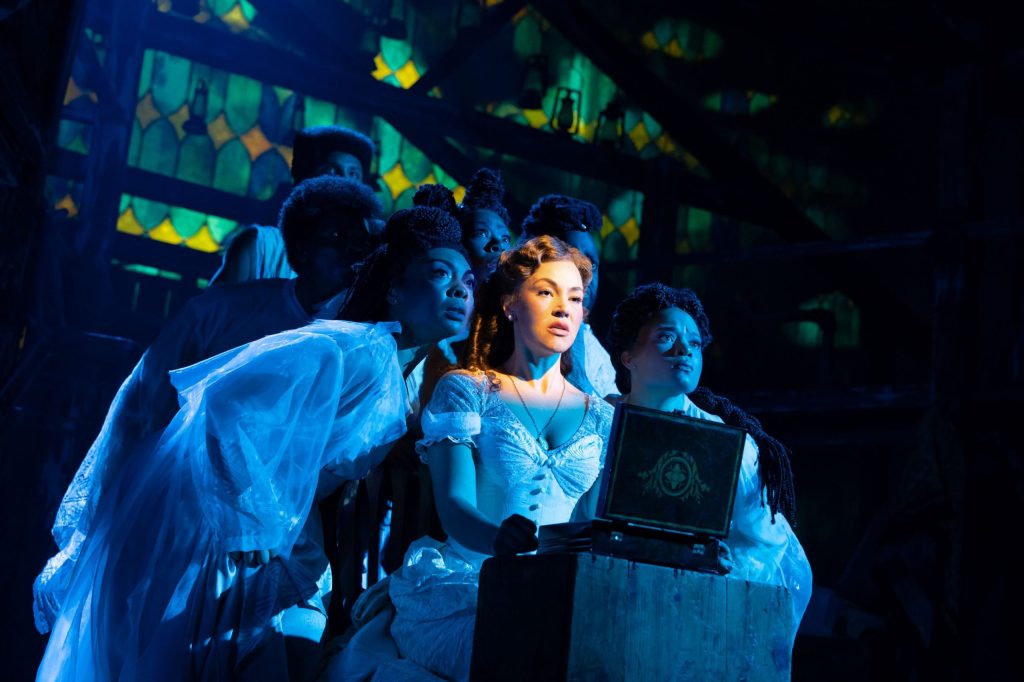
Considering her identity (“The Way I Am”), Mary powders her face and that of her mother, which haunts her in the mirror. This staging genius by Walker-Webb symbolizes her cowardly “whitewashing” of her identity, heritage and faith. Symbolically, she takes off an ancestral locket that her mother gave her – thus choosing Jesse. The themes move from racial identity to issues of feminism, and the soul’s corruption by wealth, status and power. How much of herself must Mary give up to be Jesse’s wife?
Saving Mary and their family
Martha has to focus not on romance with Elijah, as delicious as he is, but on driving her sister from a path that will destroy not only Mary, but her mother, herself and their legacy. In a powerful moment (“Trigger”), Martha effects a plan that will eventually redeem Mary and their mother, who has written to her daughters for help. To save their mother from a jail sentence and complete impoverishment and eviction from Billingsley’s place, they must return home.
Turning her back on her identity and faith, Mary convinces herself that Jesse in his love for her will accept even her Black roots. But Martha knows the secret about Jesse’s inheritance. She holds their family’s fate down the barrel of her mother’s gun.
Resolutions in Act II
Though a satisfying conclusion uplifts the legacy of this family and their faith, one remembers Mary’s recklessness, prompted by childhood abandonment by her white father. Her love for Jesse, like her mother’s love for a Frenchman, who left her with the twins, was doomed before it even began. Interracial marriage (miscegenation) was a crime that only became legal with the ruling in Loving v. Virginia (1967). It is no wonder Jesse threatens her life when he finds out her true identity.
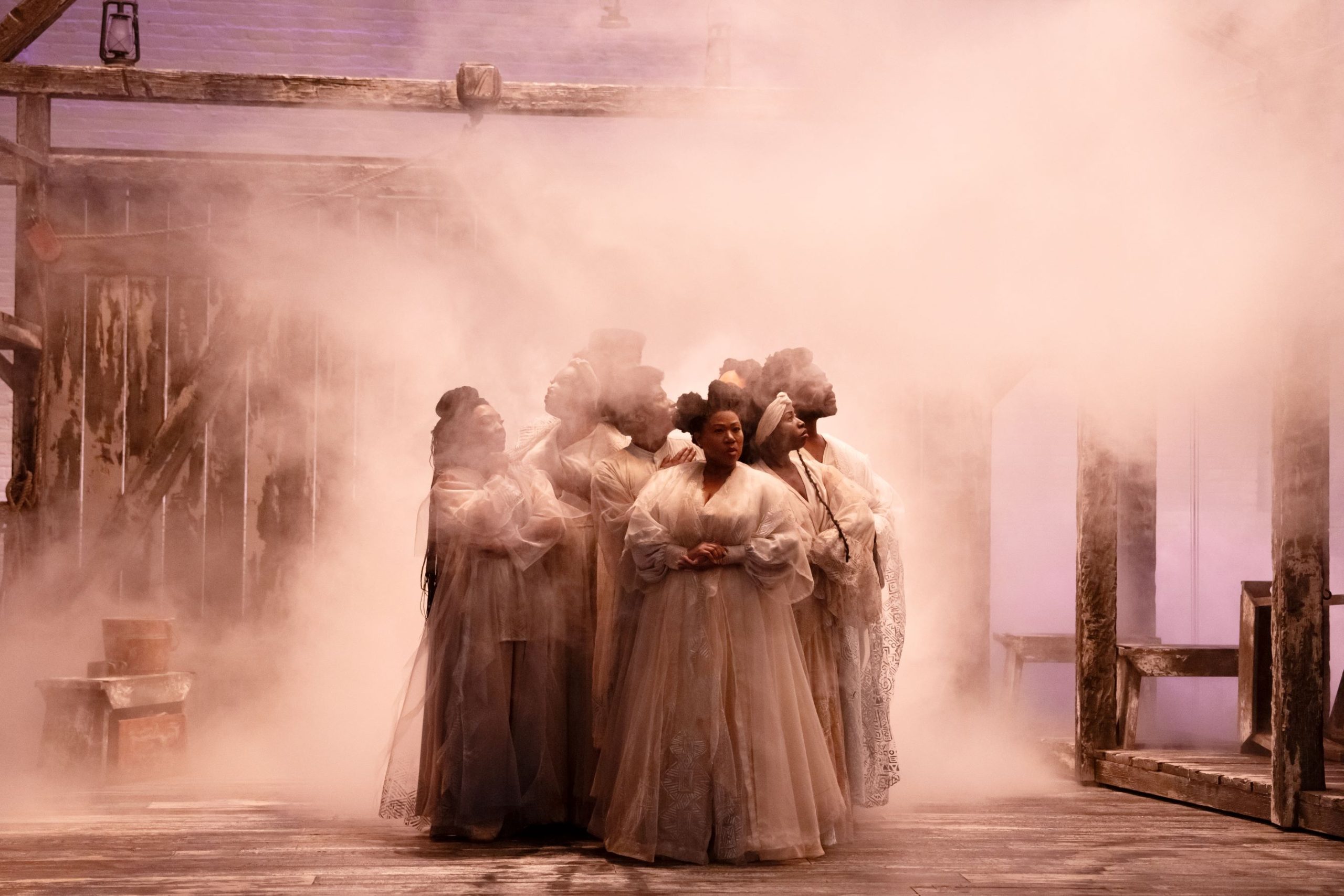
Clearly, in Wanted, Chéri creates her own spin on her aunts, whose outlawing lifted them and their mother from poverty and oppression to autonomy and self-determination. Because Chéri deals with folklore as legacy, she selects an ensemble of ancestral spirit guardians. In flashback, they set up the fanciful, adventurous, suspenseful tone of the musical in the prologue.
These “kinfolk,” dressed in filmy, angelic, outfits (Emilio Sosa’s costume design) dramatically bridge the scenes in the past with summary in song (“The Train,” “Gun and Powder,” “The Shot That Shook the Soul,” “Enough”).
The stuff of legend
The shifting atmosphere and mood of various scenes with their whimsical, farcical elements can be viewed as the stuff of legend, like an instructional story to edify and uplift. In the prologue, Chéri underscores this perspective when the kinfolk sing, “You know how family stories do, so we believe it’s mostly true.”
If one picks apart the tale, looking closely, one will note contradictions and a bit of revisionist history. However, considering that some governors in the South today have rewritten slavery’s horrific torments as gentle edification, if acknowledging lynchings at all, Chéri’s account of her aunts seems entirely just. Chéri conveys the memes around the oppressive, killing cotton plantations and a system whose remnants continued with peonage into the 1950s.
The musical is imagistic with striking and beautiful background projections (Stefania Bulbarella). Beowulf Boritt’s rustic wooden timbers in a stylized set convey time and place. The supercharged emotional singing of the terrific ensemble soars with anointed power. Using a variety of music genres including gospel, spirituals, R&B, pop, and a little bit of country, Chéri and Baum create a passionate thematic throughline. To establish one’s legacy, one must embrace one’s true identity with unflinching courage.
Wanted is at the James Earl Jones Theater through March 31, 2027.