 Blogcritics The critical lens on today's culture & entertainment
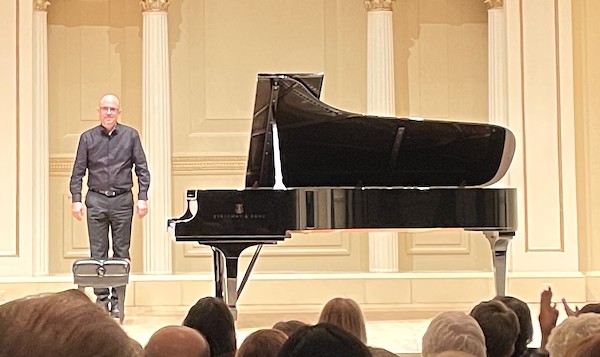
The first half of pianist Roberto Plano’s November 19 recital at Carnegie Hall’s Weill Recital Hall was a masterful example of programming craft. Schubert flowed into a Liszt transcription of Schubert, which in turn flowed into a wave of pure Liszt, which itself built in intensity, all without a pause for applause. Later Plano tucked two new-world showpieces around an enlightening set of early pieces by Federico Mompou, revealing some additional strengths – and interesting proclivities.
Time and Space
Roberto Plano is one of those pianists who bases much of his expressivity on bending time and space in search of fresh perspectives on written piano scores. The music of Franz Liszt is, on the whole, ideal for this approach to the Romantic canon. Schubert, less so. Plano’s first two selections, a late Schubert waltz (in a transcription by Richard Strauss) and an early one, were thus, for me, the concert’s weak point. The sense of a piece, the melody and rhythm, and thus the fundamental musicality, falls apart under the puffing of too much rubato. The waltzes suffered from this, despite the themes singing out nicely.
But on that note, Plano is superb at bringing out focal elements such as melody from within beds of counterpoint and multilayered harmony. This ability paid off in the remainder of the program.
I was delighted to hear a musician of Plano’s stature then play Schubert’s “Ungarische Melodie,” D. 817. This arch gem, one of my favorite short piano works by Schubert, fared beautifully under Plano’s pointed touch and exceptional sustain-pedal finesse. The resulting clarity, which had been somewhat lacking in the waltzes, shone through the remainder of the recital.
Another skill emerged in the final Schubert selection, Liszt’s arrangement of the lied “Der Doppelgänger.” Dark and haunting, at its height it filled the hall with church organ-like resonance, easily earning its rumbling climax.
Liszt
And so, having eased us into Lisztian sonorities, Plano brought out pure versions of that composer – but here too, his program progressed with great thoughtfulness. First up was the “Sancta Dorotea,” not a dazzler but a tune of childlike simplicity set amid gorgeously shifting harmonies and rolling left-hand arpeggio accompaniment.
This segued into three selections from Liszt’s Harmonies poétiques et religieuses. The first, based on a vivid, simple Renaissance-era theme, bore full Lisztian drama and even excess but also gravitas and soul. The next felt subtly devotional, a sunny, ethereal lullaby yet with a rich sound. Plano played this almost modestly, allowing the sturdy rhythms to speak for themselves, until the music softened into a hymn-like ending.
The third selection rode on lusty but controlled power, playfully varying modes (major, minor, pentatonic) in scales that descended into banged-out chords. Thus the brilliantly planned, nonstop first half ended.
A Whole New World
The second half began with a skillful transcription by Leonard Bernstein of the popular El Salón México by Aaron Copland. I say “popular” but must admit I didn’t know the piece, so I can’t measure the transcription against the orchestral original. I can say I enjoyed it, finding it bright, exciting and crisp in Plano’s often lightning-quick execution. Mexican folk themes played against and in between one another up and down the keyboard, rhythms shifting, different parts conversing and arguing, a Romantic flavor emerging at moments. Plano played with great virtuosity, and forcefully – but within the limits of the score and the room.
The Impresiones Intimas by Federico Mompou is an early work that doesn’t have the skewed, understated complexity of the composer’s later piano works; rather, these nine miniatures take their cue from the more traditionalist eddies of his 20th-century music milieu. Their moods range from gentle to stormy, swaying to rocking, solemn to explosive, velvety to folksy à la Bartók. Plano’s performance felt very natural to me, and aligned with the spirit of the music. And as I hadn’t heard these pieces before, it was nice to experience a different stage of the Catalan composer’s development.
As for George Gershwin’s Rhapsody in Blue: Pretty much every time I hear a performance of this classic, I hear something new in it. Plano productively combined his crisp articulation with the rhythmic looseness that distinguishes his overall style. Spaces opened up, distinctive conflagrations arose, and I found these welcome, at least most of the time; they resonated with the music’s jazzy spirit while making the piece colorful and expressive. Despite lots of rubato, the many micro-tempos were quick – but clarity was rarely lost.
All along, Plano’s joy in playing Gershwin’s masterwork was evident. His performance, here and throughout the concert, had bright, sometimes blazing flair making it a pleasure to watch as well as to hear.
A Final Twist
The encore, “Black Earth” by Turkish composer and pianist Fazil Say, was new to me and probably to most everyone present. It commences with dark, stuttering figures played with a hand inside the piano damping strings for a half-percussive effect. Romantic drama arrives with a dreamlike development played in “normal” style, taking on a driving force until a brief coda arrives with a return of the damped strings, at first restated in a higher octave. As fascinating as it is uniquely beautiful, the piece capped an artfully conceived and joyfully played program from an artist in his prime.
Robert Plano was presented by the Key Pianists Concert Series.