 Blogcritics The critical lens on today's culture & entertainment
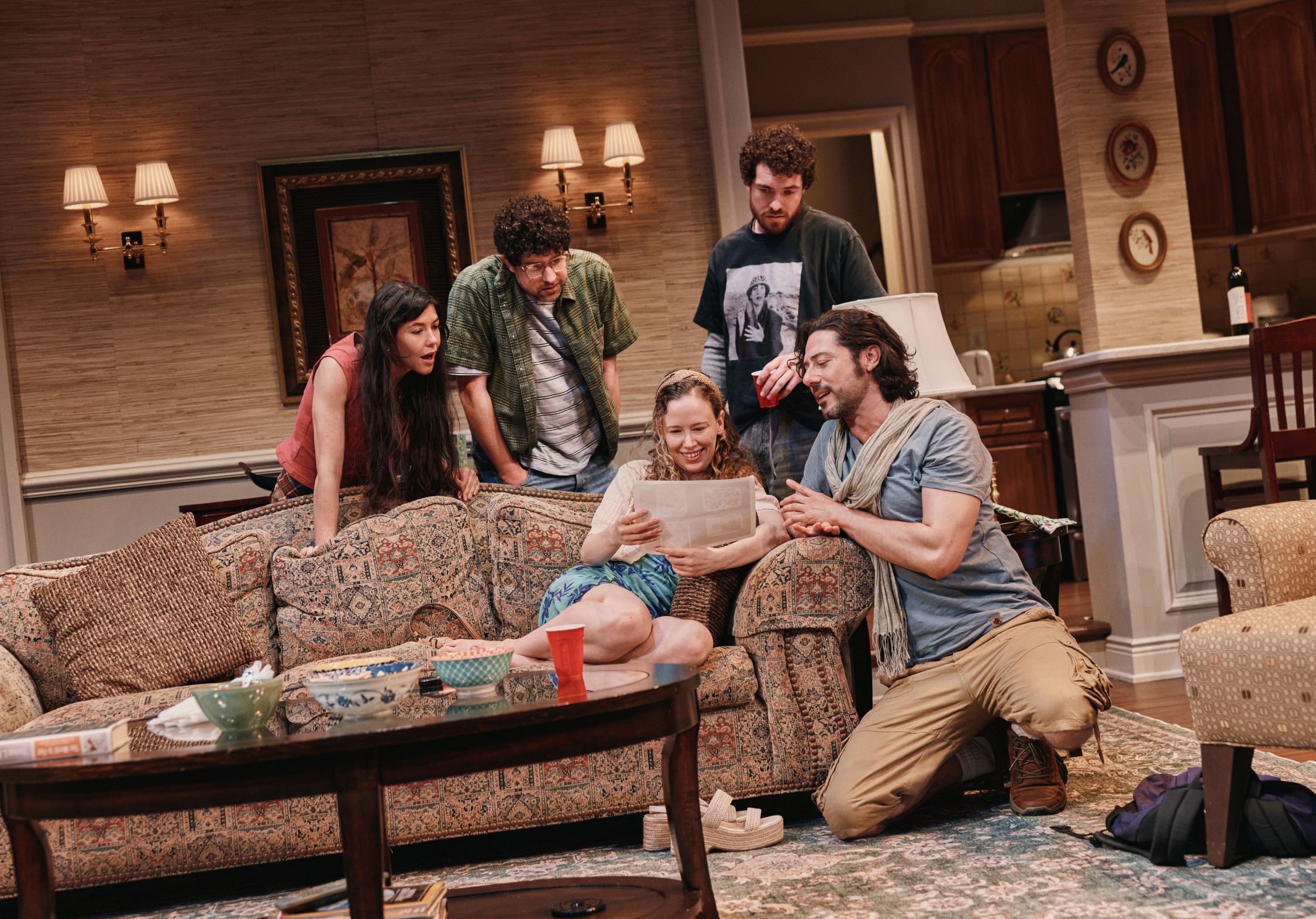
Birthright
In Birthright writer Jonathan Spector tackles Jewish identity through the viewpoints of six friends after they return from a “Birthright” trip to Israel. Examining each of the characters over an extended time, from 2006 through 2024, the play reveals their psychic and spiritual growth as they negotiate the ever-changing dynamics of Israel.
Spector brilliantly integrates the characters’ personal backgrounds, starting as 20-somethings during the presidency of George W. Bush. Then, he fast forwards 10 years to 2016, during Hillary Clinton’s momentous campaign. And the final segment settles on the salient points of their journey as they confront cultural shifts and political trends, jumping ahead to 2024 with the backdrop of President Joe Biden’s campaign.
Fascinating and profoundly human
Complex, insightful, philosophical, humorous, fascinating and profoundly human, Spector’s play strikes theatrical gold. Directed by Teddy Bergman, Birthright is in an extended run at MCC in New York City through August 23, 2026.
As he did with Eureka Day, the Tony Award-winning playwright explores controversies. His distinct characters, portrayed to near perfection by the ensemble, reveal changing perspectives. Each, raised in Judaism, expresses their own brand of personal and political liberalism. Together, they eschew the Republican Party, and in the last segment we understand that they all deplore Benjamin Netanyahu’s leadership and AIPAC’s influence over Congress. But some of the play’s humor derives from political ironies. Spector cleverly contrasts flashbacks with the present day to create sardonic humor.
A reunion party
The play opens at a reunion party that Chaya (Zoë Winters) is holding for friends who recently returned from Israel. The Birthright Israel program gives Jewish adults between 18 and 26 years old an all-expenses-paid trip to experience Israel, a trip portrayed as a “journey of a lifetime.” At Chaya’s parents’ house in a suburb of Washington, D.C. (with fine period-appropriate sets by Scott Pask), we first meet the brilliant, gay Izzy (Molly Bernard). Next, we meet politically-minded blogger Noah (Eli Gelb), then drug-fueled musician Emerson (Nate Mann). Arriving last is the philosophical, profound Lev (Hale Appleman).

Then, we discover Chaya’s ulterior motive for the gathering; to dissuade Alona (Molly Ranson) from her rash decision to immigrate to Israel (“making aliyah”), revealing what may be a personal ulterior motive.
Seeing through the purpose of the “Birthright Israel” trip
We learn the friends’ various attitudes about how authentic or inauthentic the trip may be. The friends see through the propaganda that attempts to persuade young Jewish people to leave their birth countries. With the exception of Alona, all agree to one degree or another that their camaraderie fostered a bond with each other greater than any loyalty to Israel. Lev, who left the tour, felt that it was like “seeing The Matrix.” He also realizes the significance of the hours-long lines for Palestinians to cross borders versus the 15-minute line he had easily waited on.
In the 2016 segment, during another reunion at Chaya’s, they plan their toast for Alona’s wedding celebration the next day. Then, we discover that Alona and her husband are moving to Israel. The characters have evolved as they search for a strengthened sense of purpose. Married lawyer Izzy, at polar opposites with Alona, passionately speaks out against Israel’s apartheid. Chaya and Izzy question Alona’s move in light of its moral ambiguity. As a citizen will Alona stand for justice for West Bank Palestinians, or walk obliviously over their trail of tears like Israeli settlers do?
Growth and development
Lev, who had spoken of his desire to become a rabbi, drops out of school, gets married, gets divorced, and berates himself not seeing his child. Noah quits The Washington Post and reinforces his online presence as a political influencer and eventual podcaster by 2024. Noah sustains an interest in Chaya despite Chaya’s marriage. Meanwhile her work with the Obama administration ends and she works to help Hillary Clinton get elected. Emerson, the most lost at this point, composes a few solo albums. But he stumbles into keeping kosher in spite of himself. All look forward to the hope of the first female president, though some more avidly than others.
In the last segment, the downturn becomes symbolized by the death of one of their friends, which raises the stakes of their relationships. The bonds fostered during the trip have developed into love and an emotional concern and closeness that sustain them. Likewise, on another level, Hamas’ October 7 attack, and the subsequent turmoil amidst the daily bombing of the people of Gaza, causes emotional devastation for Izzy, Chaya and Alona. To various degrees, each friend contrasts the loving, kind values of the Judaism they were raised in with Netanyahu’s bloody, never-ending punishment of Palestinian women and children.
What is the right path?
Through his characters’ arguments, Spector confronts deep moral questions. Did the initial attack justify the annihilation and ethnic cleansing of Palestinians in Gaza with U.S. weapons support? Where did this conflict begin? In foundational Zionism, as Izzy suggests – the foundation of the state of Israel as a safe haven for Jews in search of their birthright?
As it turns out, after years of wandering, in this 2024 reunion the friends are brought together once again in a new iteration. And maybe Chaya and Noah will finally hook up after all is said and done.
Birthright runs through August 23, 2026 at MCC Theater.