 Blogcritics The critical lens on today's culture & entertainment

Ulster American
With sardonic wit and dark farcical elements David Ireland’s Ulster American sends up the differences and identity politics among Irish-Americans, left-wing British, and Northern Ireland’s Unionists. David Ireland also ridicules the hypocrisy of those who adhere to political correctness only when it serves their purpose. When push comes to shove and the stakes are raised, people easily shed their posturing to reveal ugly, ingrained prejudices.
The play’s humor lands sometimes subtly, other times with uproarious riot and full-throttled mayhem. Acutely directed by Ciarán O’Reilly at a rhythmic pace, the American premiere of Ulster American runs at the Irish Repertory Theatre through May 10, 2026.
A “meeting of the minds”
The play begins with a simple “meeting of the minds” among an actor, a director and a playwright about a play which they begin rehearsing the following day. The actor, Jim Conway (Matthew Broderick, who has had a long association with the Irish Rep), is an Irish-American who has been cast for his talents and star power. The British director (Max Baker) runs his own theater company which is producing the play. Most importantly, he has chosen a female playwright from Northern Ireland (Geraldine Hughes) who has written an exceptional play.
Scenic designer Charlie Corcoran provides the comfortable environs: the director’s living room in his home in London. There the three discuss the play with openness and ease – maybe!
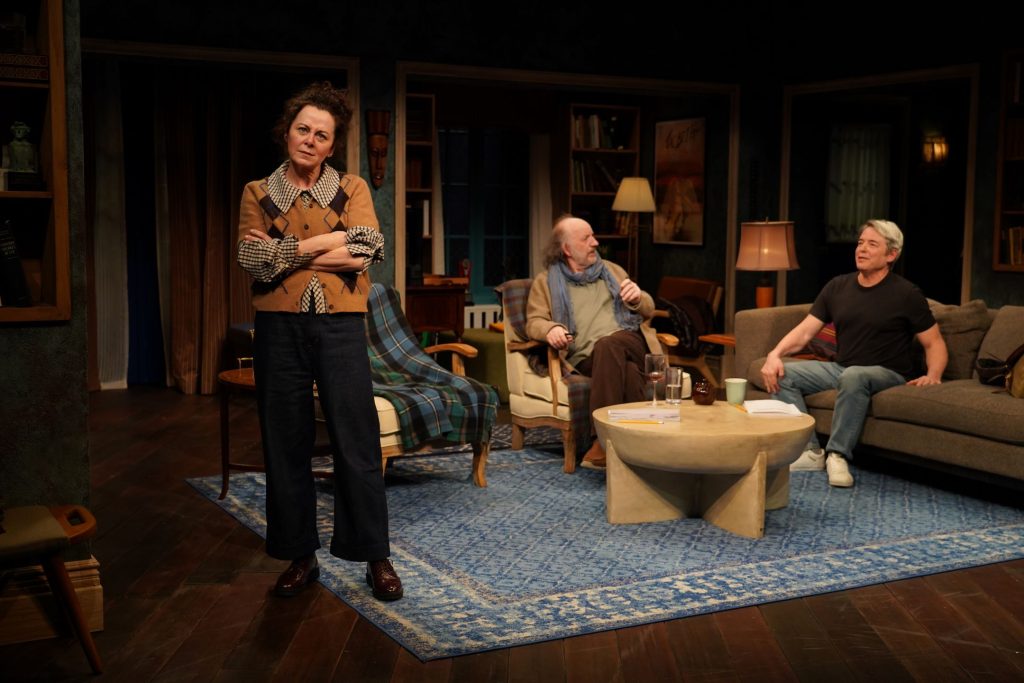
Irish Diversity, Conceptions and Misconceptions
What can go wrong among these artists who pride themselves on their craft and their humanity as creatives? The diverse ethnic combination in itself is a potential powder keg. But the beauty of David Ireland’s play and the talents of the dynamic cast manifest in the gradual reveal. Discovering who these people are and what each assumes about the others spurs the laughs. If they gain consensus and all works out, they hope they will have a smash hit that takes them to Broadway. Perhaps if all goes really well they will involve Conway’s friend, filmmaker Quentin Tarentino.
The fun is in watching the characters’ assumptions about each other and about the play go up in flames, and noting the shocking revelations as the smoke clears. How Ireland turns everything on its head after the opening scene is terrific theater. The actors deliver, hitting every bullseye the script sets up.
Disavowing the Patriarchy
Broderick’s Conway reveals the underlying pomposity of an Oscar-winning film star. He proclaims he has evolved into a better person by conquering his alcoholism with the help of his priest sponsor. Deft with the character’s initial humility, decency and humanity, Broderick pings these notes with earnestness. Conway and amenable director Leigh Carver ease into their working relationship discussing topics ranging from the use of the “N” word to the importance of “women’s voices crying out.”
They disavow the patriarchy and uplift themselves as feminists. Righteously dismissing the inherent power and status they’ve received from being males at the top of their game, they hypocritically rest on their laurels.
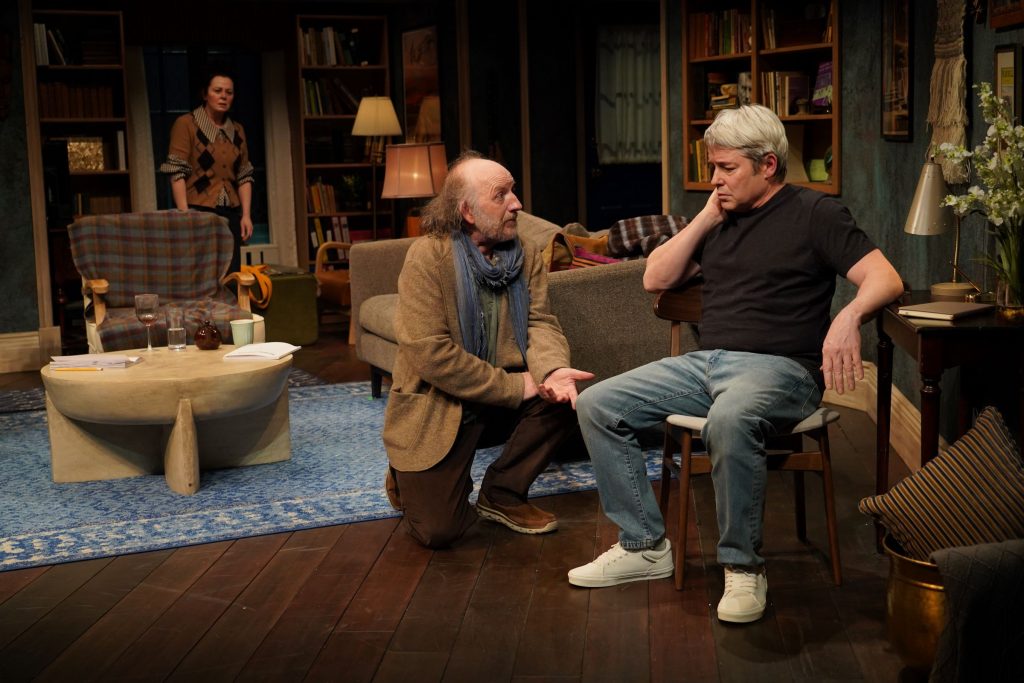
An Untoward Discussion
They talk of a scene in a film early in Conway’s career that involved his character raping a woman at the direction of a terrorist who threatens to blow up Minneapolis if he refuses. Though the studio cut the scene because women objected, Conway weirdly thinks about who he would rape to save the city.
Why does Conway bring such topics up? In ironic dialogue he ascribes it to nervousness and an attempt to establish camaraderie with his director. Then, instead of winning Carver’s trust, he asks the director an untoward question. The disgusted Carver responds with a riotous and even more untoward answer. But the discussion so upsets him that he breaks his confidence with Conway.
The Worm Turns
The male actor and playwright have agreed with each other’s self-assessments and myths. Humorously, Ruth gradually undermines their delusions. As the artists get to the “nitty gritty” of the play, all goes haywire, provoked by Ruth’s powerful female intelligence. And we see the truth behind the men’s well-meaning platitudes as they try to dominate Ruth by altering her entire play because they “know better.”
Questions about Irish vs. British identity arise and unsettle Conway who expected something else. Ruth calls him on his misunderstanding. Did he really “get” what her characters were about? Does Conway really mean it when he says it’s the best play he’s read in a decade and that it’s like Chekhov? And does Carver mean it that the play is better than Harold Pinter?
Ruth Holds Her Own
Ruth finds ways to fight back, using the men’s own admissions against them. Remembering how they patted themselves on the back for their feminism, we note that the white knights become black knights, especially when they change her play to save their egos. For her part Ruth cleverly uses shocking leverage to get what she and her play need.
The details of how these webs are woven to catch the self-duplicitous entertain and delight. The actors move from moment to moment and give nothing away, leading to an ending that tops even the belly laughs throughout this well-wrought production.
Ulster American runs at the Irish Repertory Theatre until May 10, 2026.