 Blogcritics The critical lens on today's culture & entertainment

Who Does Your Laundry?
Two women, seemingly strangers, immigrants from opposite sides of the world and different socioeconomic strata, meet in a divey laundromat in New York City. They clash, bond, clash again, and part, each a little bit changed. The situation sounds a bit contrived. But in Who Does Your Laundry? what actor-playwrights Alice Litchfield and Martina Demaio have actually contrived is a witty, concentrated one-act that says a lot in not much over 45 minutes. I caught its opening performance on the opening day of NYC Fringe 2026.
Alda (Demaio), from Argentina, has a profession that’s one of the play’s unexpected reveals and that feeds the passions she later expresses. Relaxed, totally at home in the laundromat, she’s grooving to some private beats as she loads her clothes.
Celia (Litchfield) enters frostily, unfamiliar with the milieu, having forgotten to bring detergent, and helplessly waving a credit card at the quarters-only machine. She’s a transplanted Australian lawyer living in an apartment with a washer (awaiting repair) and dryer, with pickleball on her schedule. But her actual career situation is another character-deepening reveal.
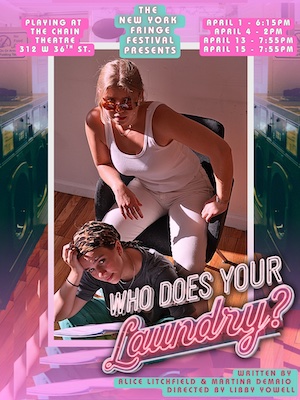
The setup shouts stereotypes: the hot-blooded Latina, the frosty white professional. Alda believes “feeling things” has the power “to make others feel.” Celia believes that “if we just walked around feeling things all day nothing would ever get done.” But the heart of the play and what makes it so successful is how Litchfield and Demaio draw out the similarities between these two people of very different backgrounds and philosophies. Linkages include 21st-century feminism and relationship disappointments, both of which, for these women, live deep and hot in their font of experiences.
Their interaction – funny, compelling, and well directed by Libby Yowell – expands into both bickering antagonism and potential friendship. Top-notch writing makes their poignant speeches feel both literary and organic. And of course none of it would work without gritty, open-hearted performances from the two talented creators.
How to Become a Saint (while wearing pants)
This mishmash of satire, song-and-dance, gender nonconformity, and related facetious religious commentary is a classic case of hitting the road without a guiding hand on the wheel. Funny in spurts, perplexing as a whole, it’s set in a heaven reserved for saints – and clowning, striking poses, even burlesque. And its seams really show. A talented and energetic cast of five tries so hard to whip up fun and high spirits that the laughs, for me, were laced with jabs of discomfort.
For some bureaucratic reason, saints who arrive in Saint Heaven must reenact their journeys to sainthood. Saint Marinos, in earthly life a real woman who lived as a monk, is painfully shy, and seems, weirdly for a supposed heaven, to be keeping their gender secret even from the angel-bureaucrats. Marinos is presented as the show’s focus but in an unexplained twist turns out not to be.
Margery Kempe, a real-life mystic who in the show says she’s married to Jesus and has 14 children but is still a virgin, is a ham’s ham. It’s a little weird that her gaudily entertaining depiction is so distorted and outrageous compared to the funny but circumspect one of Marinos.
But the story, such as it is, actually centers on Joan, newly arrived from the stake and tasked with discovering why she has become the sainted Joan of Arc (hint: see title of show).
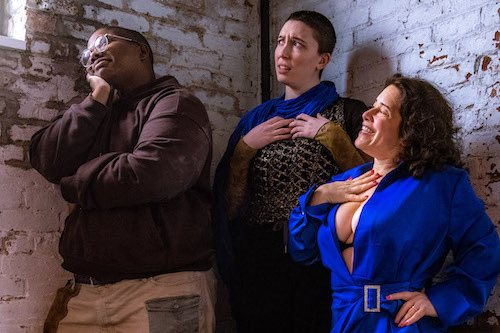
As for theme: One moral a person could draw from this show is that trans and gender-nonconforming folk can find acceptance only in an afterlife. Not only would that be depressing, it doesn’t jibe with the aggressive positivity and joyful clowning on stage. Or are we meant to contrast the mores of past ages with those of today? That’s not exactly a refreshing prospect either. Or, there being no mere mortals in this heaven, is the message that you have to be a “saint” to defy or overcome prejudice? That seems unlikely.
So – what then? I just don’t know.
There are enjoyable, well-executed sequences in the production; the choreography is especially vigorous and fun. But those passages aren’t contiguous, leaving the show in need of flow and lacking focus.
Tickets to these and all NYC Fringe shows are available at the Frigid NYC website.