 Blogcritics The critical lens on today's culture & entertainment
Turn on HBO’s newest Game of Thrones spinoff, Knight of the Seven Kingdoms, and you might be forgiven for thinking you’ve stumbled not into Westeros, but into an old-fashioned television Western.
Episode one begins with a burial.
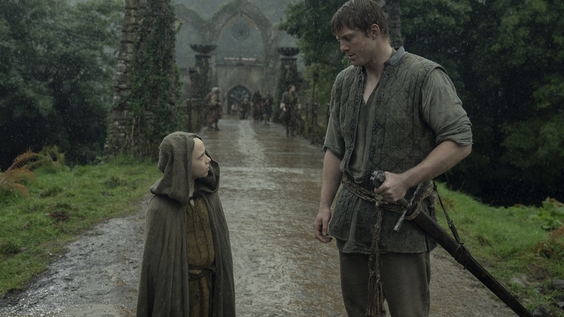
A very tall young man, the squire Dunk (Peter Claffey), lays his master, Ser Arlan of Pennytree, into the ground by the side of the road. No cathedral. No witnesses. No ceremony beyond what one man with a shovel, a sword, and a sense of obligation can manage. It’s a fitting burial for a hedge knight—a journeyman with no estates, no titles, and little to his name beyond three horses and his devoted squire.
The camera lingers on the physical labor of Dunk’s grief: dirt, sweat, silence. It’s a scene straight out of a frontier drama—the aging gunslinger laid to rest, the trusty apprentice left behind with a battered shield, a plain sword, and ideals built on embellished tales told by a wandering knight to a simple boy.
From that moment on, Knight of the Seven Kingdoms ambles to the rhythms of a Western that has, accidentally on purpose, wandered into the middle of a Renaissance faire. Spurs become greaves, revolvers become swords, and the dusty horizon is now Westeros—but the genre DNA is unmistakable.
Welcome to Westeros
Knight of the Seven Kingdoms is set roughly a century before Game of Thrones. Some names and places will sound familiar: Targaryen, Baratheon, Lannister, Dorne, Tyrell, King’s Landing. It’s an era when the Targaryen line still holds the Iron Throne, and the memory of the last dragon has not yet passed from living memory. (One dragon makes a brief, telling appearance—as spectacle rather than power—at the market fair surrounding the tournament.)
The series distinguishes itself immediately from Game of Thrones by narrowing its focus. Instead of a sprawling chessboard of noble houses, we follow two unlikely travelers wandering Westeros in search of a tournament where Dunk hopes to win glory in the jousting lists and—perhaps—become a knight in the service of a great lord.
But more than status, the young, naïve, and quietly courageous Dunk wants to carry on his master’s legacy, even if that means remaining a hedge knight. As Ser Arlan repeatedly told him, “A hedge knight is the only true knight.”
Hoping to distinguish himself, Dunk takes the name Ser Duncan the Tall (naturally). Trailing him is a precocious scamp of a boy called Egg (Dexter Sol Ansell), who insinuates himself—cleverly and persistently—into Dunk’s life and future. I have questions about this kid.
The Western comparison deepens here. Dunk is the reluctant moral center, carrying his master’s teachings like an inherited revolver—heavy, imperfect, and dangerous if mishandled. Egg is the observant kid riding shotgun, asking the kinds of questions that expose the contradictions adults have learned to live with.
There is clearly more to him than meets the eye. He claims to be an orphan—but is he? Really? Is he a runaway with ties to one of Westeros’s great Houses? Is that why he flinches at the sight of a Baratheon—or a Targaryen? Or is he simply far wiser than his years? Hmm.
Power Seen From the Ground
Where Game of Thrones trained its lens on castles and councils, Knight of the Seven Kingdoms keeps its camera at eye level. Lords and princes appear, but they are not the sun around which the story orbits. Instead, the first two episodes are concerned with how power feels when you’re standing in its shadow: how casually it humiliates, how quickly it turns cruel, how easily “honor” becomes a luxury item.
Even the tournament—ostensibly the most colorful, pageant-like setting—feels unstable rather than glorious. Armor dents. Bodies fall badly. Violence arrives not as spectacle, but as interruption, echoing the Western tradition where confrontations are sudden, messy, and final.
A Quieter, More Human Westeros
This is Westeros before it becomes a story people tell about itself—before dragons and dynasties harden into myth.
After two brisk half-hour episodes, Knight of the Seven Kingdoms feels confident in its smaller scale and unhurried pace. Beginning with a grave by the roadside is a statement: this is a story about inheritance, about what gets passed down when glory doesn’t, and about whether decency can survive in the margins of history.
If Game of Thrones was an epic about who would rule, Knight of the Seven Kingdoms is shaping up to be something quieter and, in its own way, more radical—a Western about how to live when no one is watching, and the road ahead offers no promises at all.