 Blogcritics The critical lens on today's culture & entertainment
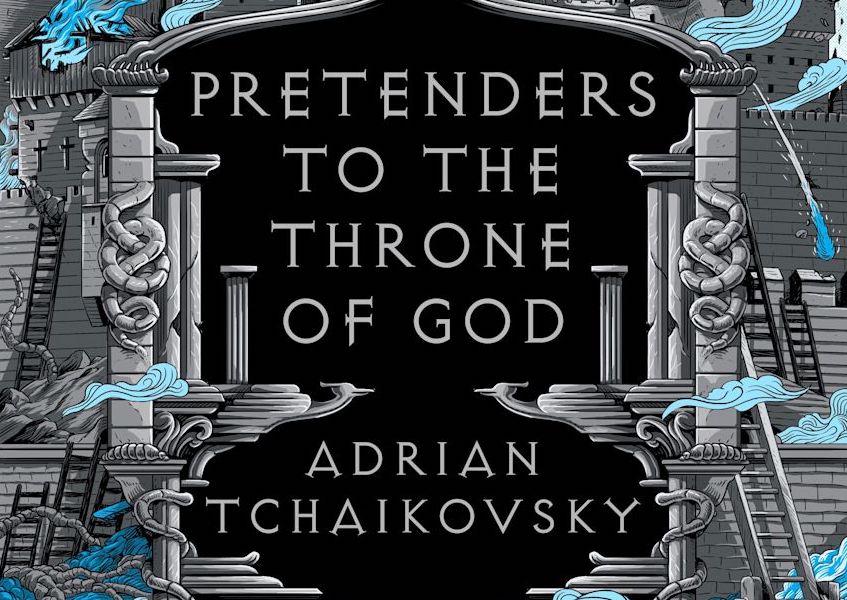
Pretenders to the Throne of God is the fourth book in Adrian Tchaikovsky‘s Tyrant Philosophers series. Tchaikovsky has established himself as one of modern speculative fiction’s preeminent world builders and this book, and series, are stellar examples of that skill.
The Palleseen Sway are on a mission to perfect the world – making everything neat and orderly. That entails stamping out pesky worship of any gods too out-of-touch to know they are now surplus, no longer required – and saving people from their messy superstitions. Then there’s magic in all its shapes and forms.
Sure, necromancy has its uses. Who doesn’t want an army of soldiers who don’t need feeding or shelter? However it still stinks of the imperfect and goes against everything the Sway stands for. Sure, the Pallessen have used magic out of necessity, to defeat difficult enemies, but as far as they are concerned that’s just another example of how much work is required to bring perfection to the world.
So the city of Eres Ffenegh, built on the back of the giant Crab god Ffen, represents all that is wrong with the world, and must be brought under the Sway for its own good. But the occupants of the city don’t know what’s good for them and want to hold onto their pesky superstitions and nasty beliefs.
Even more galling, as far the Pallessen are concerned, is the presence of two religions whose congregations are primarily former soldiers of the Sway. One is the cult of the Fisher King – the god the Palleseen Sway abandoned – and the other is the Hospitallers, a pacifist healing cult.
The hierarchy of the Sway can’t decide which cult they hate more: the one that reminds them of their own imperfect past or the one which produces soldiers who can’t fight. However, as they’re both comprised of deserters – they will gladly kill all of them.
So the Pallessen Sway has plenty of motivation to bring Eres Efenegh under its control. Unfortunately things just aren’t working out for them, what with the magic the city can bring to play in the battles, the lousy weather, and the fact that the city is kept well supplied by a variety of sea pirates who delight in putting it to the Sway.
Those who have read the previous three books (plus novella) in the Tyrant Philosophers series will recognize plenty of characters. Tchaikovsky’s ability to create memorable characters is remarkable. You may not like all of them, in fact some are quite easy to despise, but you won’t forget anyone.
There are gods of various types, magic users, priests, ex-priests, soldiers, wannabe heroes, and people who are heroes without wanting to be. That’s not even mentioning the various demons, undead, and politicians who hang out in the city or in the Pallessen army.
The picture Tchaikovsky paints with his characters, his descriptions of life in the city, and the besieging army camp, is one of contrasts. On the one hand you have a diverse and colourful population who have freedom of thought and religion. They’re argumentative and cranky and think fondly of the past.
On the other hand are the grey and efficient Pallessen who are hell-bent on creating absolute conformity. They have culling lists which details who and what needs to be removed from the army and society for the good of everyone. Differences aren’t tolerated and are ruthlessly stamped out.
Oppressive regimes always justify their actions as being for the “good” of their people. If you act like we tell you to behave you’ll be much happier. They also become very confused when people oppose them, and can’t understand why they’re not grateful for what they’re being offered.
Without being overt or actually making any statement of any kind, Tchaikovsky has created a perfect mirror of our world. We have governments in various parts of our world trying to impose a homogeneous society on their people in spite of the splendour and diversity of our world.
Read Pretenders to the Throne of God by Adrian Tchaikovsky for pleasure, but appreciate the picture he paints of the dangers of anyone preaching greatness or perfection.