 Blogcritics The critical lens on today's culture & entertainment
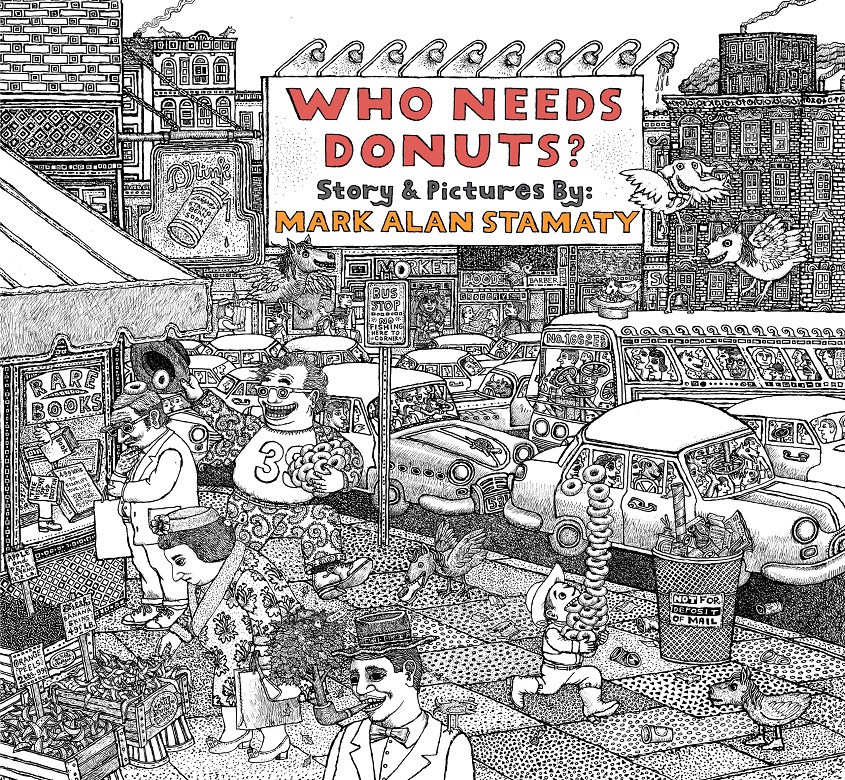
Who Needs Donuts? by Mark Alan Stamaty, published by Drawn and Quarterly, is packed with visual surprises and absurd humor. Stamaty’s work takes a wide course, from cartoons in the New Yorker and GQ to his comic strip Washington to illustrations in children’s books. Who Needs Donuts? is his foray into creating his own children’s book, although the existential jokes, subtle wisecracks, and subversive wildness best suit the kids at heart.
Who Needs Donuts? maintains its children’s book motif with a just a few words on each page to carry the plot. The story begins with Sam, who lives with his family in a nice house in the suburbs. Life in pleasant, but Sam wants more: specifically, donuts, and “not just a few but hundreds and thousands and millions—more donuts than his mother and father could ever buy him.”
Sam begins his quest on his tricycle to the big city, where he meets a host of characters like the Sad Old Woman, Pretzel Annie, and Mr. Bikferd, who shares Sam’s affinity for donuts, though not quite his appetite. Through trials and triumphs, Sam gathers donuts, chows down as many as he can, and ultimately uses them to save the day when a rampaging bull causes the coffee factory to flood.
The artwork on each page in Who Needs Donuts? elevates the whimsical story to ever greater heights of whimsy. At first glance, the pages are straightforward images of children at play in the yard, city shops Sam passes, or even busy streets jammed with traffic. Upon closer examination, however, the art reveals countless jokes and surprises. Readers will find bumper stickers reading “bumper sticker” or “misspelled” misspelled as “missssspelled” on a newsstand. Shoes could be pointed the wrong direction, TV antennas could turn into paper clips and safety pins, plants might have thought balloons reflecting on their roles in the universe, and previous narrative text becomes part of the background from another angle. One ongoing joke is giving pigeons different heads like a horse’s, an elephant’s, or that head of a fellow with a fancy pipe.
Stamay’s art is finely detailed with hatching, giving vivid texture throughout the book. Leaves, bark, and sidewalks all stand boldly with careful lines, creating patterns that seem to hypnotize. When the reader notices something different, like shoes in the trees amid the leaves, they are a wild surprise. Readers might then carefully check each square inch, looking for the next surprise.
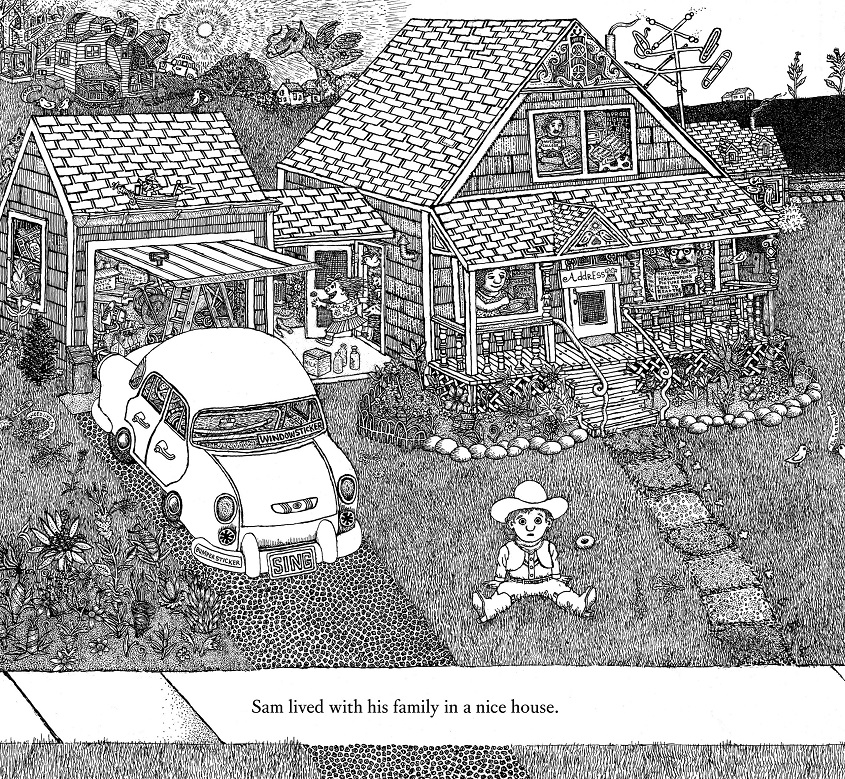
There is always something new to see in Who Needs Donuts?, which prompts readers to study each page carefully and then return for more on the next rereading. Readers might notice story arcs in the background, such as a hunt for buried treasure, as well as any number of sight gags, like a covered wagon actually being pulled by a car with the horse in the passenger seat, blending in by wearing a suit. With so much to discover, Who Needs Donuts? is a vivid read for kids and grownups alike.