 Blogcritics The critical lens on today's culture & entertainment
The little OPERA theatre of ny’s spiffy new production of the 1958 opera ‘Wuthering Heights’ by Carlisle Floyd, which ran Nov. 19–22 at the Sheen Center in New York, raised an interesting question: Why hadn’t it been seen in NYC since the New York City Opera presented it in 1959, the year after its Santa Fe Opera premiere? Did it just get lost in the shuffle of continually emerging new work? Was it overshadowed by Floyd’s subsequent operas, like Of Mice and Men and Prince of Players, or his earlier success with Susannah?
Whatever the reason, this return, though brief, spoke powerfully to the timelessness of Emily Brontë’s classic gothic tale of classism and doomed passion on the moors.
In Floyd’s telling, the story also centers on female agency in a world of paternalism. Wuthering Heights the novel is at its heart the tale of Cathy and Heathcliff’s ill-starred romance. Wuthering Heights the opera is the story of Cathy – almost all Cathy, almost all the time. Such is the soprano star turn Floyd created as composer and librettist.
Cathy’s Tale
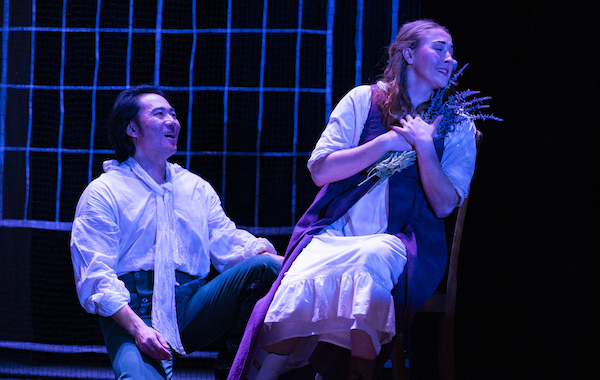
A role this substantial demands a performance of stamina, charisma, a powerfully expressive voice, and strong acting. Sara Kennedy displayed all of these in the role at the Friday night performance. (Two singers alternated performances on all the biggest roles.) Baritone Wayne Hu as Heathcliff was convincingly, gothically sullen, brooding and resentful – and often in the background. Kennedy’s Cathy by contrast was on stage for almost every scene, with arias, recitatives, a romantic duet, fraught scenes with her father and brother and later her husband Edgar, and, among the most powerful scenes, confessionals with housekeeper and mother-figure Nelly, potrayed superbly by Margaret Lattimore.
Most of the action took place in Claire Karoff’s wireframe-like set, an initially black and white sketch that changes color and character through Nick Solyom’s moody lighting as time and emotions progress inside Wuthering Heights, the Earnshaws’ timeworn Yorkshire homestead. For key scenes on the moors and crags, the actors merely stepped outside the set’s interior volume, aided by projections that splayed exterior scenery to the sides – video of birds and farm animals included.
The cast’s most powerful male voice was that of Spencer Hamlin as Hindley, Cathy’s domineering and zealous brother. Bert K. Johnson had gravitas and pathos as their father, who dies early on. Hu’s baritone was tempered and steady, effectively signaling the often repressed anger seething inside Heathcliff.
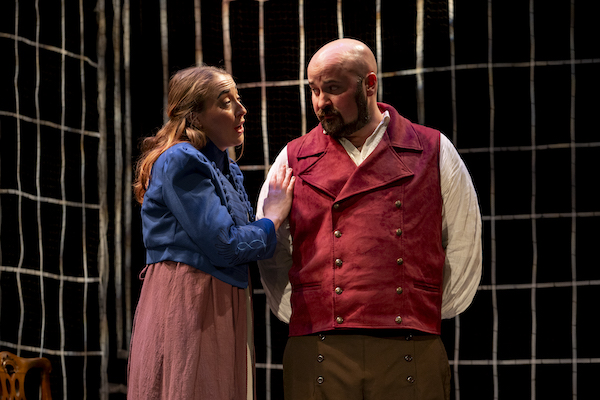
This opera’s Cathy establishes herself as a rebellious firebrand not only through her close teenage friendship with the foundling servant Heathcliff, but, in one of the many dramatic scenes, through teaming with him in resisting religious doctrine. Here’s a good place to mention, though, that coming to this opera with knowledge of the story was helpful. Lyrics sung by sopranos, particularly in their higher registers, are often hard to understand. Kennedy, with all her skill, was no exception. As usual with an English libretto, there were no supertitles. Supertitles are distracting, but I would have appreciated them here in order to understand just what some scenes were about, what thoughts and language all the emoting and wonderful singing were servicing. Without them, or a libretto in hand, one must resign oneself to gathering the gist and not the actual lines. The sooner one accepts that, the sooner one can fully enjoy the production.
Blood and Dust
Helpfully, director Philip Shneidman worked in many staging elements that revealed feelings and motivations. Examples included Cathy’s tending Heathcliff’s wounds after he has been flogged for insolence, and Nelly’s casual dusting of the furniture so as to unobtrusively eavesdrop on the lovers’ conversation. The blocking of the dances in the second act, and the (to me verbally incomprehensible) group song, illustrated the societal and economic pressure that induces Cathy to marry Edgar, as well as the sexual tension between Cathy and Heathcliff even after the latter returns from a long absence transformed into a rich gentleman. Kudos to costume designer Lara De Bruijn for colorfully delineating the distinctions between classes and between the more and less fortunate among the landed.
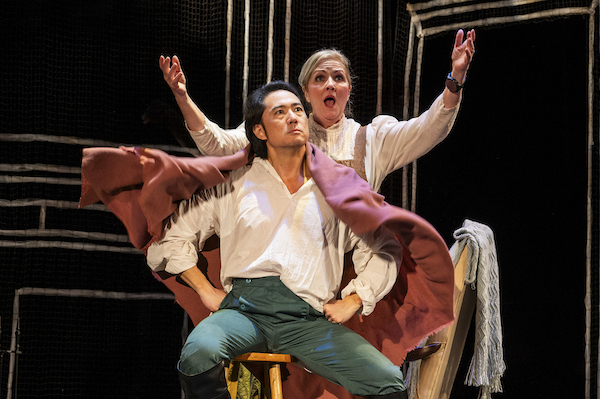
Ryan Allais as Edgar revealed great high notes that rose from a more cloaked, honeyed tenor than Hamlin’s as the peevish Hindley. Soprano Teresa Castillo sang a glowing Isabella, Edgar’s sister, who falls for the “new” Heathcliff. Brilliant in her upper range, buttery in the lower, she sang what is probably the most straightforward music in this opera of traditional tragic drama couched in melodic and harmonic modernism.
On that night, though, the production belonged foremost to Sara Kennedy, who was nothing less than spectacular.
Conductor Richard Cordova led a large (for the space) chamber orchestra that fused tightly with the action on stage and gave a solid account of Carlisle’s score, which I now feel is among his finest. Its bald dissonances and rhythmic intricacies signal its mid-20th-century era, but its vivid colors and alignment with the language make it digestible and, I would argue, appealing for audiences of any period, now and in the future.
On that note, I would love to see the little OPERA company of ny reviving this excellent production so more people can experience it.