 Blogcritics The critical lens on today's culture & entertainment
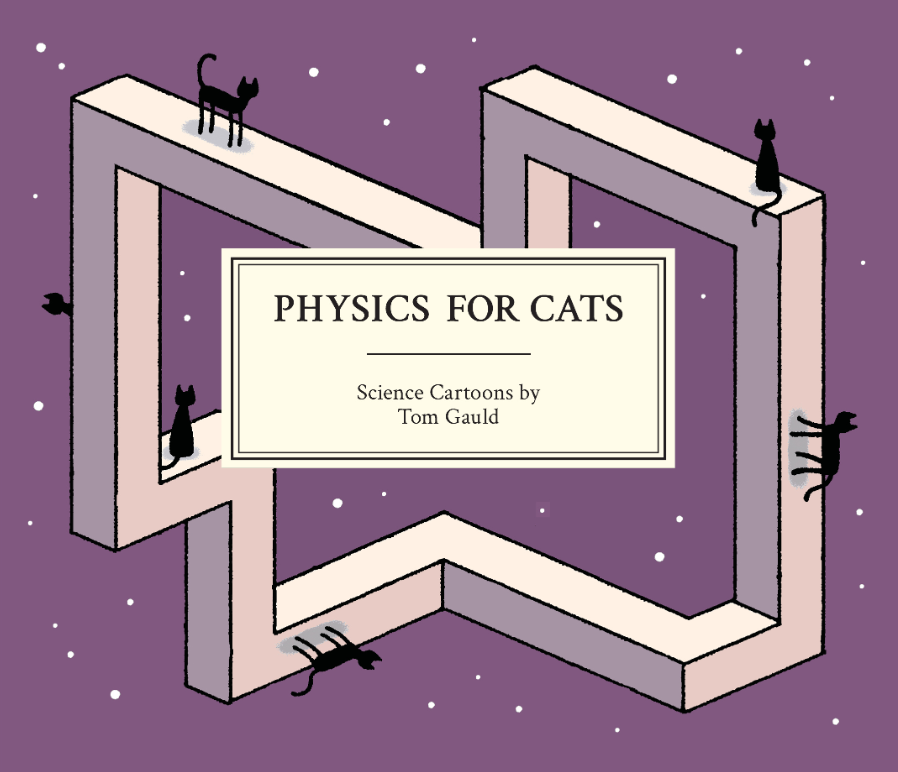
Physics for Cats
Physics for Cats by Tom Gauld, published by Drawn & Quarterly, brings together a second collection of Gauld’s science-centric comics created for New Scientist. Gauld has been producing science and science fiction comics for years, such as his Department of Mind-Blowing Theories collection and his graphic novel Moon-Cop. But Gauld’s work stretches far beyond STEM, with writing about literature and contemporary topics for the New Yorker, but he stands today among the greatest “nerd humorists” with his ongoing twists on practice, theory, and the straight-up weird.
Physics for Cats is for scientists and for the rest of the world, presenting even the most complicated theorems in a way anyone can understand. For example, most students learn the scientific method in school, but the better way to remember it is to poke fun at it with “Science Cat” dressed in a lab coat. After forming a hypothesis about pushing a mug off a table results in it smashing on the floor, Science Cat confirms the hypothesis but says further research is required.
Another cat, this one in an astronaut suit floating outside a space station, wants back in right after being let out. More animals come into the mix, with ducks in various fields studying bread, such as the Duck Statistician wanting to know how much there is, the Duck Psychologist asking why humans give them bread, and the Duck Philosopher wondering if there is more to life than bread.
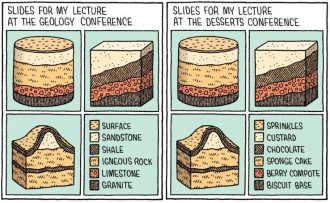
One of the main themes in Physics for Cats is how the same thing can be very different in a different situation or in a new perspective. The same dialogue, “This is for spending all your time staring into space,” means different things in two different environments, whether receiving an F in school or receiving an award at an astronomy conference. The same map can show how budget restrictions can change a Primate Feeding Study from mountain gorillas and monkeys in a tropical forest to spouses and offspring in the kitchen. Slideshows for a geology conference and a dessert conference can be uncannily similar with so many layers and striations.
Many of the comics in Physics for Cats are self-referential, creating meta jokes that work literally on another level. For the scientists who created a device to test whether their entire reality is a simulation, which it is as a comic strip, they ask, “Does it at least have a good punchline?” Regretfully, “Nope” is the answer, although that could be debated. Meanwhile, for the scientists walking into a lab that exists largely as dotted lines leading to nothing at all, it is very understandable that their project “is still very much at the conceptual phase.” Another cartoon shows people walking by a still lake that shows a mirror-image of them pondering whether they are the reflection. The dialogue carries over to the other side of the water, leaving the reader to wonder just as much as they do.
In Physics for Cats, Gauld continues his mastery of cartooning art. His characters are mostly silhouettes, not only an iconic style that makes comics recognizable as a Gauld work but also showing how so much can be done with so little. That is not to say his work takes shortcuts. Rather, it shows intricate details, for example of robots ready to receive human hearts and souls, or a crowd either wowed or horrified into silence, each character different. On every page there’s something new and unexpected, just like the pursuit of science.