Blogcritics The critical lens on today's culture & entertainment
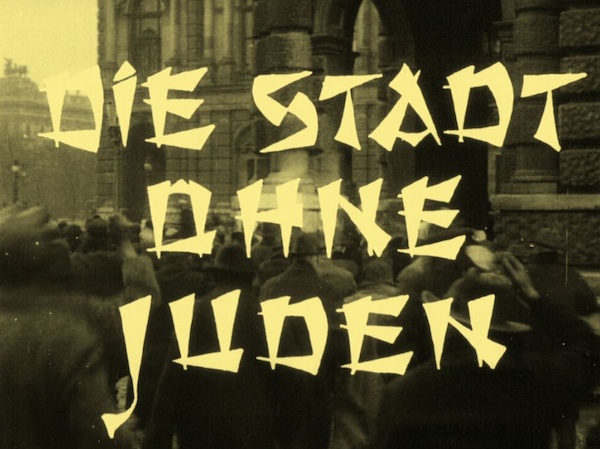
What if a European government decided that the Jews were a curse on their country and had to be gotten rid of? You may be surprised to learn that someone imagined it decades before Hitler’s Final Solution. Thanks to Parlando, Ian Niederhoffer’s forward-looking chamber orchestra, a New York audience just had the chance to experience this disturbing vision in multimedia.
Niederhoffer gives a difficulty score to each score Parlando performs, from easiest-listening to most-challenging. He rated as a four-out-of-five the 2017 score by Olga Neuwirth to the 1924 Austrian silent film Die Stadt Ohne Juden (The City Without Jews). That indicates music quite difficult to take in if you’re not accustomed to avant-garde contemporary music. And heard out of context, this music might indeed pose a challenge to some listeners.
But accompanying a showing of the full 80-minute movie, and performed live by a stripped-down and highly specialized version of Parlando, Neuwirth’s sometimes harsh experimental score fitted as smoothly as a silken prayer shawl.
The City Without Jews
Director Hans Karl Breslauer based his 1924 film on a 1922 novel by Hugo Bettauer. Using a large cast and much of the best film technology of the time, Breslauer depicted a fictional version of Austria in which public protests against economic hardship convinces the authorities to scapegoat and expel all the country’s Jews. Unsurprisingly, since the Jews are significant components of the country’s financial and economic engines, things don’t turn out as the leaders had hoped.
And while much of this satirically intended film’s interest today lies in its eerie presaging of real events of the Nazi era, Die Stadt Ohne Juden has a happy ending. Not to mention that it’s a fine piece of art, as well as of movie history.
Neuwirth’s score works very well with the film, enhancing and illustrating the action with judicious force and emotional expressivity. Watching, it was easy to forget that this was a live ensemble being conducted by a live human being, aligned not only with the film but with a pre-recorded track of electronically manipulated voices, music, sound effects, and crowd noise.
The score forms a brilliant collage. Solemn, echoey vocalizing accompanies the Jews praying in the synagogue. Energized orchestral elements illustrate the greedy glee of the financial speculators. Snatches of dance rhythms bring scenes of celebration to life; a crowd shouts “Out with the Jews!” to the strains of a march. Musical jests parallel jokey moments, and a twisted snatch of “smooth” jazz limns a scene of comic romance.
It’s all interesting and all of a piece. Indeed the music doesn’t just feel like part of the film; it actually feels right, or right enough, for the time period. Neuwirth uses electronics artfully, integrating it with acoustic wind instruments, strings, brass, and percussion. And didn’t the early 20th century give birth to “modern” music anyway? Stravinsky’s Rite of Spring was already a decade old when Breslauer made his film, and the movie coincided more or less with the rise of the Second Viennese School.
Varying Fates
Niederhoffer’s spoken introductions are always integral to Parlando concerts. We learned that Bettauer, the novelist, was murdered by a Nazi in 1925. Breslauer’s Jewish co-writer on the film, Ida Jenbach, died in the Minsk ghetto in the early years of World War Two. Breslauer himself joined the Nazi Party in 1940 and worked for the Reich as a writer, but died impoverished in 1965, according to Wikipedia.
I’m so glad Parlando made this rare effort. Their precision performance of this superb score highlighted the artistic and sociological depth of a historically important and expertly made movie from the golden age of silent film. Bravo.