 Blogcritics The critical lens on today's culture & entertainment
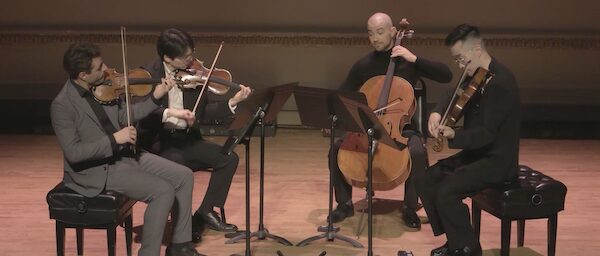
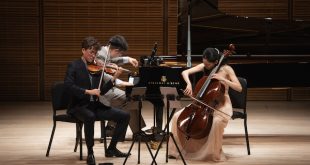
The estimable Dover Quartet was the “surprise” ensemble at the final event of the People’s Symphony Concerts’ 125th season. Whatever the “surprise” was meant to be – the Dover Quartet is no stranger to the Peoples’ Symphony schedule – word went out in plenty of time, and a large enthusiastic audience heard a program that included music by the tried-and-true Felix Mendelssohn and Franz Schubert. What was no surprise to me, given the Dover’s past performances – and especially with the addition of a string quartet by the remarkable 20th-century composer Grażyna Bacewicz (1909–1969) – was the fervor and excitement these musicians brought to music both familiar and not-so-familiar.
Grażyna Bacewicz
You always know you’re on solid ground with Schubert and Mendelssohn, but many listeners aren’t familiar with Grażyna Bacewicz. Yet she was one of the most “complete” composers of her time, writing music that could be very appealing even as it engaged in sophisticated and challenging ways with developments in 20th-century music. On hearing her Piano Quintet No. 2 (1965) a few years ago I wrote that it “married traditional form with 12-tone thinking, pure abstraction, and blood-quickening passagework.”
The String Quartet No. 4 from 1951, the centerpiece of the Dover Quartet’s concert, represents an earlier stage of the Polish composer’s mature style. It shows an absorption of late-Romantic feeling and a lively capturing of folk music along with chromatic expressionism. The musicians revealed a velvety tone at the start, through which the first movement’s romanticism and drama shone. A striking passage featured cellist Camden Shaw’s beautifully modulated sound in a high-pitched melody played over lower-pitched vibrato and pizzicato accompaniment from the other instruments. The timbral effects of this type of writing can be very interesting. Later passages alternated between tight and open harmonies that evolved one into another seamlessly in this flowing performance.
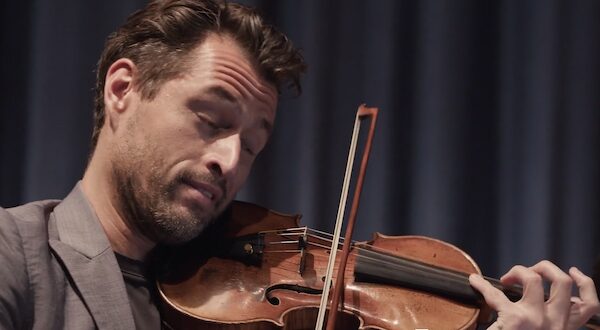
Violist Hezekiah Leung, substituting for Julianne Lee not for the first time, played especially movingly in the “Andante” second movement. The fast changes and chipper triplets of the closing movement sailed as apparently easily from the musicians’ bows as the air they breathed.
Schubert and Mendelssohn
Speaking of breathing, Schubert’s String Quartet No. 11 felt corporeal as much as artistic. Even with a substitute member, this ensemble establishes such fine synchrony that the merest pause, the slightest ritard, the subtlest accelerando emerge as if produced by a single mind. I observed this in particular in the fast passages of the “Minuetto,” which carry their own tiny stretchings of space.
As for the slow movement, the Dover Quartet took it at a slightly quicker pace than some might, without losing any of its feeling. And the “Rondo” finale felt capricious in a wonderfully folksy way.
Schubert wasn’t even 20 when he composed that quartet, and it was already his 11th. Mendelssohn’s String Quartet No. 6, by contrast, was a “late” work – from 1847, his last year of life, though he never reached the age of 40. The quartet betrays all the force of his towering talent. The excitement and passion of the first two movements burst out like the sun breaking through clouds; even the little “minuet” within had a deeply serious ring. Another example of the impressive synchrony came in the second-movement passages where the cello and viola melodicize in unison an octave apart; it might have been a single instrument.
The slow movement featured much sweetness from violinists Joel Link and Bryan Lee along with the shrouded mysteries that, to me, lurk within the music – and that also came across beautifully. And I didn’t want the technically challenging “Allegro molto” finale with its power and its mighty triplet action to end.
Visit the Dover Quartet online for its upcoming schedule, and the Peoples’ Symphony Concerts website for future events as they sail into their 126th season.