Blogcritics The critical lens on today's culture & entertainment
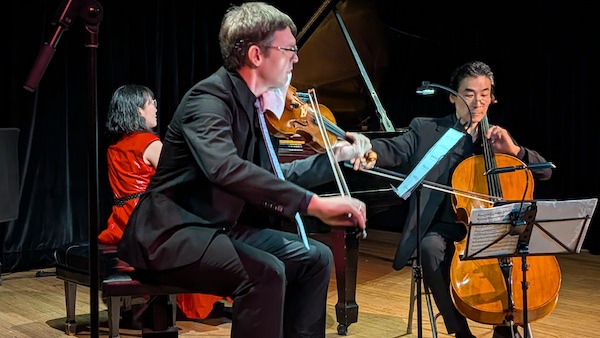
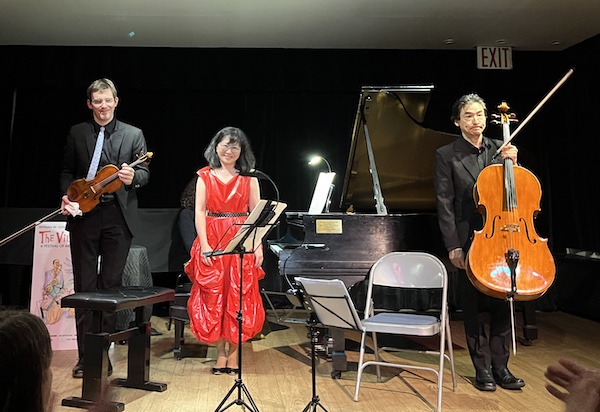
I’ve traveled the highways and alleys of contemporary and avant-garde music on and off for almost half a century. These days I still listen to a lot of it, and write about it. Yet I still have trouble with certain strains of 20th-century music. Last night’s concert by the Horszowski Trio, part of the Village Trip Festival, served up some wonderful Brahms; a bracing new work by William Kentner Anderson; and an “Homage to the New York School” that touched on some of the 20th-century music that has never worked for me. All in a day’s work here at Blogcritics!
A Piano Trio for Today
Anderson’s Piano Trio titled 25 Decades opened the concert. Introducing the program in the intimate upstairs auditorium of the Greenwich House Music School, as a rainy nor-easter spluttered outside, the composer inexplicably commented that we didn’t look like “a Brahms audience.” I couldn’t tell whether to take it as a compliment or an insult. In the event, the audience loved the Brahms. But Anderson’s piece came first and it too received an enthusiastic response, deservedly so.
Though not noted as divided into movements, the piece plays out in two main sections. The first is intensely rhythmic, with a sense of constant motion and the violin, cello, and piano equally featured. Amid the steady rhythm come unexpected accents and rests. These combine with frequent shifts in register to grip the listener. The thematic material develops intelligibly, adding to the music’s accessibility.
In the second, slower section, a steady modality kept me comfortably attentive and appreciative. Contemplative melodies arise amid continually interesting interplay among the instruments. One section feels almost folksy. Thoughts of Brahms crept into my mind as I listened; I felt a similar spirit in the two composers, a gentle hand-holding that eases the discomfort of unpredictability. Though Anderson uses a species of modernist language that Brahms would have scratched his beard at, I felt a kinship between the integrity of Anderson’s new piece and Brahms’ controlled adventurousness. In the end, the pairing of these composers proved apt.
Homage to the New York School – in a New York School
The New York School homage began with Etude No. 5 for solo piano by another contemporary composer, Augusta Read Thomas, whose work I always find interesting. Titled “Rain at Funeral: Homage to Morton Feldman,” it’s part of a larger work. It was a spacious and dramatic exercise in sustain – and sustained drama – in the sure hands of pianist Reiko Aizawa.
Then followed two short solo works by Feldman himself. Cellist Ole Akahoshi played the tiresome “Projection 1” for solo cello with conviction, but can anyone squeeze water from a stone? “For Aaron Copland” for solo violin was written much later in Feldman’s career and was much more listenable as performed by Jesse Mills, who as a onetime member of the Flux Quartet (whom coincidentally I have just been listening to) has more than enough new-music cred to make a case for the avant-garde of yesterday as well as today.
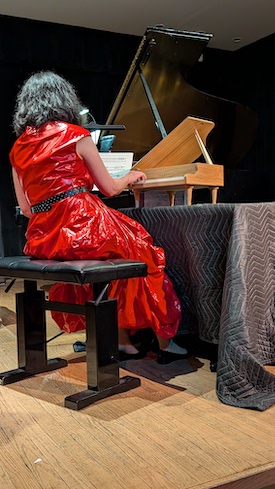
Aizawa put similar focused energy into a curiosity by John Cage, the Suite for Toy Piano. Its three movements all hold to a simple major scale, with the first pretty much all monophonic, but the playfulness and charm shade into a cagy musicality that might surprise listeners familiar only with Cage’s more out-there conceptual pieces. It was a well-chosen finish to the first half of the program.
The Horszowski Trio: a Tight Unit
All three musicians performed admirably throughout the concert, both individually and, most impressively, as a unit, first in the Anderson, and then in the Brahms Trio No. 2 in C major. The first movement of the Brahms had a dark riverine flow, richly textured and stormy. The second movement was, if anything, even better, with Brahms’ endless complexity and creative harmonizing shining through and, after a march-like middle section, a deeply touching minuet-like segment.
The Scherzo, played at maximum speed, showed off the musicians’ technical virtuosity, while its cascading triplets in the sentimental passages reveled in warmth. Finally, the trio brought electric energy to the muscular “Allegro Giocoso” finale, with all the happy tension its diminished-seventh arpeggios could contain.
This trip through a wide range of traditions was part of the Village Trip Festival, which continues through October 4, 2026 at various venues in Greenwich Village and the East Village.