 Blogcritics The critical lens on today's culture & entertainment
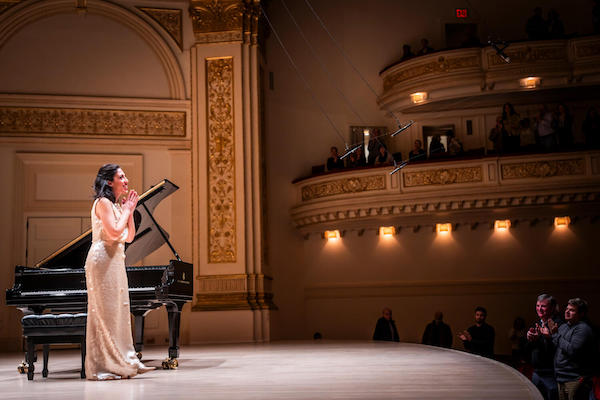
Beatrice Rana wastes no time. The Italian pianist had barely touched the piano bench when her mighty left hand stormed the Steinway on the stage at Carnegie Hall. It was “The Montagues and Capulets,” from the piano suite that Sergei Prokofiev created from his Romeo and Juliet ballet score. The force of her left hand seemed almost too much for the poor piano. But it’s the fiery dotted arpeggios that burn the piece into one’s ears. They struck like lightning under Rana’s cast-iron fingers, launching a blazing concert.
Three more selections from the suite followed. In them Rana revealed her gift for exquisitely cushioning melodies amid their accompaniment, like diamonds in the most complementary settings a jeweler can find. She enlivened “Friar Lawrence” with intertwined grace and agility. The romantic “Young Juliet” evoked pretty, windswept imagery even as it depicted the moodiness of Shakespeare’s doomed heroine. And in a “Mercutio” of great power and clarity Rana again wielded that anvil of a left hand.
Studies from a Wild Imagination
The pianist would return to Shostakovich in the program’s second half. But first, she found other gears for the six Book II Études of Claude Debussy, from 1915. I was familiar with these only through a recording; Rana’s performance revealed what makes them so special – and relatively seldom heard in concert. They are indeed “studies,” in that each exercises a specific pianistic skill. But they’re also quintessential Debussy, bridging eras and leaning into the innovations of the then-young 20th century.
Rana’s rendition of the clouds of chromatic passagework in “Pour les degrés chromatiques” sounded almost supernaturally dextrous (an effect she returned to in her second encore). For “Pour les agréments” she exercised a soft and precise touch, expressive and technically flawless – really stunningly good and rising admirably to the opulence of the piece.
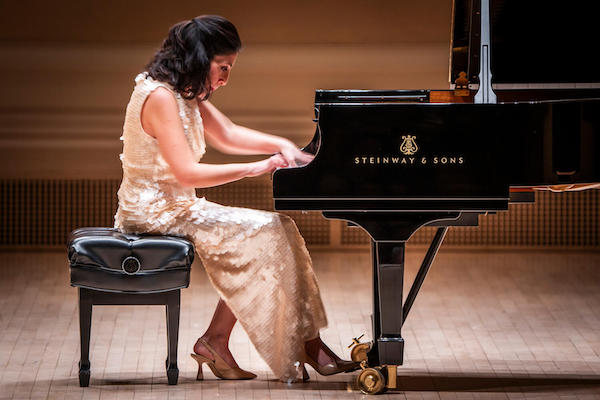
The impression there, and again in the Étude focused on repeated notes, was of a musician fully present for every stroke of Debussy’s wild imagination. Judicious use of the sustain pedal limned the ruminative sonorities in “Pour les sonorités opposées.” The colors are dark in the Étude focusing on arpeggios, but Rana delivered a vivid and shimmering performance of this Chopin-esque number, reveling in its improvisational feel. Bright energy reminiscent of rock and roll enlivened the final Étude, taking us into the intermission on a high note.
Dancing and Hammering
It was smart, if not absolutely necessary, to open the second half with music that’s more familiar. Mikhail Pletnev’s piano arrangements of music from Tchaikovsky’s The Nutcracker Suite are true to the original’s themes, but the contemporary Russian pianist expressed his own creativity in them as well. Rana in turn portrayed charm, quiet ecstasy, and, especially in Pletnev’s Rachmaninoff-like version of the “Intermezzo,” more of that beautiful melodic distinction that is perhaps supreme among her many virtues.
The first movement of the Piano Sonata No. 6 by Shostakovich arrived like a tsunami carrying away with it all niceties and indeed all expectations. Rana thundered through the piece’s agitation and angst, pounding out the dissonances while keeping the threat of actual chaos at bay. The relatively playful “Allegretto” provides some relief.
Rana brought great richness of tone to the jazzy slow-waltz movement, making much of the impassioned passages and the unexpected changes, harmonies and modal shifts. Intimations of chaos return in the frenetic “Vivace” finale, tempered by lyrical interludes. Rough music like this benefits from the fine sense of flow that a great pianist like Rana can muster.
She showed the flip side of this talent in her first encore, the lyrical and sweet Étude Op. 2 No. 1 by Scriabin. From the composer’s early, Romantic period, it’s harder than it sounds. I was sure a second and more virtuosic showpiece had to follow, and sure enough, Rana brought out another Debussy Étude, “Pour les huit doigts,” once again demonstrating the pianistic prowess that she wields in service of the wide-ranging expressivity that signals a true and complete virtuoso.