 Blogcritics The critical lens on today's culture & entertainment
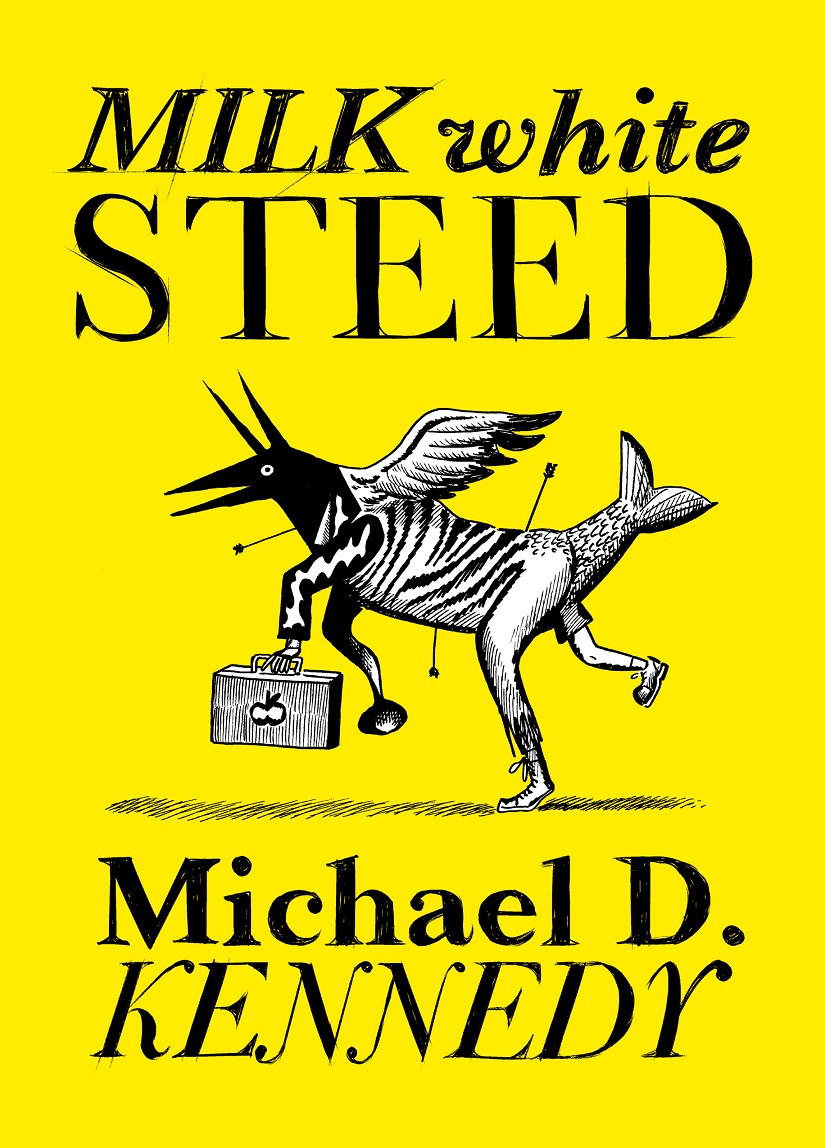
Milk White Steed
Milk White Steed by Michael D. Kennedy (Drawn and Quarterly) presents 10 stories, wide-ranging in theme and voice as well as genre, all tied together by the experience of isolation even when surrounded by people. Kennedy brings much of his own perspective to the stories, experiences of growing up in the West Midlands with both Irish and Caribbean heritage. Many of the characters also have mixed heritage or are a minority in the predominately white culture of the heavily industrialized city, or the white-dominated music industry of interwar Louisiana, or even Mars.

Each story in Milk White Steed comes with a few lines to establish the setting, such as 1960s Birmingham, 2010s Tamworth, or Year Unknown in Outer Space. These are instrumental as anchors upon which the rocking ships of Kennedy’s stories pull.
Some stories are more tangible than others, such as “Green Men,” telling the tale of a man from the Caribbean coming to England to try to find buyers for apple harvests back home. He struggles in a land not at all like what was described to him by his English teacher as “sweet airs.” Instead, it is hot and wet in the summer and cold and wet in the winter, and he finds hurdles in every path trying to set up contracts. His trademark green suit only causes confusion with the Green Man from English mythology, but the cultural misunderstandings pale in comparison to the bitter racial strife.
Other stories in Milk White Steed are far more abstract. “Giddy Up Duppy” follows a child’s imagination, as a shape-shifting lagahoo that can travel through water faucets takes up pursuit of Cowboy, who ultimately wrangles the beast into a wolf-like steed to become a legend himself. “Duke Ellington on Mars” is a nearly wordless exploration of Ellington wandering a bitter, ruddy red landscape filled with regret.
Still more stories in Milk White Steed dance across the line between abstract and literal. “Yellow Bird Blues” begins with the devil swallowing up a blues player in a yellow suit, singing the song of a woman struggling to sell her music sings as her life continues to unwind. “Red Snapper in the Rea” goes furthest of all with a boy fascinated by sci-fi comics growing to be a struggling writer, even appearing as a comic-within-a-comic created by his son, before his visions of metamorphic sea creatures become more and more real, leading him to the River Rea.
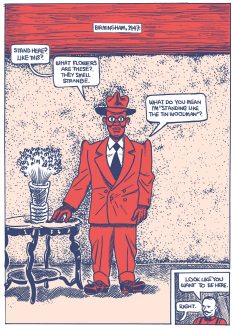
Fluidity, as with the river being both a barrier to life as well as a hidden world, is a significant theme throughout Kennedy’s Milk White Steed. Reality grows and shifts and folds in on itself, allowing just about anything to happen. Kennedy’s art translates the impossible well, with bold inking and wide colors affixed to iconic shapes.
All around these is careful hatching that gives texture and depth to complex worlds. The characters’ expressions are packed with emotion, from screaming horror to exuberance to quiet moroseness. Reading the pages is like taking a deep gulp from a drink, swallowing before you even know what it is and tasting it long afterward.