 Blogcritics The critical lens on today's culture & entertainment
From I Play Rocky:
“This movie, it’s about having a belief in yourself. It’s about going the distance. I put my heart and soul on the page. If I’m not willing to live up to what I wrote, then what’s the point? So, do you believe in me… or not?”
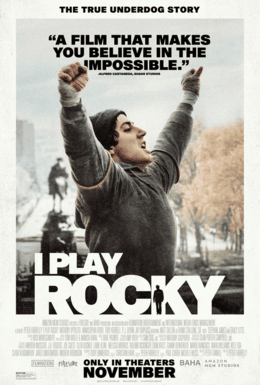
I Play Rocky recreates the making of the 1976 film Rocky, which became a powerful element of the zeitgeist in U.S. culture and gave its originator, screenwriter and lead star Sylvester “Sly” Stallone, considerable control as an actor/filmmaker in the Hollywood system.
Rocky started a new, powerful movie genre, a.k.a. the “Rocky Formula” or “underdog sports drama,” showing audiences the amazing lengths we reach for to achieve our dreams.
Amazon MGM Studios’ retelling of the making of Rocky, originally released by MGM Studios, showcases endless personal stories from Stallone’s life.
Belief, Authenticity, and the Power of the Underdog
After an incredible shared experience at a local bar, Stallone literally puts Rocky on paper and hands it off to his family and filmmakers who expand the scope with their related stories.
Each of these special experiences could easily spin off into its own movie (e.g. Stallone’s training and transformation into a real boxer) or even a series (e.g. the origins of the Steadicam), so when they’re all compounded together, I Play Rocky easily holds our attention and successfully presents a uniquely satisfying and authentic cinematic experience.
This focus makes I Play Rocky an instant crowd-pleaser without trying, because the stalwart Rocky already provided the moment. This element addresses viewers’ interest directly and explains why films like Apollo 13 and Titanic were so successful: Audiences want to experience the formation, origin, and journey of these zeitgeist events.
The filmmakers, cast, and crew should be very proud of this stellar meta film with its laser focus on the story and the circumstances behind this quintessential comeback story. They ensure other biographical details do not detract from this specific focus.
Directed by two-time Oscar winner Peter Farrelly and written by Peter Gamble, I Play Rocky portrays the straightforward scenarios that Stallone encountered with the authentic base of the classical communication method of ethos (credibility), logos (reasoning), and pathos (emotion).
The depicted filmmaking decisions expand this effective base by often depicting Stallone and his film team questioning themselves. Ultimately, they don’t know in the moment and just have to “take [their] shot.” Everyone can relate to that.
Farrelly’s casting director, Rick Montgomery, assembles an incredible cast who help the filmmakers mirror the real story on many fronts. The screenwriter (Sample) has only one feature film to his credit. They cast a relatively unknown lead actor (Anthony Ippolito (The Offer)).
Ippolito Goes the Distance as Stallone
Ippolito shines in this star-making role, effortlessly showing Stallone’s physical prowess (one-armed pushups in the re-created training sequence) and authentic emotions (“I don’t know what I’m doing”). Ippolito demonstrates the tremendous resolve Stallone had, which ultimately trumped the endless challenges he encountered when filming Rocky on his terms.
As Stallone, Ippolito endures a constant lack of support with memorable lines like “You wrote it, you figure it out” amid union challenges, exhausting physical training shots, the fight choreography, and the “one-take” shooting schedule. Even at the finish line, he still had to contend with a minuscule premiere release in New York. “They’re still trying to strangle us,” he says.
Thankfully, Stallone had Sasha in his corner, played by AnnaSophia Robb (Bridge to Terabithia, Soul Surfer, Rebel Ridge). She provides endless support as well as essential accountability checks like “If you don’t believe in yourself, how are you going to get anyone else to believe in you?” Sasha’s reading of his finished script is a strong sequence and an important step in the story’s progression along with a touchstone private moment with him at one of the premiere showings of Rocky.
Stallone’s ironclad passion and quiet strength aren’t enough at times but thankfully he gets these incredible boosts from others along the way.
The independent producing team of Irwin Winkler and Robert Chartoff, depicted by P.J. Byrne and Toby Kebbell, get some great one-liners (e.g., “On the next film, everyone gets a polygraph”) and provide great moments of the central negotiation that Stallone established as well as the financial risks and creative decisions they made. In a trailer, this pair screens Bill Conti’s memorable musical theme as one comments on the “parade-like” feel of it and hesitates to use it for Rocky.
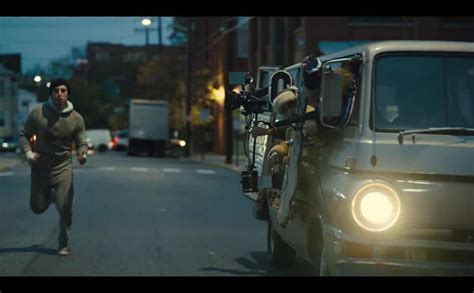
The high-quality side stories logically combine into a solid composite. For example, the filmmakers’ decision to use the innovative Steadicam deserves a film of its own.
“Something is missing. I’m not buying it,” Avildsen says to Stallone during a key sequence with Burgess Meredith (depicted by Robert Morgan) who famously portrayed Rocky’s trainer Mickey. He eventually gets to the place and delivers that “thing” that Avildsen is looking for.
Stephan James portrays charismatic Carl Weathers, who co-starred with Stallone as Apollo Creed, and shines in the re-enactment of his initial tryout for the role. I wanted to see more of James as well as Sly’s boxing coach Pete, portrayed by Erik Palladino, and Kiki Seto who portrayed Talia Shire (who played Rocky’s love interest Adrian Pennino). This trio were still impressive in these mainly functional supporting roles.
Matt Dillon portrays Sly’s father Frank. Sly is patient and, thankfully, resists making excuses for Frank’s constant putdowns about his acting career. The antagonistic studio executive Sandy Maddox (Tracy Letts) provided even more challenges to Sly in the fight to make Rocky a reality.
Rob Demery portrays Joe Frazier in a short but very effective sequence while Scot Teller has a blink-and-you’ll-miss-him appearance as Burt Young, playing Adrian’s brother Paulie.
Sly’s doctor (John K. Kramer in his feature-film debut) makes the most of his limited role. “I see you’re still acting,” he quips as he contends with Sly’s latest injuries, which, unfortunately, are a necessary element of filming Rocky. Veteran actor and frequent Farrelly brother film actor Steve Sweeney also makes a memorable impression as Rick, a bartender.
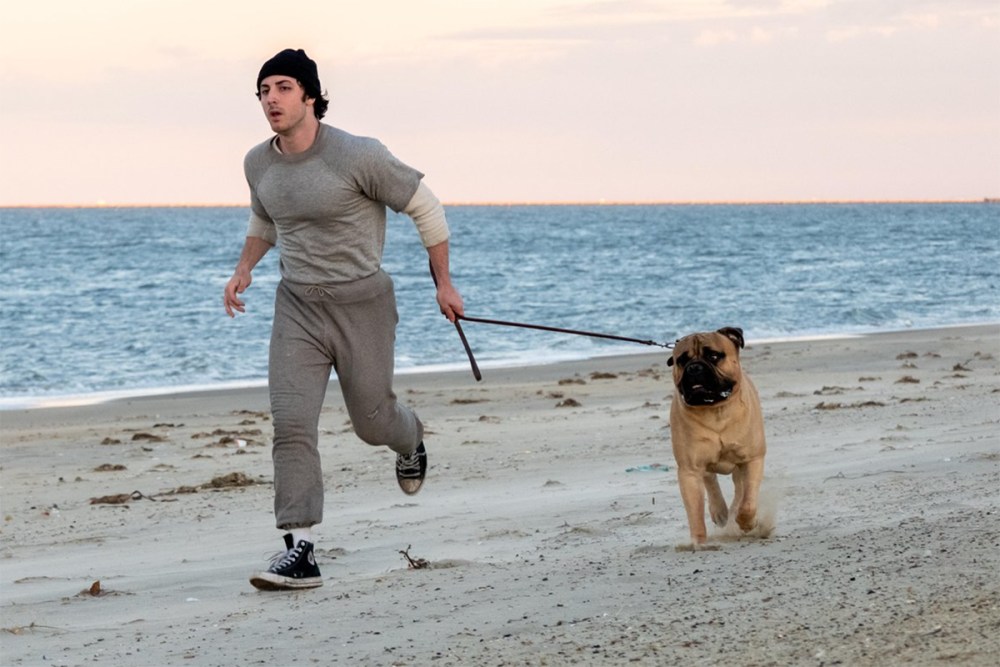
Stallone’s real life bull mastiff named Butkus appeared in Rocky and Rocky II and definitely adds appeal as a key part of Stallone’s life in this wonderful film.
The entire film team also get high marks for the film’s closure. For example, the movie shows that Stallone received multi-faceted abuse from his father but it doesn’t manifest its true effect until later. If audiences are observant and patient, they’ll fully understand these elements by the film’s end. I also enjoyed the sly and subtle sequence of Sly and Sasha’s former boss noticing them (his former employees) as they walk into the Rocky premiere at his theater.
Highly recommended (three-and-a-half out of four stars) and rated PG-13 for strong language, brief sexual material, and smoking. I wanted more after seeing this memorable 128-minute narrative – and the filmmakers delivered more, with additional recreated Rocky sequences during the end credits as well as a special real-life award sequence.
See I Play Rocky in theaters in limited release starting November 6 then in wide release on November 20 – exactly 40 years after the premiere of Rocky at Paramount Theatre in New York City. Produced by Toby Emmerich, Christian Baha, Peter Farrelly, Michele Weiss, and Paul Currie.