 Blogcritics The critical lens on today's culture & entertainment
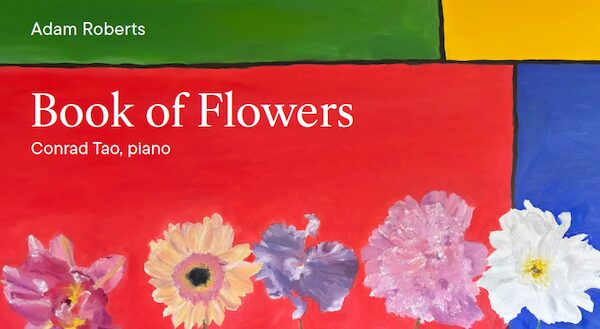
Pianist Conrad Tao is growing a big profile in contemporary music. I first heard him a year ago in concert with the Junction Trio, which switched effortlessly from Shostakovich’s “distress, verging even on the macabre,” to John Zorn’s string-breaking furor and “thunderclaps of noise,” to the lyricism and finesse of the Brahms Piano Trio No. 1. Tao proves equally adept as a soloist performing the 15 character pieces for piano that comprise Book of Flowers by Adam Roberts.
The tradition of collections like this goes back centuries – from Bach, Schumann, and Chopin to Debussy, Scriabin, Crumb, and many others. Roberts’ title also calls to mind Ivan Tcherepnin’s Flores Musicales with which it shares a certain gamesmanship with the force of gravity. But while Roberts’ suite may hark back to notable predecessors, it projects his own illustrative sensibility.
Depart, Rise, Repeat
The first set of five pieces begins with the contemplative “Points of Departure,” which builds from a single hard-struck middle D. “Hard Fall” offers a stark picture of jumpy triplets and dotted-rhythms building to a fiery rising-up along the keyboard before a final fall back to the bass.
“Chaconne” builds variations on a set of five chords: deconstructing them into fidgety arpeggios, dancing over the whole range of the piano, introducing icy dissonances and grace notes, pulling back to a gossamer skein, building up again with rolling figures, and relaxing once more before a couple of high-register tone-clusters tie a knot on it. Despite its variations format, this piece, the album’s second longest, has a compelling narrative flow.
“Uprising” is an insistent collage of modes and gestures without resolution. The first set ends with the jaggedly gyrating “Outcry,” whose punchy chords do seem to cry out for some kind of understanding. Comprehension can be found, I think, in the modality that gives the piece both consistency and a kind of tremulous structure.
Rest and Restore, Dance and Romance
The second set, like the first, opens with a contemplative, spacious piece titled “Shavasana.” Rumbling bass chords start to tell a story, as in, for example, a Chopin Prelude, but then fade into the ether, where tinkling high notes take over. Like most of the pieces, the glassy, playful “Isosceles” achieves effective contrast, in this case alternating rumbling bass notes and pointillistic figures in the upper register. The two registers collapse into one at the end, which flows into “Rolling Waves,” perhaps the album’s closest flirtation with the Romantic. Here, rather than merging registers, the composer divides the work into three parallel “stanzas” with the two hands reprising their parts progressively further apart on the keyboard.
The dry spikiness of “Mad Dance” follows as an abrupt counterpoint, with scampering rhythms and figures, metrical mixings, and a central section with a fanciful swing beat. It’s one of the most fun listens on an album full of ear-twirlers. Tao’s crisp playing stands out here, as it does throughout the album, finding as much nuance in jumpiness as he does in sentiment. The set ends with the quiet yearning of “Stained Glass,” recalling “Shavasana” with its easy, cloaked dissonances.
The Tide Goes Out
The last set commences with the gruff “Brutality,” which delivers just that, both sonically and emotionally, with broken arpeggios, tinkling bells, and pounding percussion-like bass chords. Initial high spirits seem to bloom into a vague threat. The rolled “bells” of the intriguing “11 Bells for John” ripple out, generating high, stuttering gestures at the very top of the keyboard and single low bass notes.
With stated inspirations from Chopin and Beethoven, Roberts returns to the sea by turning the piano into what he describes as “a gong-like soundbox” in “Underground Waves.” Explosiveness returns with “Block Screams.”
Roberts returns to a watery setting for “Tide Ripple,” which evokes not a peaceful tide coming in but a furious shoreline. Like the other pieces, especially the longer ones, it seems to contain a complete story, or at least chapter.
“Tide Ripple” stirs right into the last and longest piece, the masterful “Final Declamation.” Full of contrasts and with plenty of room for thought, rather than summing up what came before it builds a more ambitious edifice out of the same characteristics and influences.
Book of Flowers is replete with pianistic virtues, thanks to an immersive set of compositions and a symbiotic connection between score and pianist. The album is out now on New Focus Recordings and available at Bandcamp.