 Blogcritics The critical lens on today's culture & entertainment
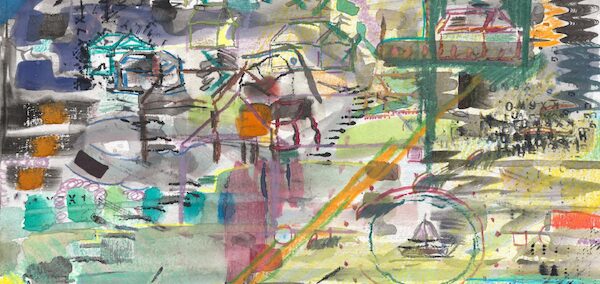
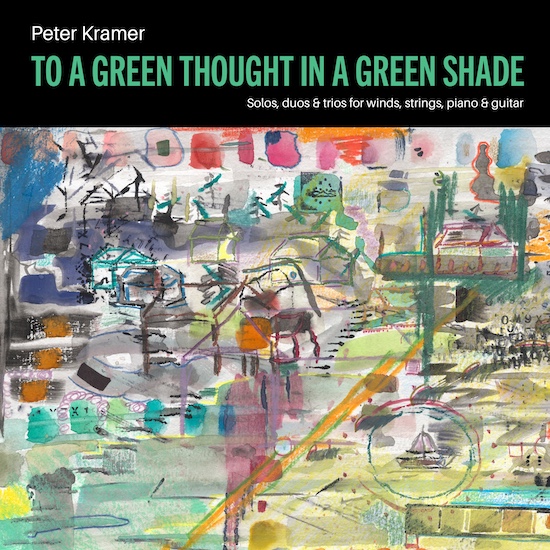
To a Green Thought in a Green Shade, a portrait album of music by composer-keyboardist Peter Kramer, starts and ends with its liveliest music. Otherwise it’s a slow burn.
Bookending the set, Zachary Good plays two versions of a folksy piping-tune called “Heights.” The one on alto recorder is the more expressive interpretation, lasting three minutes. The clarinet rendition is faster, breathy, and a mere two minutes long. The music is full of leaps and jagged arpeggios, but in a classical mode and a friendly style.
The warm “Copse of Trees” for bassoon and piano (Kramer plays all the album’s piano parts) plunges us into a different, more chromatic sensibility. Dissonances punctuate classical harmonies as the instruments seem to circle around resolutions that remain latent. Bassoonist Benjamin Roidl-Wardand wanders through some extended techniques during a slow and peaceful coda.
The trio Longleash (Popham, violinist Pala Garcia, and pianist Renate Rohlfing) performs what is by far the longest piece, “Pietà” for piano, violin and cello. It commences with a stichomythic wash of squiggles and stabs. Modal structure and harmonic movement assert themselves in fits and starts. An episode of harsh bowing intrudes in the fifth minute, clearing the way for an interregnum leavened with empty space. Just when we feel settled in, the angst of the first section returns, denser than before. It’s as if the violin can’t stop swatting at mosquitos while the cello sings a sad, halting, unmoored kind of song.
A little past the halfway point of the 17-minute opus, we begin to hear some real harmonic movement. But that episode is quashed quickly too, this time by high, pounded piano chords, and we arrive at a second spacious interlude.
More classical harmonies try to intervene, but nothing can tame the skittering, scratching violin, and resolutions remain elusive until the final three minutes. The music at last settles more comfortably into its mode, despite some dissonances. A throaty progression of piano chords finally scratches the itch and brings peace to this troubled and gripping opus.
“Still Life,” a pleasant but innocuous piece for solo guitar, merges American and Spanish folk elements. Daniel Lippel performs it gracefully but it leaves little impression. Cellist John Popham joins Kramer for the wee “In Miniature,” a meditation in an unchallenging modernist style, and again for the much deeper, two-part Limbo Tunes.
Each piece in the collection has an associated fragment of poetry. The dark rumbles, pregnant pauses, and whole-note intervals of the first “Limbo” piece, “Eclogue,” jibe with the grim lines of verse that go with them: “With scarlet corded horn / With frail wrecked knees and stumbling pace / The scapegoat came…” Then the cello sings a somber song, then a brighter one in the more traditionally modal – but still whole-tone heavy – “Background Landscape,” whose striking coda forms a strong finish to the main body of the album. The sparkly clarinet version of “Heights” then serves as a kind of encore.
It’s nice to see serious composers creating piano pieces for children. The three by Kramer here will give young students hints of modernism (“Raining”); two kinds of sweetness, folksy and American Songbook (“Fairy Tale”); and a taste of perpetual motion (the rather haunting “New Places”). That last one would have been a welcome replacement for the namby-pamby “Spinning Song” that kids of my generation all had to play in our early piano studies.
To a Green Thought in a Green Shade from Peter Kramer is out now on New Focus Recordings and available at Bandcamp.