 Blogcritics The critical lens on today's culture & entertainment
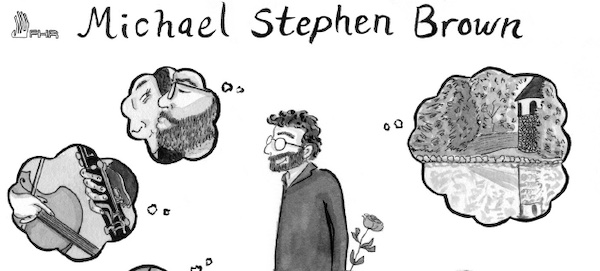
Michael Stephen Brown: Twelve Blocks
Pianist and composer Michael Stephen Brown has released his first album of all his own music. Together with some eminent collaborators, Brown showcases on Twelve Blocks his facility with lending broad appeal to modern idioms – and with playful children’s music too. The set opens with Four Lakes for Children, a quartet of piano pieces meant for young hands.
Each of the four was inspired by one of the lakes named in honor of the four deceased children of Yaddo founders Spencer and Katrina Trask. (Brown spent part of the summer of 2024 at the famous artists’ retreat in upstate New York.) Something of this sad background touches all of the album’s brief, often somber works, despite the playfulness that at times finds its way into the “adult” pieces.
The third children’s piece, “Lake Christina,” at first breaks the mood with evocations of bird calls and other sounds from nature. But the relief is only temporary; a melancholy procession of grimly dancing chords fills the center of the piece.
I believe that as a young piano student I would have found these four pieces quite emotionally affecting, if in some sections rather technically challenging.
Music for Grown-ups
The three movements of Pas de Trois each highlight one of the three members of the SPA trio: pianist Anne-Marie McDermott, violist Paul Neubauer, and soprano Susanna Phillips. “Piano” and “Soprano” are airy settings of poems by D.H. Lawrence and Rita Dove. “Soprano” especially shines, reveling in the composer’s comfortable modal art and delicate sense of tension and relief.

Brown himself wrote the quirky lyrics of “The Violist,” an aggressively amusing feature for Neubauer. Unfortunately Phillips performs the piece’s spoken-word vocalizing with a syrupy preciousness that turns me right off. That’s in vivid contrast with the lovely, buttery tone and vibrato with which she sings the rest of the triptych – and the Schumann-inspired song cycle Love’s Lives Lost, on which Brown returns to the piano to accompany her.
That cycle is also programmatic, set to eight poems by Evan Shinners about “two former lovers running into each other after years apart.” The assertive piano parts are more than accompaniment; the short, dramatic songs come across as duets. Inspired melodies in the voice often alternate with the piano as it takes, perhaps, the role of one of the lovers.
In each miniature Brown forefronts a different facet of his sensibility: the cloaked simplicity of the “Introduction”; the flowing lines of “In-Lookers” and billowing chords of “Onlookers”; the gentle rocking, interrupted by curious piano explorations, of “Chanson Triste”; the stichomythic piano attacks and musical-theater soprano hijinks of “Kalamazoo!” Conversational contrast is a constant.
Relationships, Imagined and Real
The Relationship is a four-movement programmatic work written for and performed by clarinetist Osmo Vänskä and violinist Erin Keefe. Brown’s friendly modernism fits these two dexterous musicians like a bespoke suit. It sound as if it were written for some of their especial strengths, from their wide-ranging expressivity to their long-practiced synchrony. Their relatively unusual pairing of instruments helps make this the album’s freshest-sounding work.
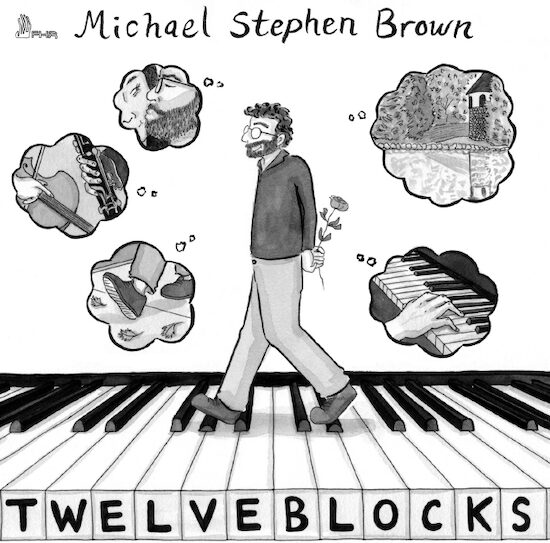
Brown relinquishes the keyboard to the eminent Ursula Oppens and Jerome Lowenthal for the duet “Twelve Blocks for Piano (Four Hands) and Poetry.” The longtime collaborators decorate the music by reading snatches of poetry in English and French (though to me parts of the piece have a vaguely Russian feel), speaking simply and without self-consciousness.
Its length makes this the most substantial single work on the album. The presence of Oppens and Lowenthal seems to have brought out the composer’s most intense vocabulary, and they express its syntax with firmness and fire.
In much of Brown’s work on Twelve Blocks, thematic specificity belies underlying compositional sophistication. To close the album, Brown plays two of his piano pieces, “Breakup Etude” and the love song “Pour Angeline.” They boast jumpy histrionics, fiery up-and-down-the-keyboard passages, spoken-word comments (“What was that all for?” “The truth is, I’ll be fine”), and finally sweetness and sentimentality. They can be listened to abstractly or as identifiably meaningful, and like the album overall have more than one layer of appeal.
Twelve Blocks further establishes Michael Stephen Brown as a composer with skills on par with his pianism. It’s out February 26, 2026 on First Hand Records.
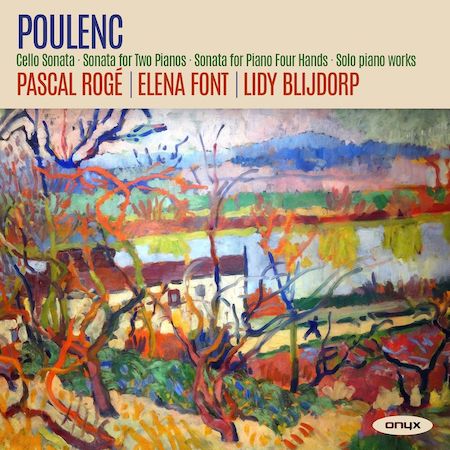
Pascal Rogé, Elena Font, Lidy Blijdorp: Poulenc
Michael Stephen Brown strikes me as something of a kindred spirit with 20th-century French composer Francis Poulenc. While Brown doesn’t (yet?) plumb quite the emotional depths Poulenc did in his later work, the music of both partakes of generous amounts of both charm and depth. Another excellent new mostly-piano album is devoted to the music of Poulenc. Pianists Pascal Rogé, a noted Poulenc specialist, and Elena Font offer Poulenc, with cellist Lidy Blijdorp joining them in the Sonata for Cello and Piano, FP143.
Blijdorp’s cello sounds a bit thin in the cello sonata, but her expressive, dexterous playing tends to make up for that. She and Rogé deliver a mature, sensitive reading of a work that’s marked by the composer’s dismay at France’s fall to the Nazis, but also suggestive of hopefulness, not only in the sprightly “Ballabile” but in the emotional complexity of the Finale. (The work was actually completed a few years after the war.)
Motion, Perpetual and Passionate
The Mouvements perpetuels, FP14 and the restive and quirky Improvisations, FP63 are in good hands with Elena Font. So is the fast-paced first of Poulenc’s FP56 Nocturnes. The pianist conveys the latter with due respect to the influence of Romanticism and without a hint of schlock. It’s a high point of the album and makes me wish to hear her interpret the whole set of nocturnes.
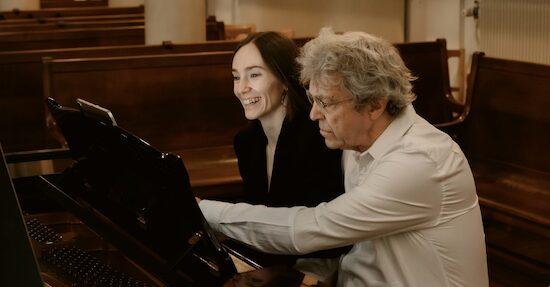
Rogé and Font seem to delight in one another’s musical company in the playful Sonata for Piano Four Hands, FP8, a much earlier work (though revised years later). Highly rhythmic, it strikes first an industrial feel, then a folksy, then a circus-like.
The two pianists join forces again, this time on separate benches, for the Sonata for Two Pianos, FP 156. This is Poulenc at his densest and most passionate, and Rogé and Font treat the sonata with intense clarity. While programmed at the end, its four movements comprise the heart of the album. I’ll admit that I was not very familiar with the work, but it’s hard to think of what more one could ask for in a recorded performance.
Poulenc is out January 30, 2026 on Onyx.