Blogcritics The critical lens on today's culture & entertainment
In 2023 I was fortunate to attend a rare U.S. concert by the Czech choir Tiburtina Ensemble and interview its director, Barbora Kabátková. The program focused on truly early music, mostly by the 12th-century abbess Hildegard von Bingen. To Hildegard, Kabátková told me, “there was no successor…No one was following her in her way of composing. So it was just her. It’s like you have just one mountain, and it was Hildegard, and there are no other big mountains like that.”
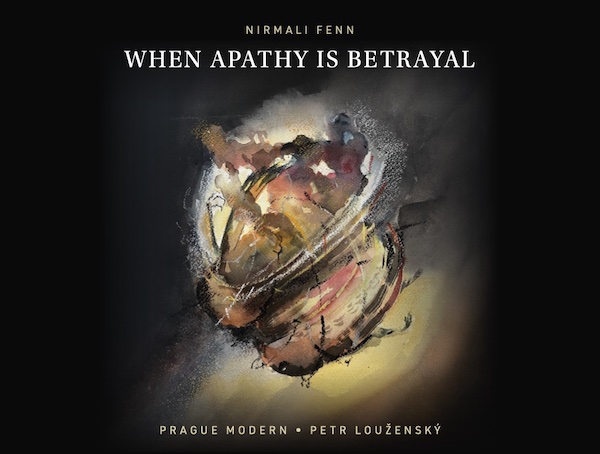
That may be so. But there is a stark beauty and a focused power that Hildegard might have recognized in a recent release of contemporary music that features Kabátková. Like many of the most dynamic early-music interpreters, the Czech soprano also immerses herself in contemporary music, and there could be no better example than When Apathy Is Betrayal, a suite by Sri Lankan-Australian composer Nirmali Fenn, now out on New Focus Recordings. It’s performed by the Czech contemporary music ensemble Prague Modern conducted by Petr Louženský and featuring Kabátková and fellow soprano Pavla Radostova.
A Land of One’s Own
Fenn is a mixed-ethnicity Sri Lankan educated in Australia and England. The suite incorporates traditions from Sri Lanka and from northern India, but sounds overwhelmingly as if it hails from a land of the composer’s own devising. One movement incorporates sampled sounds from protest movements around the world, in line with a politically-awakened trend in contemporary music of various genres. Percussion, electronics, and the sopranos dominate, with flute and strings adding voice and color. The sopranos voice just a few spare lines of mostly German poetry that aren’t easy to decipher without looking at the liner notes. Mostly, their singing reads more as musical color and intense emotion than as a conveyor of literal meaning. A final movement built mostly on an easeful pentatonic scale is one of the suite’s few consonant segments, though it ends on a questioning fifth rather than a homecoming root.
The nine movements of When Apathy Is Betrayal occupy nearly an hour. Individually as well as in sum, they repay close and repeated listening.
Patterns of resounding drums launch the first movement, “do you hear the cry in the night,” with a nod to Sri Lankan Kandyan drumming. March-like rhythms develop but quickly devolve into sound clusters or die away into silence. Then, in the movement’s second half, rumblings from drums and cymbals create washes of sound from which solemn strains from the strings billow up, followed by the first appearance of the sopranos and of shimmering electronics. A combination of dissonance and exaggerated vibrato tells us that the quality of sound from the sopranos is going to be of a piece with the abstract instrumentation. The movement concludes with a dyad battle between dissonant and consonant harmonies.
In the second movement, “night splinters,” a more pastoral mood settles in, with a warbling flute and gentle siren-calls and bird-like caws from the singers. This music effectively evokes a night sky full of stars, with electronic twinkling forming a blur of background light. The third movement calls on us to “listen to the stars,” now delineated by percussion and soft whistles. The two sopranos return in hesitant harmony, but then once again they seem to engage in a slow duel with an inconclusive ending.
Meaning from the Abstract
The fourth movement finds the singers at first an octave apart, then diverging in range and technique. Electronics in the background suggest sounds from nature. But honestly, it’s hard to take much meaning from what sounds mostly abstract. The activist title of the piece, When Apathy Is Betrayal, suggests a call to arms, and I do feel enormous power in the music’s starkness and spaciousness and continual exploration of the possibilities of a deliberately restricted palette. But as for any programmatic quality, the disjointed imagery of the lyrics registers more than the overall theme does.
Fenn’s work molds space and time in sinewy ways. The fifth movement, “people who walk barefoot in their hearts,” indeed treads very lightly – it’s well over a minute before you can be sure anything that’s meant to be heard is happening at all.
When the sopranos and strings enter, an eerie pall builds. As the movement develops, Fenn has the singers melodize at an extreme frequency distance from rumbling drums.
Then gongs and electronics bring a great change. Washes of sound arise and grow stormy. The pounding bass drum of the first movement returns. The strings wobble over distorted recordings of protests. The soprano voices grow agitated. If anything is still “barefoot,” its feet are getting bloody.
A desperate-sounding plaint from the sopranos and a frightening, toneless sigh bring the movement to a devastating close. But we are far from finished. The vibratos and dissonances of the first movement return with more starry-night imagery. A synthesized drone underlying the vocals creates an unsteady background, eventually leaving the voices high and dry; they subside in favor of bird-like flute calls, and while the flute speaks a nonhuman language, it draws us onto ground that’s familiar and comforting.
All to Splinters
But soon the birds are gone, and hesitant pizzicato notes herald a return of the singers, now accompanied by gently tinkling bells. One realizes that the key word of the lyrics isn’t “stars” or “night” but “splinters,” a verb applied to both “night” and “light” in the movement titles. There’s a sense of splintering throughout the suite, of dissociation and the associated discomfort – all conveyed through a sonic palette suffused with beauty.
In the eighth movement Fenn brings back the drums and cymbals for another rhythmic call to arms. The music seems to be really fighting apathy here, as the suite’s title implies it would. Drums accelerate and crescendo. It’s here that Fenn also evokes the ancient north Indian tradition of Dhrupad chant, but in a context of conflict – with the drums, with electronics, with our expectations of human voices.
To great effect the sopranos return for a final movement that reasserts melody and harmony. “If apathy begins with the closing of the ear,” writes the composer, “then this piece proposes listening as an act that binds us, however tenuously, to the lives of others.” That’s well said. Of course, it could be equally well said about music in general. Yet even with all the abstract material threaded through it, and despite – or because of – all its agita, this masterwork of musical strength and beauty argues for unity with unusual and distinctive force.
When Apathy Is Betrayal from composer Nirmali Fenn is out now on New Focus Recordings and available at Bandcamp.