 Blogcritics The critical lens on today's culture & entertainment

Argentine composer Diego Tedesco’s first portrait album reveals a composer with a sure grasp on the musical language he wields. Varietas, out now on New Focus Recordings, includes an assortment of striking works. Three feature soloists (violin, guitar, voice). The others are ensemble pieces. All uncover fresh seams of gold in well-explored mines of atonality and abstraction.
Portraits
In “Portrait #1,” essentially a single-movement violin concerto, soloist Miranda Cuckson uses rapid-fire extended techniques to define a fascinating vocabulary.
Flashes of interruption from electronics create a frame for a devilish instrumental “portrait” with two faces. First we encounter a busy, in-your-face visage. In the second half, we stare into a flow of whines and hums, as the violin expands into more sustained gestures.
There’s an intimacy to the performance that makes it unsurprising that Tedesco composed this work for Cuckson. As the semi-chaos returns towards the end, it feels as if her instrument has said all the composer and performer could get out of it, and more.
“Portrait #2” features Daniel Lippel, for whom it was written, on classical guitar. In this performance he must navigate his virtuosic way through a nebula of otherworldly electronic bleeps, rumbles, and scratches.
Lippel describes the music accurately as a “deconstruction of the guitar’s voice, splintering into a distorted collage of [the instrument’s] myriad stylistic tropes.” The guitar burbles and pounds, sings and trills and slides and pops, as percussive as it is tonal.
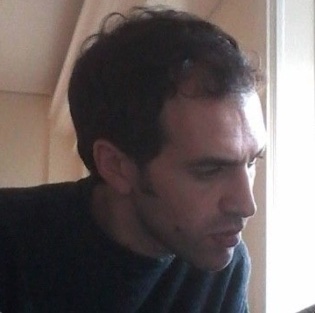
Where in lesser compositional hands such flamboyance can seem gimmicky, in Tedesco’s, shaped through Lippel’s masterful performance, it conjures a compelling and holistic “portrait” indeed.
It’s also worth noting that, like “Portrait #1,” this work for soloist and electronics is in part a tribute to the pioneering electro-acoustic work of Mario Davidovsky, a mentor of Tedesco’s.
Eyes on the Voice
In “De los Sos Ojos” Tedesco creates something similar for the human voice. The wondrous Natalia Cappa commissioned the piece. In it, she duets with her own supple soprano in lyrics and vocalise, with light accompaniment from electronic effects. She spits staccatos, exaggerates the rolled r’s of Spanish, gasps and wails, floats operatic vowels, and emits dark spoken-word mutterings that stand out against murky silences. The composer’s description – “distortion, nonsense, and the limits of comprehension” – aptly apply.
Stereophonic and muting effects add dimension, but the real strength of the piece lies in Cappa’s full biological mastery of her vocal capabilities.
Experimental music featuring the human voice continues to be one of our most fertile grounds for innovation, with space for the tongue-in-cheek, the steely and tragic, and everything in between – like this meaty, 11-minute-plus opus. Cappa’s voice quivers and breaks on an extended high-E in the 10th minute. This implies an admission of weakness or incomplete resolve. But in the final minute the note returns, playing along with several other manifestations of the singer, to re-establish control.
Ensemble Works
“Capriccio” is full of movement that one could plausibly call “capricious.” But it’s also replete with dark, rusty dissonances and swirling momentary harmonies that weave in and out of focus, lending the music weight and density.
Different voices surge to the fore from moment to moment, gasping out snatches of melody – violin, piano, trumpet, French horn. Instruments collide on the same or adjacent notes, creating an air more of argument than of accord.
While unpredictable, the music progresses with an inexorable, original logic. Flurries of rising and descending chromatic scales finally lurch it to a cacophonous stop. There is never, to indulge in cliché, a dull moment.
The “Scherzo” reads as an episodic game between the strings and woodwinds of the ensemble counter)induction). One segment is unabashedly playful, another harsh and grinding (yet with a comical wink), a third ruminative, like a balloon slowly deflating amid soft pizzicatos and pointillist prickings. When the pace picks up again it’s with an ethereal, dancing spirit that explodes in a sudden mood crash.
With two minutes to go, chromatic passages that hark back to the “Capriccio” emerge, along with portamentos and nervous stutters, punchy and jocular. For all its fun, the piece ends breathlessly, anxiously, with an open-strings squeal from a violin.
The three movements of the title piece, performed by the Composers Conference Ensemble, epitomize how some contemporary music can feel like the sonic equivalent of a drip painting. One motive or passage grips the ear, only to be seemingly wiped away by the next. Where sounds land in space and time could be anywhere and anywhen.
It’s in the subconscious that we register recurring or related scraps of sound, pieces of abstract meaning that aren’t themes but have resonance. Such meaning can also be found in the interplay of specific instruments; in dynamic ebb and flow; in spontaneity and planning. A stutter from a trumpet, an attack of vibrato on strings, a percussive blast – this music can grip and pull along a willing listener.
Un Día en Granada
Tedesco also takes inspiration from more direct experience. Struck by an irruption from a flock of starlings and an outpouring of celebration from Granada FC fans, he composed “Before the World” as an attempt to capture the experience for the sound of an orchestra. (The Orquesta Amigos de la Nueva Música is conducted by Juan Miceli.) We hear the shrill of the birds at the outset; some tense quiet intervals; and victorious blasts from the brass, sometimes joined by strings as if the birds and humans are in unison. Random notes suggest enthusiastic conversation among the crowd. Do I hear somewhere in there an imitation of a vuvuzela?
Yet this isn’t programmatic music. One doesn’t need liner notes to appreciate it. As in all the music on the album, fundamentally it’s an expression of a distinct sonic vocabulary both fully formed and always under development. This composer “portrait” displays many colors but a singular exploratory vision.
Varietas from Diego Tedesco is out now on New Focus Recordings and available at Bandcamp.