 Blogcritics The critical lens on today's culture & entertainment
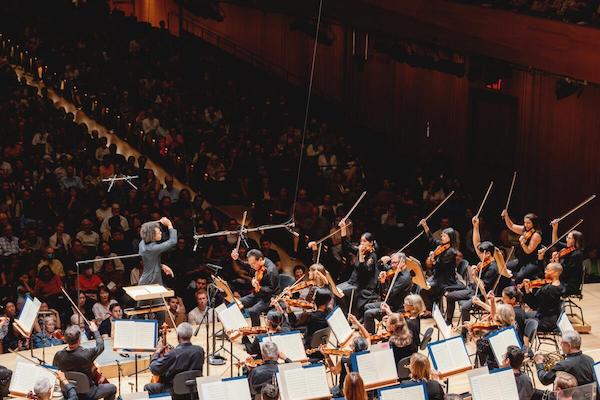
The Festival Orchestra of Lincoln Center, under the baton of music and artistic director Jonathon Heyward, wrapped up its 2025 season with a program titled “In Sickness and in Health” and devoted to Robert and Clara Schumann, along with a related world premiere by James Lee III.
The unique story and legend of the Schumanns, with Robert’s mental illness, Clara’s celebrated virtuosity and stifled composing, and their intimacy with Johannes Brahms, has been perhaps overtold at this point. But we do continue to discover unheard music by Clara that testifies to her talent as a composer.
An Unfinished Gem
The “Konzertsatz in F Minor” for piano and orchestra is a concerto movement that reinforces the idea that Clara Schumann could have been among the titans of the late classical/Romantic era as a composer had she had the opportunity.
The work is a single movement from an intended concerto that for unknown reasons Schumann never finished. She wrote out solo and tutti parts in 1847 but it took a century and a half for someoneto complete the score of the movement (we have pianist Josef Beenhouwer to thank). New to me, it impressed me on every level, especially the fluent and flashy piano writing. (No doubt on stage Clara could be, among many other things, a showoff.) She was a fine orchestrator too, at least as far as she took it, and the completed version is packed with inventive ideas.
Maybe she thought the piano writing a little too flowery, I don’t know. But in the hands of gifted pianist Yeol Eum Son it glowed and flowed like silk. Eum Son drew a gauzy, at times haunting tone from the piano, with an almost ghostly touch during the (few) quiet passages. From the fractal-like leaps up the keyboard to the solemn ending, the fragrant and smooth performance by pianist and orchestra had me transfixed.
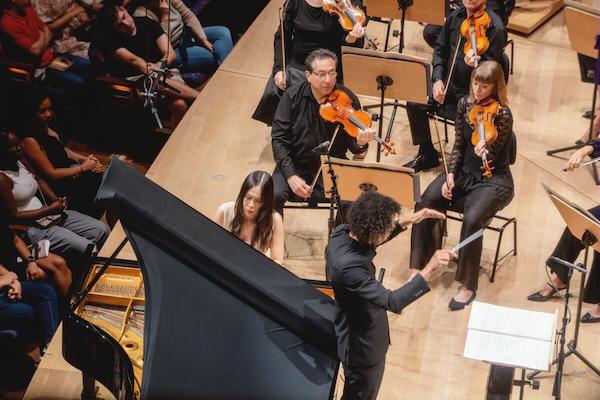
It’s actually pretty hard to imagine Clara Schumann unsatisfied with her work on this piece. Perhaps she left the concerto unfinished because Robert’s mental illness interfered with their lives at the time, and she had intended it as a gift for him. Or maybe her concert career interrupted her. But it’s wonderful to have it in the repertoire today.
Eum Son got such a warm reception she returned to play a solo encore of Robert Schumann’s “Träumerei,” and forgive me for gushing, but she delivered this beautiful little piece, one every piano student learns, with such soft, shadowy lyricism, so free from schmaltz, that I was profoundly moved.
Symphonic Gravitas
The first half of the concert included another Schumann work that fell a little bit between the cracks in a different way. Robert called his Overture, Scherzo & Finale a symphony at first, then changed his mind probably because it lacks a slow movement. But as Maestro Heyward well knows, it has symphonic gravitas, signaled by the angsty introductory accents, which the conductor leaned into with Beethovenian force. He went on to adroitly navigate the shifts between flow and staccato in the Scherzo, and finished off with an eloquent and spirited Finale painted in vibrant string colors.
It was a good omen for the Fourth Symphony which awaited in the second half. But before we heard that larger work we experienced the world premiere of “Connected Perceptions,” a substantial one-movement work by James Lee III. I last encountered Lee’s work in a far sparer format just a few months ago. This piece, by contrast, bears witness to his mastery of orchestral writing.
Connnections
The impetus for “Connected Perceptions” had to do with the Schumanns’ story, with specific inspiration from Robert’s Fourth Symphony. Those references were certainly present. But for me the piece’s coruscating wind figures and dense, broad harmonies evoked the natural world. Amid a rather amorphous progression of ever-shifting moods one hears chittering trumpets, rolling tympani, dissonant clouds, birdlike calls. Massive yet limpid tone clusters alternate with or accompany passages suggestive of, perhaps, frogs in a pond and butterflies in the air.
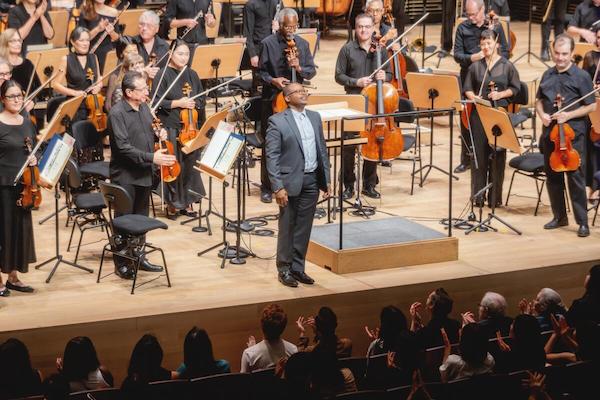
A mighty buildup subsides into a scherzo-like section in a fast 3/4 meter, which quickly gets explosive. And the end comes sooner than I anticipated – did the piece really span the advertised 20 minutes? That, to me, is a sign of a piece of music that really lives. I found it captivating, full of character, and masterful in its use of all the orchestra’s dimensions and hues.
Heyward then led the Festival Orchestra in Robert Schumann’s Fourth Symphony. The dark introduction and the bright main opening theme set the table for the symphony’s unusual handling of exposition and development, with movements flowing, or nearly flowing, into one another. The themes of the evening – artistic collaboration and communication in the context of mental illness, and the connectedness of the pieces – solidified. We could hear, for example, the trumpet accents that Lee’s piece riffs on.
Perhaps it was the symphony’s structure, unusual for its time and still surprising today, that made things feel a little unsteady, notably in the Scherzo. I couldn’t quite put my finger on it.
The “Romanza” movement had to my ears a bit of an Eastern flavor, something I haven’t perceived in the past. And the Finale landed quite solidly, a firm closure to an exciting and rewarding program.
Yeol Eum Son was a hit, and Jonathon Heyward continues his tenure with the Lincoln Center Festival Orchestra next summer.