 Blogcritics The critical lens on today's culture & entertainment
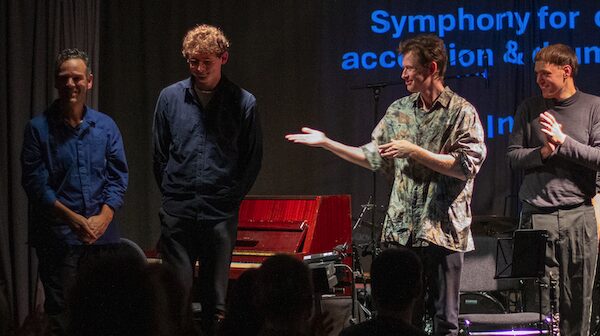
Matthew Shlomowitz continues his study of polytonality and other unorthodox compositional techniques in his newest collection. Polytonality is simply music with elements in different keys at the same time. Shlomowitz applies the concept in different ways in the five short pieces on this EP.
Rock and pop musicians will recognize the chord progression indicated in the title of “I – vi – IV – V.” It’s the “Heart and Soul” progression that countless songs, from doo-wop to contemporary pop, have mined. Here the instruments play the pattern in different keys and also at different speeds and rhythms. The carnivalesque result feels discombobulated in a funny way. In this piece and throughout the short set the music stitches together a cockeyed list of styles.

“Polytonal Organum” is just as playful. It takes its title from the harmonic writing that developed from medieval monophonic chant. The piece builds harmonies on an initial theme, but instead of adding monkish fourths and fifths, Shlomowitz takes the music polytonal, deepening the dissonance with each iteration. While he notes that the piece includes a reference to the band Soundgarden, I hear also a collegiality with jazz experimentalism like the Chase Ennea album.
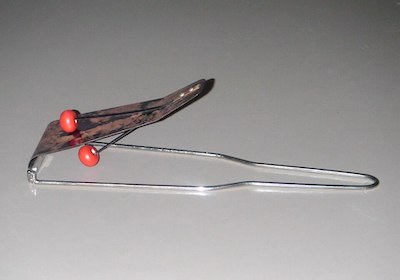
“Timeless Interlude” suggests both mellow jazz and ambient or space music, with a sequence of modulations linked by chromatic scales. “Call & Answer” alternates ensemble passages with improvised jostles and whistles on a flexatone. (I remember playing with a flexatone in school – but not so hard as to destroy it, as percussionist Matias Seibæk did here.)
“Additive Binary and Tritone Substitutions” is exactly as described. The first part adds clashing tones and chords to a theme. The second part piles on tritone substitutions, a common polytonal technique in jazz, for a sound familiar from that genre but increasingly out-there in this realization.
Shlomowitz’s polytonality project began with the piano pieces of Vol. 1 back in 2021. Danish experimental art-music ensemble K!ART (pronounced “klart”) performs the works on the present Vol. 5. The instrumentation is a big part of the jocose spirit of this chapter: keyboards, clarinet, cello, drums/percussion and electric bass. Thanks to synthesizer sounds and other effects the ensemble can sound like it includes other voices too.
It’s actually quite possible to enjoy (or disdain) this music without thinking or knowing anything about polytonality, or any other music theory for that matter. A little bit Charles Ives, a little bit Raymond Scott, a little bit Looney Tunes, this project conjures a fusion – really a plurality of fusions – all its own, and all with tongue in cheek.
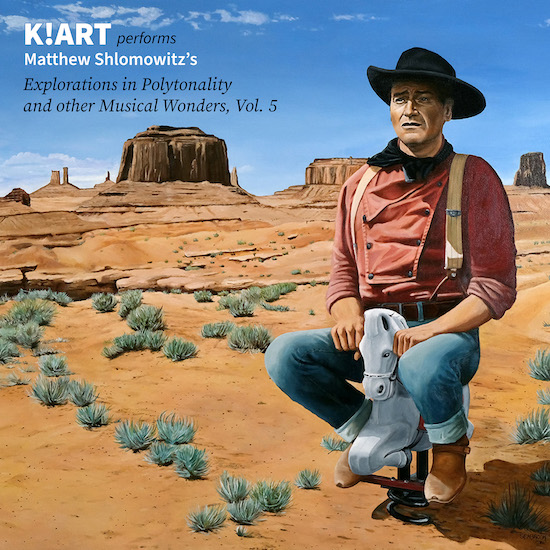
Explorations in Polytonality and Other Musical Wonders, Vol. 5 from Matthew Shlomowitz and K!ART is out now on New Focus Recordings and available at Bandcamp.