 Blogcritics The critical lens on today's culture & entertainment
 Hesperus is Phosphorus, a major new choral work by Pulitzer Prize-winning composer Lewis Spratlan, sets a series of texts loosely connected by a celestial theme to appropriately expansive music scored for the chamber choir The Crossing and the six-piece Network for New Music Ensemble. Ranging from a two-line quote from physicist Richard Feynman and an equally brief New Testament passage to poems by A. R. Ammons and Adrienne Rich and lengthy prose selections from the work of David Eagleman, the texts evidently inspired the composer to great imaginative heights.
For example, the eerily triumphant “Unity” uses Ammons’s poem “Guide” to reflect the suite’s overall theme, the ancients’ realization that Hesperus, the evening star, and Phosphorus, the morning star, are one and the same: the planet Venus. “You can’t come to unity and remain material…how I said can I be glad and sad: but a man goes from one foot to the other.” Two feet, same body. Spooky and transcendent, the music suggests the breadth of space as well as the fire of the stars.
The composer’s impeccable choral touch ties disparate elements and moods together throughout the nine-movement suite. Elements of “The Afterlife II” hint at classical oratorios (Mendelssohn in particular), medieval monophony, and 12-tone modernism in a grand fusion.
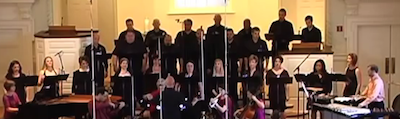 Also featuring fine solo voices and exciting, pinpoint playing by the Ensemble, as in the dark seventh movement (“Falling”), the dense but accessible music repays repeated listening. Spratlan has a surpassing ability to set tightly packed texts to correspondingly expressive music using the combined vocabularies of tradition, modernism, and even (as in “Stepping Backward”) the jazz age. The descriptive melodies and rhythms he builds for the imagery of the final movement, “The Afterlife III,” are a notable case in point: as your atoms recombine after your death, “your manner of expressing joy might become a seaweed sheet playing on a lapping wave, a pendulous funnel dancing from a cumulonimbus, a flapping grunion birthing, a glossy river pebble gliding around an eddy.” The music is as lively and varied as those images.
Hesperus is Phosphorus is out on Innova Recordings.