 Blogcritics The critical lens on today's culture & entertainment
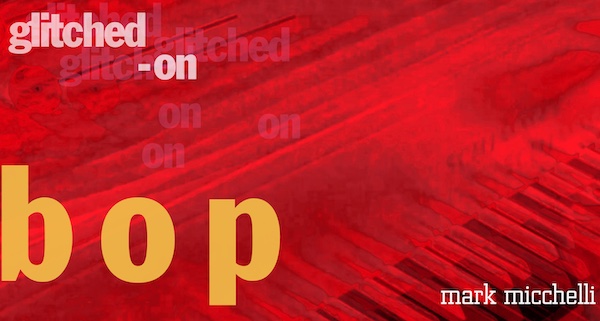
The world is full of re-imaginings of classic musical works. Pianist Mark Micchelli does something more adventurous than that on Glitched-On Bop: twisting, deconstructing, and experimenting with five jazz classics that were (with one exception) radically experimental in the first place.
Assuming you’re old enough to get the pun, the album title is a bit deceptive. Wendy (then Walter) Carlos’s Switched-On Bach brought the baroque into the electronic age in 1968 with synthesizer versions of classic J.S. Bach keyboard music. But these were essentially shifts to a new instrument, not eccentric re-imaginings. Micchelli takes groundbreaking music by Charlie Parker, Cecil Taylor, and other jazz luminaries and blows it apart, turns it inside out, and re-contextualizes and reconfigures it using his own eccentric toolkit of keyboards, percussion, electronics, and imagination.
Bird in a Whirlwind
The overused word “iconic” actually applies to Charlie Parker’s “Donna Lee.” Search online and you can find innumerable versions, from Joe Pass’s furiously fast monster to a ballad take by Joe Lovano. Micchelli, a skilled pianist himself, takes apart the tune in “Donnaleelannod,” a palindrome that reflects the piece’s halting backwards-and-forwards adoption of the “Donna Lee” melody.
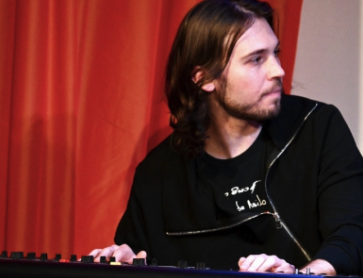
Starting with a one-hand piano statement, Micchelli develops a weird concoction of conflicting time signatures and multiple timbral layers. I was interested to read that he plays all of these pieces with no overdubs, using an electronic setup to generate multiple sounds and unexpected effects from the piano. It’s good-natured and mostly playful, right down to the stride rhythm that sneaks in towards the end.
Percussion plays a major role in “Pemm Pemm Ican Pemm,” which takes on Cecil Taylor’s more lyrical but still experimental “Pemmican.” Micchelli, also a music theorist, knows his Taylor, having won an award for his article “Sound Structures and Naked Fire Gestures in Cecil Taylor’s Solo Piano Music.”
A drum solo at the start nods to the deep bass-note accents that open the original. Miccelli’s adventure builds to a wall of sound that suggests a jazz band swept up in a tornado. After a lyrical interlude, the piano starts to fight the drums for attention. (One has to keep in mind that Micchelli is doing all this “live.”) Another whirlwind develops in the final minutes, at first more “musical” but becoming a distressed sound-collage. The piece fades with a palette of futuristic tweaks, making one wonder how some of these sounds were created without a synthesizer per se.
Ahead to India, and Back to Boogie-Woogie
Alice Coltrane’s Indian-flavored “Journey in Sachidananda” furnishes the inspiration for “Jjjjjjj (Satchidananda).” At four and a half minutes, half the length of the other tracks, it uses hovering white noise and bells with eerie sustains to recall the drones and darkness of the original. A muffled toy piano suggests the key bass line amid dominant percussion, bells, and electronics.
What’s most distinct about Thelonious Monk’s “Evidence” is its curious rhythms. Micchelli exercises his contrariness by basing his “EevVidIenDceEevNidCenEce” on the melody instead. Aggressive percussion triplets mark the opening section, followed by a peaceful development of the tune, with its strange intervals, in a focused multi-timbral construction. This piece too builds to a cyclonic climax.
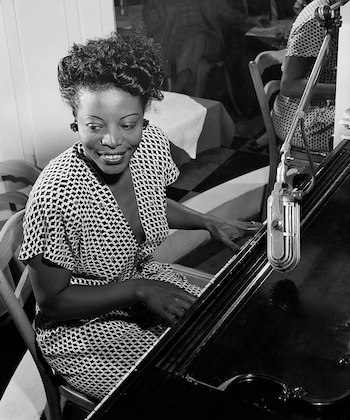
A quiet coda flows easily into the bell-percussion intro of the final piece, “Rollem Em Roll Em,” inspired by Mary Lou Williams’ boogie-woogie instrumental “Roll ‘Em” and Colin Nancarrow’s impossible-sounding player-piano works with their disconcerting rhythmic juxtapositions. Your great-grandmother’s boogie-woogie blues is here as a kernel. Micchelli displays his improvising skills during the eccentric development of the nine-minute piece, joined by electronic stabs and stutters that combine with the bluesy base in ever-more disturbing ways.
On my first listen to the piece, before I had read up on Micchelli’s process, flashes of Frank Zappa and Captain Beefheart came to mind. It’s fun for a while. To be honest, though, the rave-up starting in the sixth minute, with its clash of cross-rhythms, literally gave me a headache. And I have a high tolerance for “difficult” music (just ask my long-suffering wife). So, kudos to this pianist-composer for accomplishing something few artists have managed: making me physically uncomfortable. Switch that on, Wendy Carlos.
You can easily find online all the tracks that inspired this album. Giving them a listen will add significantly to your appreciation of Mark Micchelli’s striking new opus. Glitched-On Bop is out now on New Focus Recordings and available at Bandcamp.