 Blogcritics The critical lens on today's culture & entertainment
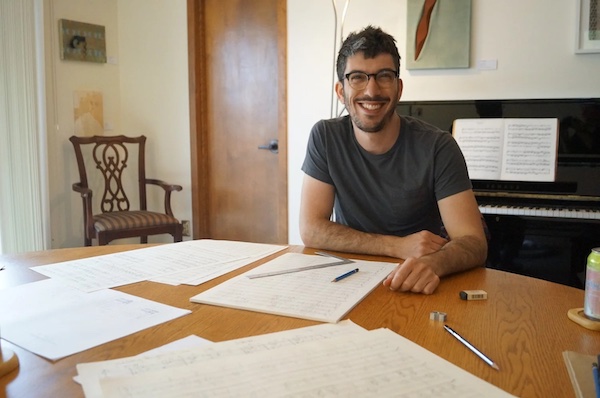
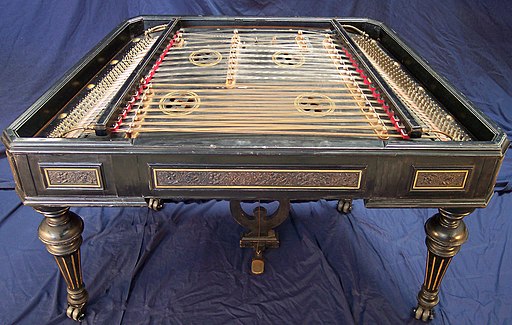
You’re forgiven if you don’t know what a cimbalom is. Picture a hammered dulcimer, increased in size and weight until it needs legs to support it Developed in its modern form in the 1870s in Hungary, it’s better known in Eastern Europe than in the West. But many composers have discovered and written for it, including György Kurtág. It’s Kurtág who inspired Nicholas Tolle to take up the instrument. And Tolle is the featured performer on Lines and Traces of Desire, the new album on New Focus Recordings from composer Mischa Salkind-Pearl.
Introducing: The Cimbalom
The collection’s most compelling music comes at the start, with “The Plum Gatherer,” a setting of a poem by Edna St. Vincent Millay for cimbalom and soprano. Here, as in a lied by Schubert or Brahms, the singer and instrumentalist are equal partners. The contemplative piece stretches over more than 10 minutes and begins with a sparse, tense introduction from Tolle’s cimbalom, acclimating us to the sound.
The attack resembles that of a harp, but the sonority is much more vigorous. The highest notes sound rather like those of a piano (both are hammer-on-strings instruments, after all). In the lower and midrange the cimbalom has a sandy twang all its own. And the timbre varies depending on how hard one strikes with the mallets.
Soprano Mary Bonhag, also heard on another recent New Focus release, River Spirits from composer Susan Botti, is a superb interpreter of modern repertoire. The music, elevated by her expressive coolness and dense with narrow melody, effectively plumbs the cloaked imagery of “grey ambiguous nettles” that evoke for the poet a youth she cannot recover. The second part of the piece, even more stark, begins with the line “The plum-trees are barren now and the black knot is upon them.” The imagery is grim. But the music, while solemn, has a quiet vigor, and casts light on the interplay between the stark sound of the cimbalom and the thickened purity of the human voice.
The three-part Palm’s Soft Terrain arises from an interesting idea that succeeds conceptually but doesn’t quite pay off musically. Here Salkind-Pearl interprets three American weaving patterns through music for solo cimbalom. “Undulating Herringbone” evokes that pattern through arhythmic stabs of sound and repeating motifs. The tuning of the cimbalom is a bit off from what we’re used to, and the repeated patterns with sudden deviations bring that to the fore.
We also hear more of the range of techniques Tolle can employ to create both tonal and percussive effects. The latter dominate the second number, “Basket Weave,” where harsh strikes (plucks?) evoke the hard material of an actual basket more than fabric. Concluding with a long series of bell-like tolls, it makes its point – but gratingly.

The third is by far the longest movement. I had to look up the “Mary Ann Ostrander Pattern.” It’s quite an intricate one. The music is more harmonic than in the first two movements, and even, here and there, smoothly consonant. Still the vocabulary feels a little constricted for a 14-minute piece, despite gnarly passions that intrude towards the end.
For all three movements, it’s worth taking a look at the referenced patterns while listening. With the visuals in mind, the music has more meaning. But it remains rather dry.
Scanning the Room, Tracing the Lines
Salkind-Pearl is composer-in-residence for the Ludovico Ensemble, the group that joins Tolle for “Map of My Room.” Though it’s an older piece, in it you can hear the composer’s musical sensibility already maturing. On a casual listen it may feel like 11 minutes of group improvisation. But that’s only because the score skilfully melds the textures of the instruments such that at many moments it hardly sounds like an ensemble. The cimbalom’s throaty sound complements the airier flute (Zach Sheets) and bass clarinet (Rane Moore) and Lilit Hartunian’s warm violin. It’s easy to accept the intended depiction: a survey, episodic and without development, of the various and unspecified items in the composer’s room (and refuge).
The title suite features Hartunian (whose admirable work you can also hear on New Focus’s recent release by Ryan Vigil) in a duet with Tolle. The short first movement continues the driftiness of “Map.” But with the second movement, titled “Unison,” come interesting sonorities, as the cimbalom’s long decay alternately parallels and lingers beyond the violin’s bowing. Tolle and Hartunian sync in sinewy style, like two horn players doubling a jazz riff, effects varying with technique, attack, and presence or absence of harmony.
Extended techniques abound in the short but spacious third movement, simulating snaps and whistles and sighs and such. The even shorter fourth alternates dissonant strikes and mellow cushioning.
The last movement begins and ends with interpretations of a keyboard sonata by 18th-century composer Manuel Blasco de Nebra. The purpose of this nod to the Baroque isn’t made clear. One can relate the sound of an 18th-century keyboard (whether fortepiano or harpsichord) with that of the cimbalom, and contrast it with the bowed violin sound that adds a dimension to the piece as originally written for the keyboard alone. It works quite well, offering a new angle on the old.
But the contemporary music on this album is quite capable of intriguing us on its own merits. Lines and Traces of Desire is out now and available at Bandcamp.