Blogcritics The critical lens on today's culture & entertainment
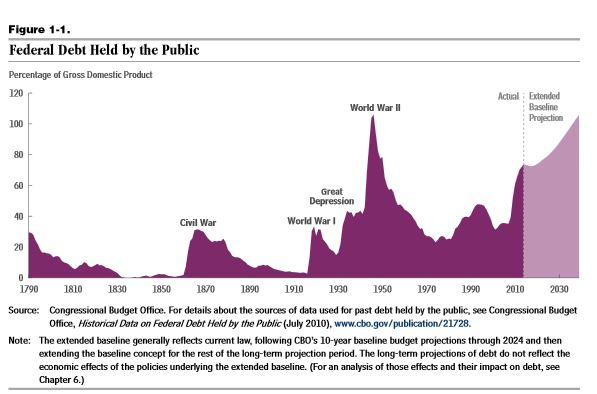 While many political reasons have been put forth to explain why Vladimir Putin seems not to be afraid of America and the West, the real reason has nothing to do with politics. It has everything to do with money – specifically, the crushing power of America’s immense federal debt.
The Great Recession caused U.S. government debt to skyrocket from 40 percent of U.S. GDP in 2008 to 74 percent in 2014, almost doubling in only a few years. In fact, the level of U.S. government debt is today almost the same as it was during World War II. By 2039, U.S. debt will exceed total U.S. GDP, possibly rising to 183 percent of GDP.
The bad news is that America’s politicians have no intention of doing anything about this growing cancer of debt. It is also improbable that the U.S. economy will grow significantly in the next decade, which would reduce the debt’s impact.
Such levels of debt will act like a straitjacket on America’s ability to respond to various crises, including fighting major wars and projecting military power abroad, as it makes further borrowing more costly.
Putin knows this, which is why he is betting that the U.S. will do little or nothing for Ukraine, even if Russia were to invade. The U.S. would simply not be able to sustain the cost of projecting a major force to Europe at this point in time. And things will only get worse.
In the near term, the size of the U.S. military will also continue to shrink because of the effects of sequestration budget cuts. At the same time, however, the debt problem will limit American’s ability to quickly increase force size should the need arise. This set of factors will have far-reaching geopolitical consequences in Europe and Asia, as both Russia and China are investing billions in increasing their military capabilities: America’s allies, wherever they are, will increasingly see that their ally is unable to actually do much should Russia or China decide to attack them.
One consequence of such a development in Europe would be the drawing of the EU into Russia’s orbit, as European states seek to maintain their economic position. Of course, Europe is already more or less attached at the hip to Russia economically: It is dependent on Russian energy, and billions in Russian cash are stowed away in European banks and invested in European real estate – money politicians in Europe would be loath to lose.
Europe’s governments also face immense debt problems because, as Ben Judah writes: “Europe is really run by an elite with the morality of the hedge fund: Make money at all costs and move it offshore.” This makes European governments not only incapable of increasing their defense spending but vulnerable to Russian influence.
It is also possible that China could start to play a more active role in Europe in order to balance Russia if the Russia-China alliance does not happen. With Russia and China trying to carve the continent into spheres of influence while the U.S. struggles to maintain a foothold, Europe might become a big Ukraine.
As America withdraws from the world because it cannot afford to stay engaged, Russia and China will expand their spheres of influence. This is bad news for countries in Central Europe and in South Asia.