 Blogcritics The critical lens on today's culture & entertainment
A Few Good Men
Aaron Sorkin’s A Few Good Men, performed in 1989 and made into a superb film in 1992 starring Tom Cruise and Jack Nicholson, deserves revisiting. At the heart of the exciting courtroom drama unfolds the theme of following orders, regardless of their legality. What does it take to stop the type of corrupt culture that promotes following illegal orders?
The answer is, “a few good men.” For corruption to flourish, good people do nothing. Sorkin’s early work, with its trenchant themes, prescient and applicable for us today, has been given an update at Lincoln Center’s Vivian Beaumont. The revival runs through January 10, 2027.
Obeying Orders
For the Marines in Guantanamo Bay, Cuba, following legal orders is an imperative. However, the oath that LCpl Harold W. Dawson (Lavel Schley) and PFC Louden Downey (Collin Kelly-Sordelt) uphold to “Unit, Corps, God, Country” gets them tried for the death of PFC William T. Santiago. The question is whether they poisoned him to get revenge, or whether Santiago died accidentally, when they followed orders for an illegal “Code Red.” Especially in the military, illegal orders must not be obeyed; the military abides by an oath not to a man, but to the Constitution.
The commanding officers of the JAG Corps (Judge Advocate General’s Corps) responsible for military justice, bypass the highly competent Internal Affairs LCDR Joanne Galloway (Krysta Rodrguez) as Dawson and Downey’s defense attorney. This fact clues in the cover-up to protect Lt. Col. Nathan R. Jessep (Bradley Whitford), who runs his base as his own private loyalty compound.
Seeking Justice
If the highly organized advocate defends the men, her prior MO suggests she will leave no stone unturned to achieve justice. Most probably, this will involve a lengthy trial and negative publicity. Also, it may wreck Jessup’s chances of a promotion to Director of Operations for the National Security Council.
With Jessup in mind, JAG officers assign the case to LtJG Daniel Kaffee (Tom Blyth), a cavalier trial novice with a penchant to defend soldiers using plea bargains. Kaffee has never tried a case. Also, he joined the military to pay off his student loans. It’s his ego permits him to do the job, obey orders and play sports with a minimum of dedication and interest. Tom Blyth inhabits the evolving Kaffee believably.
Information Revealed by Degrees
Sorkin structured his information-dense play to gradually uncover the underlying corruption of the men at the top. Thus, he builds his arc of development by withholding details and creating suspense. With nuance the playwright discloses the characters’ egos, ambitions and insecurities. The excellent lead actors (Blyth, Rodriguez, Whitford, Michael Oberholtzer as prosecuting attorney Jack Ross, and malevolent John Zdrojeski as 1st Lt. Jonathan Kendrick) pinpoint the internal flaws and conflicts among the individuals.
As the lead characters become enlightened, the audience remains engaged. Invested with the questions of justice and accountability, the passed-over Galloway provokes Kaffee’s pride to realize the case deserves more than guilty pleas. Meanwhile, his client Dawson refuses a plea, falling back on the “following orders” defense (used at the Nuremberg trials by Nazis). With the forceful Galloway taking Downey’s defense after a manipulative move, Galloway and LtJG Sam Weinberg (Nick Blaemire) join Kaffee to pursue justice. However, as happens in a morally corrupt network, the officials trap the “small fry,” while the “big fish” swim free to create more havoc. The parallels to the present are horrifically clear.
Start off as Antagonists
Galloway struggles to be heard to prove her worth, arguing with Kaffee about whether the case should go to trial. Then they consider how best to provide a viable defense. Identifying crucial information, it appears they’ve succeeded until their success blows up with a failure by Galloway. Because the mistake forces Kaffee to rethink his approach, he eventually discovers an unimpeachable line of inquiry.
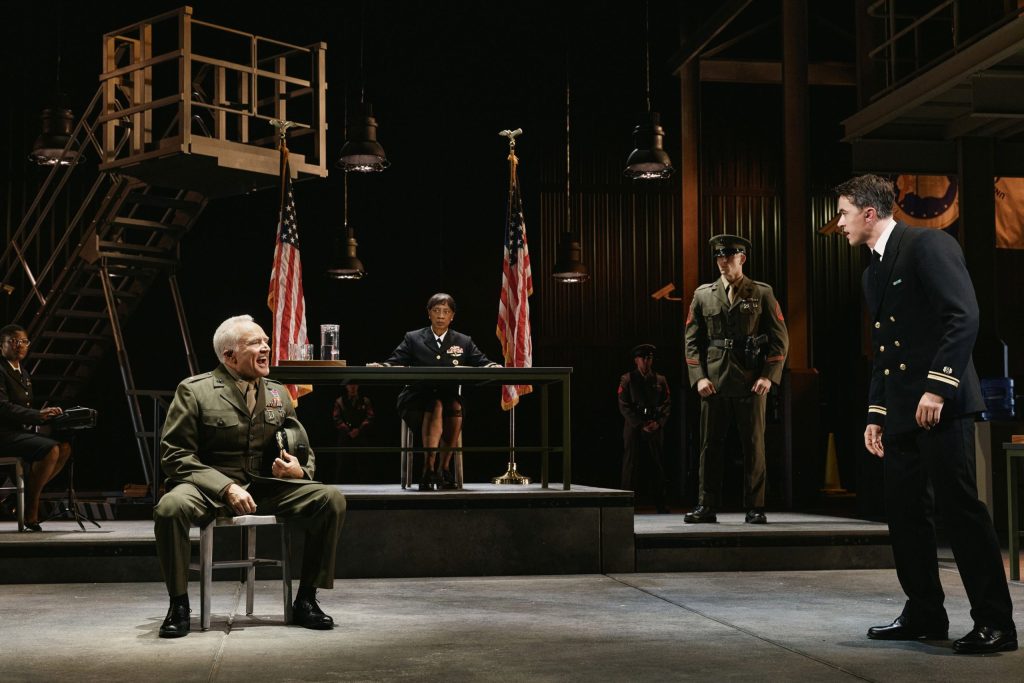
Kaffee and Jessup’s conflict of egos heightens throughout, becoming the linchpin of how Kaffee defends the men. The final turning point arrives when Kaffee must stand alone to risk his career and confront the only witness who can free the men. But that involves getting Jessup to testify against himself.
Pride Leads to Downfall
Overweening pride leads to the death of an individual and a potential miscarriage of justice. Of course the justice warranted involves true accountability and not yes men lifting up a potentially dangerous leader to a position of power where he will do more harm. Finally, Jessup’s arrogance, honed over the years through unquestioned power, and his twisted mores hoist him on his own petard with Kaffee’s help. Whitford nails Jessup as a match for Blyth’s Kaffee.
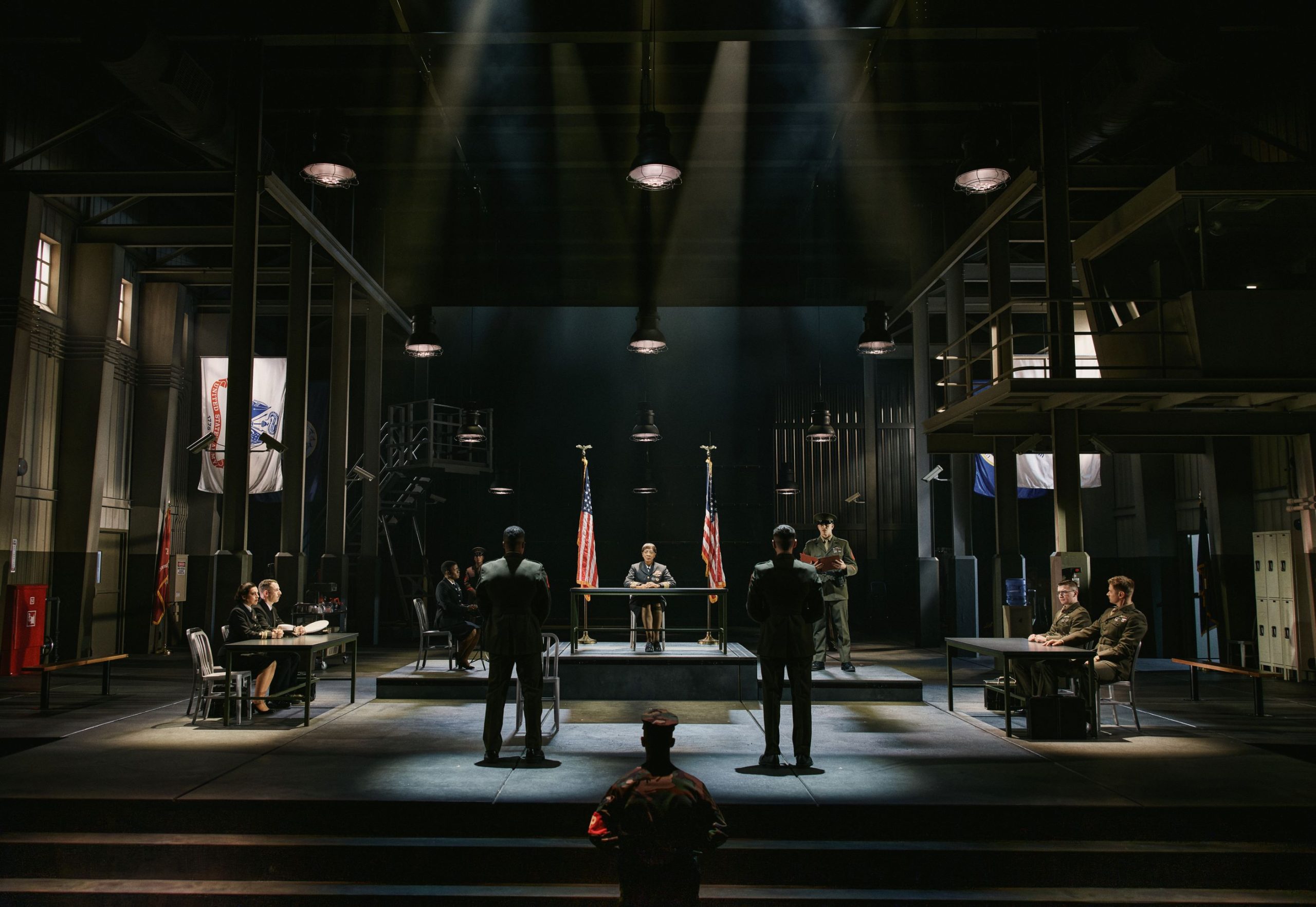
The high points resonate, crafted by director Michael Arden’s acute judgment about the staging, with Dane Laffrey’s stylized set. That design and Japhy Weideman’s lighting convey stark atmospheres that suggest the changing moods and tones of various scenes. Joshua D. Reid’s sound design aptly enhances it all. Arden uses the cavernous stage. For example he places Markinson on scaffolding, distant, isolated above the men who eventually confront each other down below during the trial.
A Sacrifice
As a key witness, Markinson alone can exonerate the men. His final choice reveals sacrifice and duty; his actions help Kaffee decide how to best confront Jessup. The final scene between Kaffee and Jessup culminates in a satisfactory conclusion. At the close the superb lighting clearly symbolizes what we must understand to be black and white about refusing illegal orders.
The production conveys a shadowy military world that civilians do not easily comprehend. Soldiers emerge from the darkness into the light with their rifles, doing maneuvers. A flag-draped coffin transfixes as one Marine folds the flag. Marines stand at the ready like sentinels moving the fallen from one world to the next. Arden shows the soldiers in shadow, backlit or with their backs to the audience, anonymously everpresent, commanding respect.
Theirs is an austere world with rules and mores. Arden’s creative vision thus all the more strengthens the moral imperatives and questions the play raises. The director masterfully highlights relevant themes for us today. This memorable production gives a sounding of the current leadership of the “Department of War” and its commander-in-chief.
A Few Good Men runs through January 10, 2027 at the Vivian Beaumont Theater.