 Blogcritics The critical lens on today's culture & entertainment

During the 1800s and into the 1900s, many girls and young women who “misbehaved” – got pregnant, did sex work, or committed less heinous “sins” in the eyes of judgmental elders – were sent to Magdalene Society asylums. At these reformatories inmates performed hard labor, sometimes for long periods, sometimes also suffering violence, abuse, even death. I first learned about these facilities years ago from my friend folksinger Karyn Oliver’s haunting song “Magdalene.”
I hadn’t realized, though, that the Magdalenes, who began in the British Isles, had such a longstanding presence in my own New York City. And it’s the real-life Inwood Benevolent Home that has inspired playwright Sophie McIntosh to write, and Good Apples Collective to present, benevolent.
Benevolent?…
Set at Inwood, the play reveals how the home’s soothing name masked harsh conditions. In a soiled-laundry basement, young inmates scrub clients’ underwear all day under the watchful eye of a matron. Benevolent vividly depicts the bonds, the conflicts, the hopes and dreams, and the living nightmares of four such women.
The time is 1917, and McIntosh’s script works in some touches of period language – “spots” for pimples, literate turns of phrase (“To what end?”). But mostly the dialogue has a perky, almost 21st-century ring to it. Still the momentum of director Nina Goodheart’s staging and the acuity of the acting bury petty anachronisms of verbiage and culture in soulful storytelling. These women feel real in an essential sense, making the best of terrible situations each in her own way.
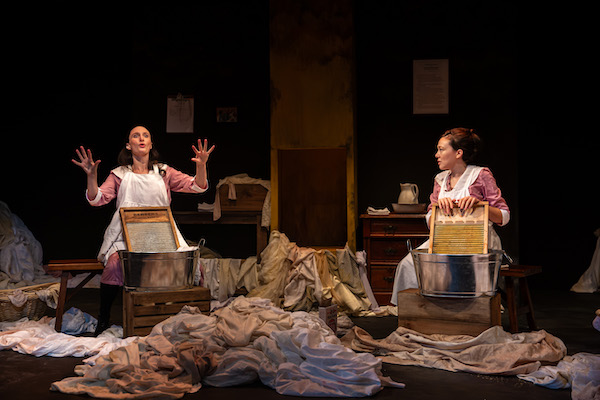
First among equals in the excellent cast is the reliably magnetic Chani Reese as Margaret, a sex worker who after years of hard knocks has washed up on a reef of cynical equilibrium, scrubbing through her time in the laundry dungeon in general good spirits. In lesser hands this kind of character could come off as a put-on-a-jaded-happy-face stereotype. But Reese, armed with the script’s sharp character development, makes Margaret a winning antihero whose growing appeal for fellow inmate Sarah (a spot-on Rachel Ravel) – whose only sin seems to be a penchant for singing for pennies on the Coney Island boardwalk – feels fully believable.
McIntosh skillfully Jengas up the plot to keep us on our toes. A red herring throws off expectations as to whose troubles will set the most serious action in motion. And there’s a twist at the end that I didn’t see coming. At the same time, the production isn’t the least bit squeamish about showing realistic scenes of both eroticism and terror. The latter comes with a depiction of an abortion in the very, very bad old days (now alas returning) of strict interdiction.
Not So Much
Each woman has her own story. Both Margaret and Emma (an understated turn by Mia Fowler, and the more powerful for it) have been sex workers, but racist attitudes – the story doesn’t dwell on these, but doesn’t sweep them under the laundry pile either – have made their lives diverge economically and otherwise, despite both ending up in the same place for the moment.
As for Abby (an endearing and powerful performance by Livvy Marcus), despite her privileged background her strict father has dispatched her to the Magdalenes after just one unchaperoned assignation. Marcus plays Abby’s innocence somewhat for laughs, but through episodes of friendship – and betrayal – the character reveals depth and the kind of power that today we call “agency.”
The play leaves the women’s fates no more certain than at the start, in some cases even less so. But we’ve come to know these four mighty well. And while it’s a period piece, benevolent can’t help reminding us how hard-won and fragile are the freedoms that women and working-class folk have won since the days of the Magdalenes. As in centuries past, tradition and religious faith are being used today as justifications for oppression. What the undocumented are going through today in the U.S. is nightmarish already; from there, it’s a small step to institutional subjugation of citizens, and many U.S. states have already taken that step. To their credit, the women in the play find ways to stay positive. But theirs is a cautionary tale indeed.
Benevolent runs through September 5, 2026 at the IATI Theater. Tickets are available online.