Blogcritics The critical lens on today's culture & entertainment
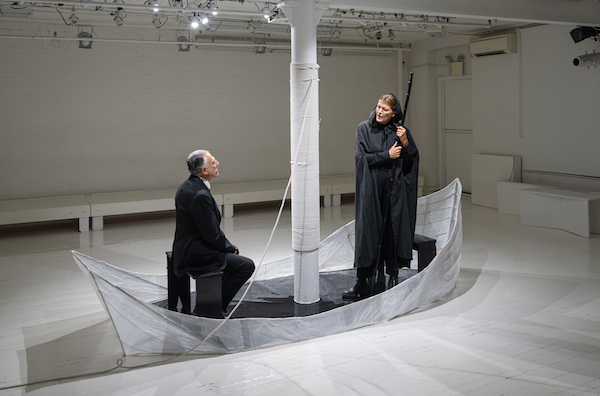
Fans of intellectually epic theater have a rare opportunity this fall. The award-winning The Invention of Love, a sprawling, rarely produced masterpiece by Tom Stoppard, is at Theaterlab’s white-box off-off-Broadway space for a short run. The inimitable David Greenspan plays the Victorian poet and scholar A.E. Housman while leading a large cast of talented younger actors.
The prospect of seeing a Stoppard play I had never experienced (it had a short Broadway run in 2001) would have been enough to draw me. Too, the subject matter – Housman and his milieu at and after his Oxford education – is close to the heart of your reviewer, a once-and-always English major and onetime scholar of Ancient Greek.
But Greenspan’s casting drew me to the production just as much. The actor employs an old-school declamatory style perfect for Stoppard’s version of the dying septuagenarian Housman. It’s less perfect for the boxy space of this theater, where some of the actor’s musically softened syllables can get lost. But his Housman magnetizes, looking back on the poet’s student days, early career, and unrequited love for his school chum Moses Jackson (a warm and charismatic performance by José Espinosa).

A (Stifled) Invention
The play operates on several levels. Importantly, it illuminates the social and mental compromises that must be made when society outlaws an essential part of one’s very nature. This theme simmers throughout the play’s patchwork-bildungsroman.
It becomes explicit in later scenes, first when the young Housman (Yaron Lotan) is warned against a casual friendship with a more “out” co-worker at the patent office where he takes a job after University.
Then, more colorfully, it emerges when Oscar Wilde (a thoroughly convincing Sam Bolen) – a contemporary of Housman’s, though the two apparently never met – engages with deathbed-Housman in an encounter made possible by the magic of fiction and drama. The flamboyant Wilde, who was tried and sentenced to hard labor for what Housman memorably euphemised in a poem as “the colour of his hair,” embodies something the reserved poet-scholar could never be.
Reclaiming the Past, Claiming a Future
But that’s just one strand. The story also celebrates the joy and intellectual rewards of literary pursuits – the “science,” as Housman insists, of textual criticism. Much detective work and literary archeology go into the study of ancient Latin and Greek texts, which are often incomplete and ambiguous. Of the writings of the original inventor of the love poem, we are told, just one line survives.
And then there’s ambition. Post-graduation, Housman and his friends must bow to economic reality and labor in patent offices and libraries. But “I know what you want: a monument,” Pollard, one of his school pals, tells Housman. Daniel Liu’s commanding baritone makes Pollard an especially vivid character; Liu also plays a scholar whose inferior work Housman eviscerates with rapier wit. Other actors also play two roles, with notably fine turns by Abrar Haque and Leland Fowler among others.

Stoppard expands his imaginative scope and adds context via the conversations of journalists and an MP, and that’s on top of all the dons and writers and others weaving in and out of the story. It can be a little hard to keep track of who’s who in the large cast of characters. But the overall quality of the acting enables Stoppard’s fast-flowing wit to capture attention. The biggest problem for me was the awkward English accent of a key character, part of an otherwise compelling performance. I could not catch some of his lines at all.
Come Sail Away
The production is very basic, centered (and sometimes literally rotating) around one set: the boat on which Charon, played by an excellent Annabel Capper (who also plays other small roles) ferries the dead to Hades. The play launches with Housman getting on board, but the boat becomes the central meeting point for Stoppard’s imagined conversations and fanciful interactions between the generations. Zachary Elkind directs in a smartly stylized manner that easily legitimizes the fantastical elements. His production, like the play, is an impressive achievement.
Are the days over when a play like this – or even a musical with a real literary pedigree, like the late Duncan Sheik’s Spring Awakening – could even open on Broadway? It sometimes seems that way. Fortunately we still have small-scale producers (in this case The Map), thoughtful directors like Elkind, reams of talented young performers, and treasures like David Greenspan to bring such visions to life for dedicated audiences. The Invention of Love is at Theaterlab through October 3, 2026.