 Blogcritics The critical lens on today's culture & entertainment
Other Desert Cities
With a celebrated cast led by Julia Louis-Dreyfus in her Broadway debut, Jon Robin Baitz’s Other Desert Cities, currently in revival at the Hudson Theatre, also stars Ed Harris and Allison Janney. Joe Kerry, making his Broadway debut, and Lily Rabe round out the award-winning, versatile cast. Other Desert Cities runs through January 17, 2027.
Because each of the actors does such a yeoman’s job, Baitz’s complex, tricky play does resonate. Wiry and sometimes contrived, Baitz’s characters ask the audience to follow them in a leap from well-placed humor and a light-hearted tone to the darker side of sacrificial revelation. The reveal can and should release a searing, emotional catharsis.
Overall production doesn’t quite land
Directed by Jon Benjamin Hickey, Other Desert Cities doesn’t quite get to its expected cathartic, profound, heartbreaking result. It should land in expiation and forgiveness, with the audience recognizing that people can and do change, even staunch conservatives. The original production yielded that emotional lightning bolt. This production does not.
Comparison between the original, which starred Stockard Channing and was directed by Joe Mantello, and this revival may be unfair. This ensemble may arrive at that needed result as the production settles. Importantly, the splendid cast pinpoints the characters and more importantly, they challenge our penchant for viewing “the other political side” without empathy.
Christmas Eve, 2004, and a war is on
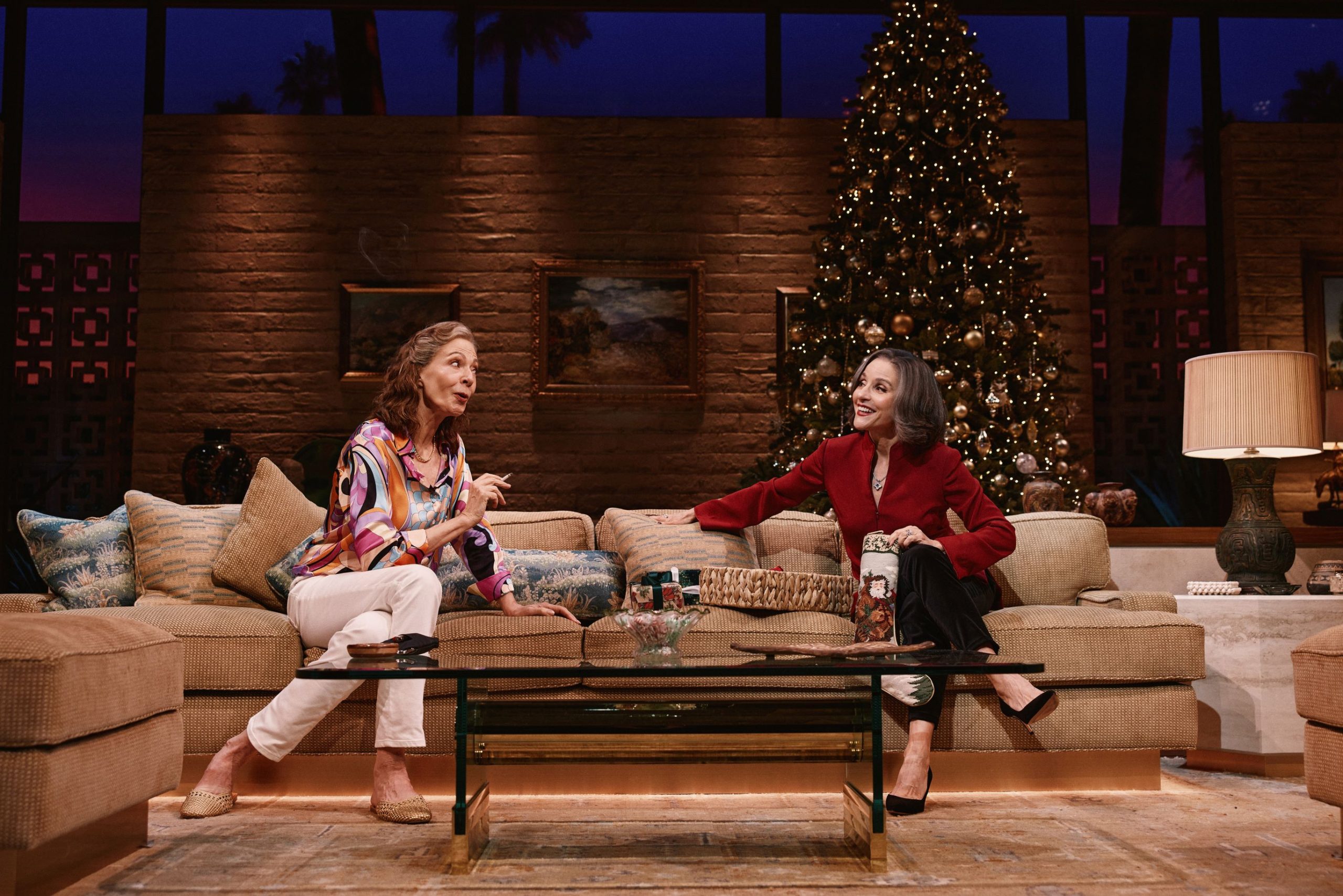
The play opens on Christmas Eve 2004 at the Wyeths’ upscale home in Palm Springs. Scot Pask’s set design is predominately sandy taupe with tonal complements. It appears as if the desert has moved inside and dried out the older characters emotionally. Yet, the Wyeths’ home evidences care, reserve and attention to detail. Indeed, organized perfection in the decor appears in every inch of the expansive living room. This even includes the huge, elegant, beautifully appointed Christmas tree backstage center.
When we first see them, dressed in coordinated tennis outfits, Polly (Julia Louis-Dreyfus), a former film writer, and Lyman (Ed Harris), a movie star turned ambassador for the GOP, look serene. (Costumes are by Tom Brodecker.) This attractive-looking, “with-it” couple reflect happiness at having their adult children home for the holidays.
Who the family presents themselves to be
By degrees we learn about this family through the banter and lively conversation which reveals the parents’ politics (Republican), the children’s politics (liberal Democrat), and other details. The “always on” Polly spills spiky one-liners often directed toward her children in response to their provocations or hers. Her gibes keep them on their toes.
We gradually discover that daughter Brooke’s first novel, a success, ended in writer’s block and a decade-long battle with depression after a breakdown. Having gone through rehabilitation which her parents paid for and family helped her through, she wrote another book.
Silda, Polly’s sister
As the coup de grâce, we meet Silda (a deliciously wry Allison Janney), Polly’s sister, a recovering alcoholic and a Democrat. Lyman very generously insists that Silda will be living with them, and they will watch over her, though Polly objects to this at a distance from Silda’s hearing. Importantly, we note that though the sisters collaborated successfully writing in the past, in the present they’ve achieved detente only by sniping at each other sarcastically.
Along with Silda, present for Christmas, we learn that someone else hovers. Trip and Brooke had an older sibling in a depressive state who drowned himself. His long-ago loss Polly and Lyman mention sparely because of the grief and heartbreak.
A successful, self-satisfied family
Thus, assembled before us appears to be a together family. The daughter’s edginess about her book evolves and like all hidden truths with this family, erupts and surprises by the end of Act I. Though the children “don’t discuss politics” for Christmas, we imagine arguments happened among them about the current war and the aftermath of 9/11.
By the conclusion, the symbolic parallel of deserts referenced in the title makes sense because families live with the consequences of (desert) wars and no one escapes. So even in tony Palm Springs, a family must live with the consequences of war, with an administration, whose party they supported then, continuing to start wars to this current day.

Arc of development
Louis-Dreyfus shines in Act I as she and the cast volley sarcasm back and forth. Lyman referees and gently chides when someone hits one beyond the lines. Indeed, Louis-Dreyfus and Harris seem the old married couple in their element. But this dynamic changes in Act II when Lyman takes a stand. The ensemble and director follow the largely expositional script until they finally arrive at the heart of the matter. However, Baitz deliberately draws out the act, misleading us into stereotyping the Wyeths.
What Polly, Lyman and Trip don’t know is that Brooke passively-aggressively neglected to tell them about her book. She decided to drop it like a bomb, face-to-face at Christmas, a time for love or revenge. She reveals to her parents that her second book will be released in the new year and excerpts will be published in The New Yorker in a few weeks. Wheeee!
Conflict
Initially thrilled that Brooke finished her book, they grow pale when she explains that it is memoir about brother Henry. Primarily, it ties in the part they played causing his downward spiral to his death in the 1970s. Withholding nothing, she relates that their Republican, conservative rejection of Henry’s lifestyle forced his drug use, deterioration and estrangement from family. She posits that their nihilistic influence left him no choice but to end his life after his involvement in a cult bombing that killed a man.
Brooke stubbornly resolves that if Polly and Lyman can’t bear to speak of Henry, whose presence haunts them even to there being no photos of him anywhere in the house, then her book will memorialize him. It will tell how they and their Republican values sickened and killed him.
Boasting of her self-awareness, Brooke assumes that her well-heeled parents, who fled Los Angeles after Henry’s death to hide in the desert, will take this new book in their stride. Wrong! Likewise, when she asks Joe Kerry’s Trip for support in Act II his beautifully delivered response startles her. And Kerry wins the audience’s applause for his efforts.
The book upsets the parents
In Act II, after Lyman and Polly filter what the memoir is and does, they shock Brooke. Lyman says he won’t read it, then begs her not to publish it until after his and Polly’s deaths, but he realizes his words mean nothing. Meanwhile, Polly, having read through most of it, says she will disown Brooke and never see her again if she publishes it.
The sarcastic jabs in the first act dissolve into justifications, defenses and accusations until Lyman says he can’t go on. With a commensurate shock and awe, Polly and Lyman confront their daughter about her specious representation of Henry and the family history. They speak about the real casualties of war and what happened. Before our eyes, these leopards change their red spots. Even the sanctimonious Silda, too drunk to save Henry, rejecting his pleas for help so many years ago, exclaims, “Oh my God,” when she hears Lyman and Polly speak the truth of what happened.
The conclusion is a tour de force with all the actors on board, whether you feel the empathy, and “the world” which Lyman speaks of, lifting from your shoulders, or not. Indeed, the truth will out. And no conservative or liberal should fear it, if it is undergirded with love.
Other Desert Cities runs through Jan. 17, 2027 at the Hudson Theater.