 Blogcritics The critical lens on today's culture & entertainment
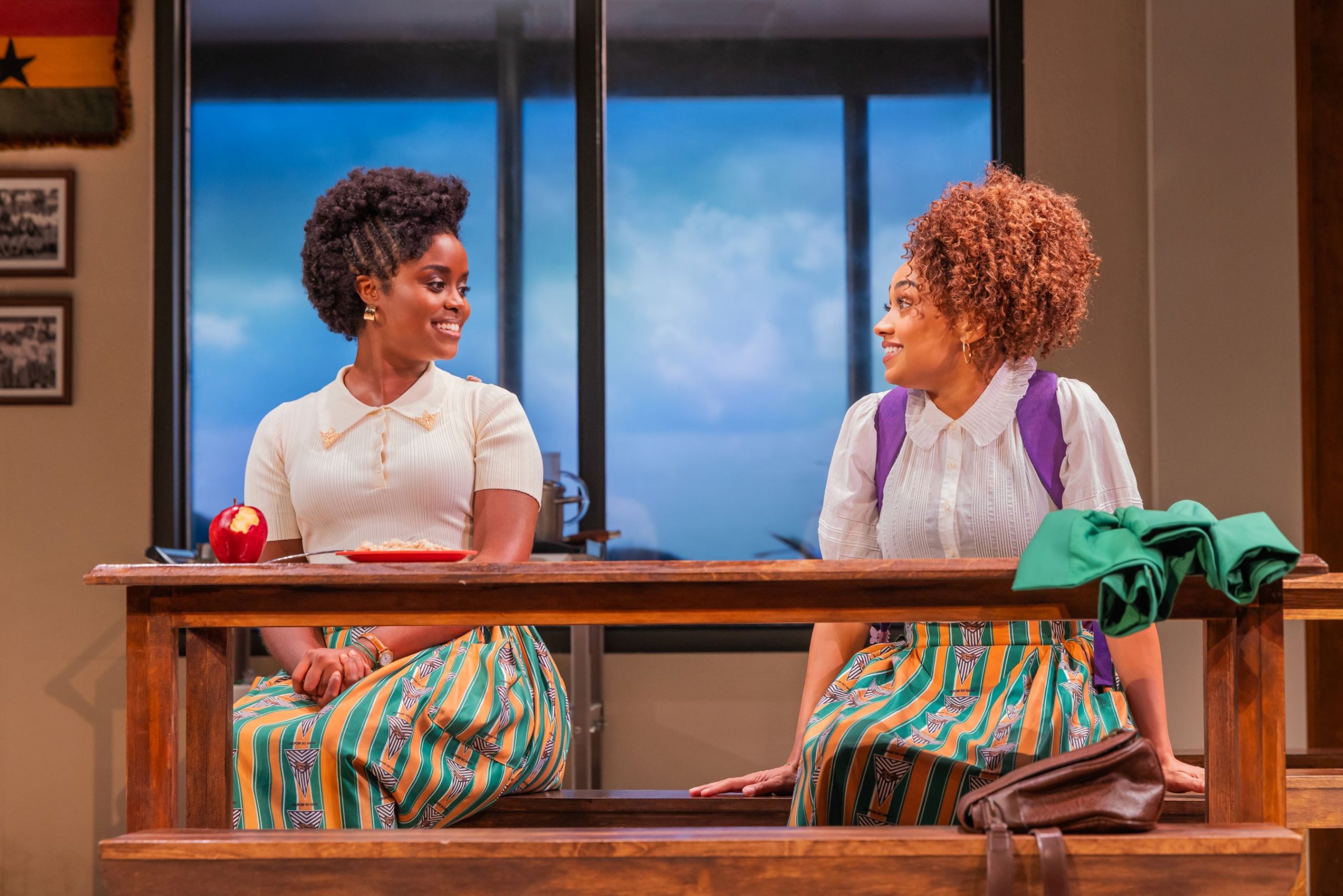
School Girls; or, the African Mean Girls Play
It’s 1986 in Ghana, an exciting time of proms and beauty pageants in the lives of teens attending Aburi (Eh-Bree), a Girls Boarding School. Playwright Jocelyn Bioh’s superb, funny and profound work in School Girls; or, the African Mean Girls Play, directed by Whitney White, affirms the magic in their Tony Award-nominated collaboration. Not surprisingly, this jewel of a production has been extended through November 15, 2026 at the Samuel J. Friedman Theatre. The production is a stepped-up Broadway debut from its Off Broadway premiere.
The multi-talented cast, led by award-nominees Denée Benton and Jordan Rice, also includes the versatile Jasmine Amy Rogers, Tony Award-nominated for the titular role in Boop! The Musical. With authenticity, humor and heartbreak the play reveals the key theme that meanness knows no bounds. Unfortunately, the noxious, warped values of fascism/racism and colonialism infect the beauty, innocence and unity of young girls everywhere.
Song as a symbol
Bobby Brown’s “It’s My Prerogative” spools in the background, signaling the time period, as well as a patriarchal theme. After a few bars of the song, the cast sits center stage dressed in the colorful uniforms of the school (Qween Jean’s costumes) in a spacious lunch room designed by Teresa L Williams.
However, all hope for an uplifting experience chokes when Benton’s Paulina fat-shames Nana (Erin Morton) about eating carb-packed porridge. Paulina cues in her subjects, Mercy (Jordan Rice) and Gifty (Nia Otchere-Sarfo), to parrot one of her mantras to stay in her popular group which she commands with a velveteen-iron rod. Nana must deprive herself “to stay fit,” “looking fine-fine.” The implied threat of what will happen if she stays fat “like a cow” stays unspoken, but Nana’s days are numbered unless she gets on Ozempic (not invented yet).
Paulina rules with fear and cruelty
Paulina rules with cruelty, using values perpetrated by the patriarchal U.S. entertainment industry to psychically oppress all females young and old with the fascist body-type image: blonde, beautiful, “fit,” aka thin. Fat-shaming weaponized by people of all genders creates a sacrosanct pecking order of beauty and superiority that keeps the weight loss and fashion industry humming. Bioh gives a nod to this issue of women trying to “be” something, and places it at the top of her play personified by an undemocratic Paulina.
Not only does Paulina control the others, as for example by making Nana feel inferior, she uses that weapon to keep Mercy, Gifty and Ama (Lucia Aremu) loyal and “worthy.” Later she uses her twisted power to force Nana to wrongdoing for her own advantage.
Paulina has learned how to dominate from the inherent system of hierarchy run by men. Thus continue the uproarious and painful ego-belittling exercises these teens go through with each other, fostered by corrupt global mores that Headmistress Francis (Heather Alicia Simms) buys into educationally, spreading the rot.
Turning points
Two turning points occur to advance the complexity and outrageousness and bring karma on Paulina with an interesting reversal. First, Paulina and her crew believe she will win the audition for the Miss Ghana beauty pageant. But when Headmistress Francis introduces the group to a transfer student from the U.S. who will also audition for the pageant, her chances tank.
The beautiful, biracial, talented Ericka (Jasmine Amy Rogers), whose father’s ancestry is Ghanaian, has light skin. Additionally, her vocal talents rival Whitney Houston’s. White’s superb staging of the audition scene, where each girl competes to be selected as the Miss Ghana candidate, brings riotous laughter.
Paulina’s chances of winning
Subsequently, Paulina’s chances close down. Eloise Amponsah (Patina Miller), Miss Ghana 1966, intends to lift the country and the Miss Ghana winner by entering her into the Miss Universe pageant. To recruit a girl who can compete commercially because her skin tones compare with those from Argentina, Brazil and Sweden, she tells Headmistress Francis that only Ericka can compete.
Everyone benefits if Ericka wins: Eloise receives a promotion; the school, fallen on hard times, will receive a generous donation; and Ghana will be seen competing on a global stage. Two obstacles stand in the way of Ericka’s success; a ferociously competitive Paulina and Ericka’s questionable Ghanaian heritage.
Tensions mount
Though Headmistress Francis has invested time and money in Paulina, even paying for the girl’s hospitalization when Paulina wounds herself with skin-bleaching cream, Amponsah’s ferocious competitiveness wants to cheat to champion Ericka. Paulina who tries to expose the sweet Ericka’s questionable heritage creates chaos, provoking fisticuffs with Ericka and harm to Nana and the other girls.
Whose personal power will dominate, the Headmistress and Paulina, or Eloise Amponnsah and Ericka? Bioh reveals the inherent corruption, bigotry and debilitating messaging such a competition evokes. Indeed, the pageant symbolizes how global nations see African nations like Ghana as inferiors to exploit. The choice between Paulina or Ericka has repercussions that extend far beyond lifting national pride. Cui bono and at what cost?
Sensational actors balance the humor and heartbreak
The actors’ moment-to-moment portrayals make the stakes comical, yet heartfelt and real. Boih suggests that twisted values continue to dominate because corporations benefit. They increase their profits from damaging skin-bleaching creams, dieting products, medical industry weight loss devices, etc. Global countries lift up commercial enterprises like the Miss Universe beauty pageant and promote biased cultural images of beauty to benefit related industries.
Bioh’s African Mean Girls asks what is the cost to Black girls in Ghana who must try to succeed by any means necessary because that is how the patriarchy has set up the life-or-death game. The play brilliantly highlights these multi-layered concepts along with the overarching theme of the velvet terrorism of group relationship dynamics. Indeed, these themes reveal a dangerous soul-killing matrix that compels its subjects to get to a “top” that someone else created for them not to reach.
School Girls; or The African Mean Girls Play enjoys an extension through November 15, 2026 at the Samuel J. Friedman Theater.