 Blogcritics The critical lens on today's culture & entertainment
The Burning Cauldron of Fiery Fire
Known for its maverick, innovative productions, the Vineyard Theatre seems the perfect venue for the world premiere of Anne Washburn’s The Burning Cauldron of Fiery Fire. In this poetic, mysterious and engaging play, adults and children in a Northern California commune have carved out their own living space under their own definition of “off the grid.” They mean to escape the indecent, cultural brutality of a corrupt American society, where solid values have been drained of meaning.
The actors are spot-on and the puppetry engages. However, director Steve Cosson’s opaque dramatization of Washburn’s use of metaphor, poetry and song makes the play sometimes confusing. Washburn’s intent is sometimes more clearly presented in the script’s stage directions, while the production itself doesn’t always theatricalize it. The themes would resonate, if the director had made more nuanced, specific choices.
Stylized, minimal set design
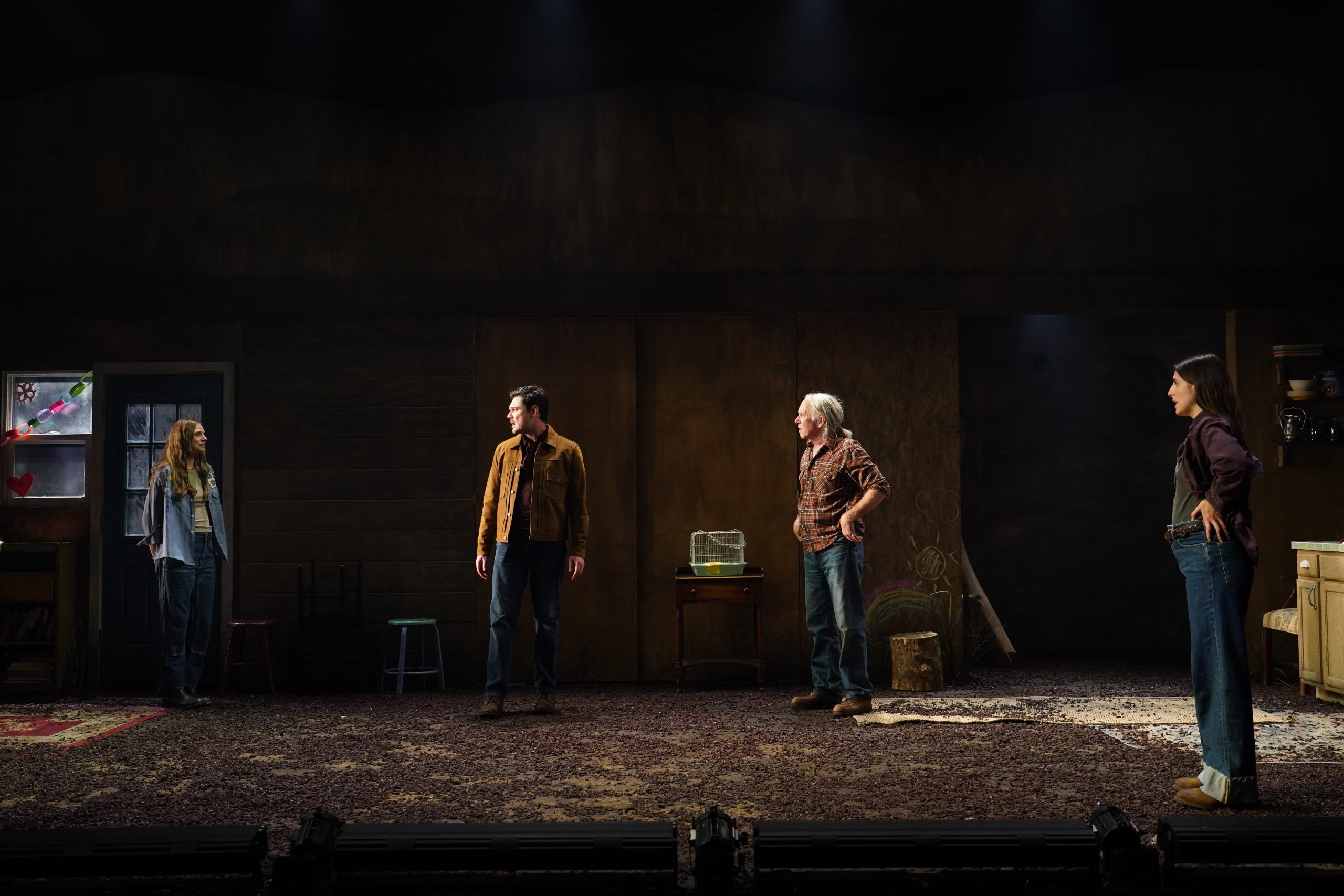
The plot, about people confronting death in their commune, unfolds within a stylized, minimal set by Andrew Boyce, heavily dependent on props to convey a barn, a kitchen and more. The intriguing lighting design by Amith Chandrashaker suggests the beauty of the surrounding hills and mountains of the north country where the commune makes its home.
The ensemble of eight adult actors takes on the roles of 10 adults and eight children. Because the structure is free-flowing, with no specific clarification of setting (time), it takes a while to distinguish between the adults and children. The scenes that focus on the children more easily indicate the age difference.
The conflict begins after a member’s body is burned
Members of the commune burn a fellow member’s body on a funeral pyre to honor him. Peter, who joined their commune nine months before, took his life, but hasn’t left a note. Rather than contact the police and involve the state, they decide Peter wouldn’t have wanted outside involvement. Certainly, they don’t want the police investigating their commune, relationships, and living arrangements, which are part of the mystery of this unbounded, “bondage-free,” spiritual community.
Nevertheless, Peter’s death has created questions they must confront as tensions mount. Should they re-burn his body in a crematorium to reduce it to ashes? They decide to bury him in an unmarked grave, which must be at a depth where animals cannot dig up his carcass. Additionally, if they keep any of Peter’s belongings, which ones and why? If someone contacts them, for example Peter’s mother, what story do they tell her? Finally, how do they deal with the children who are upset at Peter’s disappearance?
Why do they feel compelled to lie?
We question why they feel compelled to lie about Peter’s disappearance, rather than tell the truth to the authorities or Peter’s mother. Thomas (Bruce McKenzie), infuriated, tells the mother that Peter left with no forwarding address. After he hangs up, Thomas rants self-righteously rants about tearing down phone lines.
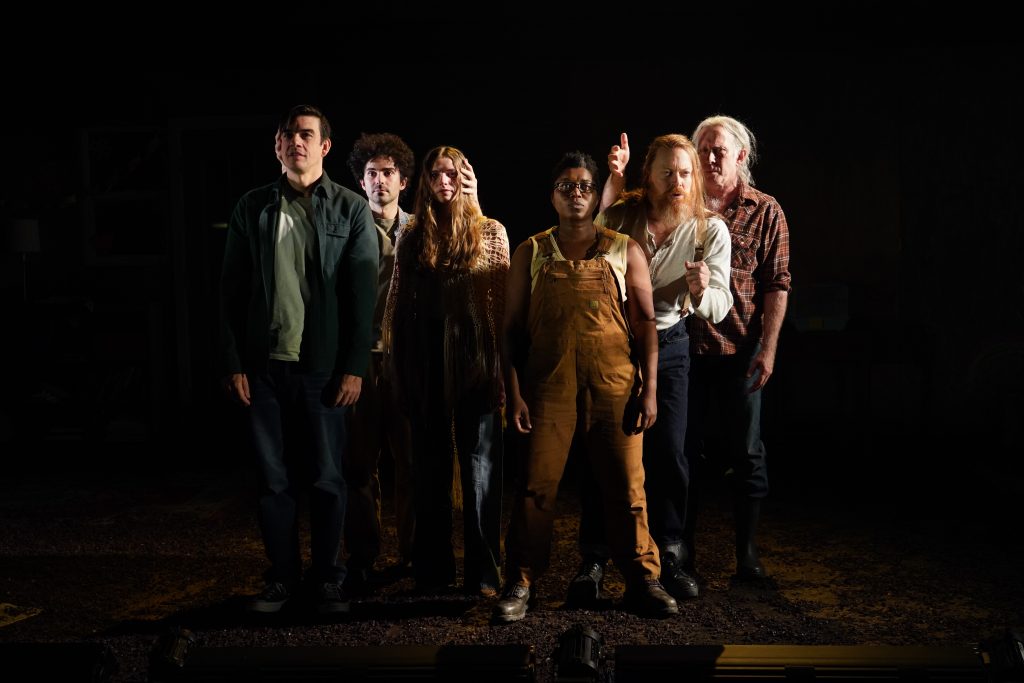
The tension among commune members Thomas, Mari (Marianne Rendon), Simon (Jeff Biehl), Gracie (Cricket Brown), and Diana (Donnetta Lavinia Grays) becomes acute with the threat of outside interference destabilizing their peaceful, bucolic arrangements. Washburn brings a slow burn of anxiety that displaces the members’ unity as they work to hide the truth. What begins with a memorial ceremony that allows Thomas and the group to take philosophical flights of fancy, goes on to augment their stress as they avoid looking at hard circumstances.
Fantasy vs. reality
Fantasy and reality clash in a well-wrought scene where the actors portray the children moving a piglet they believe is a reincarnated Peter when it chews on a poem of his. The adults allow the children to believe another convenient lie.
This particularly well-wrought, centrally staged scene, of the children in the pigsty, works to explain the behavior of the commune members. They don’t confront Peter’s death and don’t allow the children to either. The actors captivate as they portray the children relating to unseen mom Lula and her piglets. It’s one of the high points of the production because in the scene we understand the members’ faults and, by extension, a key theme of the play. Rather than confronting the worst parts of their own inhumanity, the characters escape themselves and make up their own fictional worlds.
A commune’s contradictions
The commune members cannot totally commit to “living away from society” because of the extremism required to disconnect from civilization. They have a car, do mail runs, and sometimes shop at grocery stores. At best their living arrangement is half-formed. As a result the commune runs along a continuum of pretension and posturing.
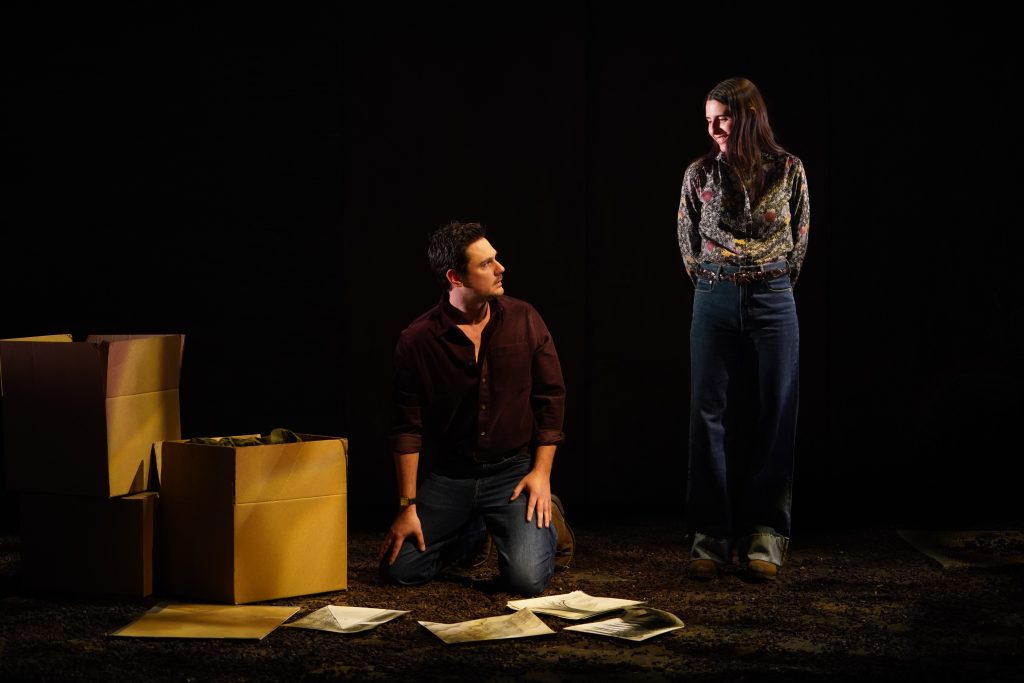
The issue of Peter’s death come to a climax when Will (Tom Pecinka), Peter’s brother, shows up to investigate what happened. Washburn ratchets up the suspense, the fantastical elements, and the ironies. Through Will we discover that Peter was an estranged trust-fund baby who would have inherited a lot of money from his dying grandmother. We note that Mari, who claims she had an affair with Peter and dumped him (the reason why he “left”), is willing to have sex with Will. They close out a scene with a passionate kiss. Will has been derailed from suspecting this group of anything sinister.
Also, Will is thrown off their lies when he watches a fairy-tale-like playlet, supposedly created by Peter and the children, that is designed to lull the watcher with fanciful entertainment.
The fairy tale parable
In that fairy tale a cruel king (the comical and spot-on Donnetta Lavinia Grays) prevents his princess daughter (Cricket Brown) from marrying her true love (Bartley Booz), also named Peter. The bad king thwarts Peter from winning challenges to gain the princess’ love. Included in the scenarios are puppets by Monkey Boys Productions, special effects (Steve Cuiffo consulting), a burning cauldron of fiery flames with playful fire fishes proving the flames can’t be all that bad, and a beautiful, malevolent, dangerous-looking dragon.
Once again the creatives (Boyce, Chandrashaker, and Emily Rebholz’s costumes) and the actors make the scene work. The clever, makeshift, DIY cauldron, puppets, and dragon allow us to suspend our judgment and willingly believe because of the comical aspect and inherent messages underneath the fairy-tale plot. That’s especially so in the last scene when Peter (the poignant Tom Pecinka) cries out in pain, then makes his final decision. We feel the impact of the terrible, the beautiful, the mighty. At the conclusion the play comes full circle.
Washburn leaves us feeling the uncertainties about what we have witnessed of a group of individuals eager to make their own meaning, regardless of whether it reflects reality or the truth. The questions abound, and confusion never quite settles into clarity. Washburn leaves it to us to divine the meaning of what we’ve witnessed.
The Burning Cauldron of Fiery Fire is at Vineyard Theatre until December 7.