 Blogcritics The critical lens on today's culture & entertainment
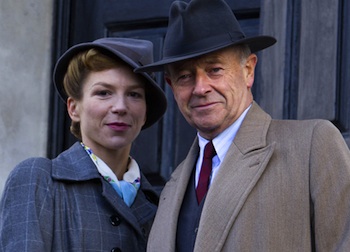
Today is Veterans Day, and I’ve been thinking about what happens when people come home from war. About my parents in the days after World War II. About nine (short) seasons of Foyle’s War, a series seemingly made for the Anglophile and British mystery fan in me. How I missed it the first several times round is beyond me. Michael Kitchen’s bitingly reticent Christopher Foyle can make a suspect reconsider an entire story simply by waiting a beat or two, perhaps pinning his subject with his penetrating but placid gaze. The ITV series also aired on PBS Masterpiece Theatre

And then there’s Samantha Stewart (Sam, played by Honeysuckle Weeks), Foyle’s irrepressible driver, who gets people to tell her things it would never occur to them to tell a policeman. The third part of their crime-solving, wartime triumvirate (for most seasons) is Detective Sergeant Paul Milner (Anthony Howell). They represent three archetypes of wartime Britain. Foyle is stiff-upper-lip England, carrying invisible scars and secrets from the last war, in which he was injured, though he never speaks of them. Sam is the eager spirit of the Home Front: young, cheerful, and wanting to “do her bit.” Milner is the injured vet now getting on with it after losing a leg.
One of the pleasures of Foyle’s War is how much of wartime Britain you get to see between the lines of the mysteries. A blackout is something you dare not neglect, for even a slight crack in the drapery can have serious repercussions (or draw undue suspicion).
Rationing affects what you can put on the table, and what somebody else can make a tidy profit selling under it, something for which Foyle has no patience and less sympathy. And of course, this being a murder mystery, there is almost always a murder to investigate. Each episode runs about 90 minutes–a feature-length film–giving the stories plenty of room to unfold in several dimensions with complexity and nuance nearly impossible in an American television series.
It would have made perfect sense to end the series with “All Clear,” as Hastings prepares to celebrate victory in Europe. Instead, the first episode of the next season, “The Russian House,” takes us into June 1945. Sam is working as a secretary. Milner, once Foyle’s sergeant, is now running his own murder investigation at a different station. And Foyle is looking for an escaped Russian prisoner of war. I like how much that setup tells us before the mystery even gets going. Everyone has a different job, and here they are working together again, only a few weeks into a peace that already has complications of its own.
The later episodes take Foyle into Cold War espionage, after Foyle, finally resigning his police work for good, is essentially drafted into MI5. But the series never forgets about the people who’d spent years waiting to come home. Where do you go when you’re finally sent home and the street you lived on has been bombed? What do you do with the skills you picked up in wartime? How do your survive as a refugee when you’ve already survived (perhaps barely) the horrors of the Nazi death camps?
In 1946, the year my brother was born, Britain began rationing bread. They’d gone the entire war without putting bread on the ration. The U.S. still rationed sugar, and American veterans also came home needing jobs and places to live. In Britain, families were looking for somewhere to live in towns that had lost whole streets to bombing. Here, the GI Bill helped my dad train as an electrician. In time, that trade gave us the comfortable suburban life I grew up in. Their struggles were much different, if equally challenging–especially for the vets and refugees.
My own dad had served in the Army Air Corps, stationed in North Africa when he went overseas. My mom was a secretary in the Treasury Department, a crack typist and steno. After the war, she went back to being a young wife and gave up the idea of continuing to work. My brother served in a different era, during the height of the Vietnam War. He spent both his years in the service stateside. When I think about the veterans in my family, those are the facts I know best: where they served, when, and for how long. I find myself wondering what each of them would have told me about the day he came home.
My parents rarely talked about the war years. Dad had a large wooden chest full of leaflets in English and French. Mom kept a photo album from his time in North Africa, where he worked closely with Senegalese soldiers. I wish I’d opened that chest with him and asked him what he remembered. And I wish I’d sat down with my mom more often and gone through the album with her. Come to think of it, I’d have liked to hear about her days at the Treasury, too. I know she was a crack typist. I wish I knew what she typed. What secrets she could never disclose.
You can watch Foyle’s War on Acorn TV (available via Prime) or search for it on your favorite platform.